The landscape of enterprise messaging is undergoing a seismic shift, with Business Rich Communication Services (RCS) emerging as the dominant successor to traditional SMS. Enterprises are increasingly migrating authentication, crucial notifications, targeted marketing campaigns, and customer service interactions away from the limitations of SMS towards the enhanced capabilities of RCS. This transition is not only set to redefine how businesses connect with their customers but also unlock substantial new revenue streams for telecom operators worldwide.
The Rise of RCS: A Transformative Leap in Enterprise Messaging
For years, Short Message Service (SMS) has been the ubiquitous channel for businesses to reach their customers. However, its inherent simplicity – limited character counts, lack of rich media support, and vulnerability to spoofing – has become a significant bottleneck in delivering engaging and secure customer experiences. RCS, on the other hand, offers a comprehensive suite of features that address these shortcomings, paving the way for more interactive, personalized, and trustworthy communication.
Juniper Research, a leading market intelligence firm, forecasts a meteoric rise in global business RCS traffic. By 2030, the volume of messages is projected to surge past 485 billion, a staggering 286 percent increase from the 125 billion messages anticipated in 2026. This rapid expansion has been significantly propelled by Apple’s pivotal decision, announced in 2024, to embrace RCS. This move dramatically expands the addressable market, ensuring compatibility across a far greater proportion of the global smartphone user base, thus democratizing access to richer messaging experiences.
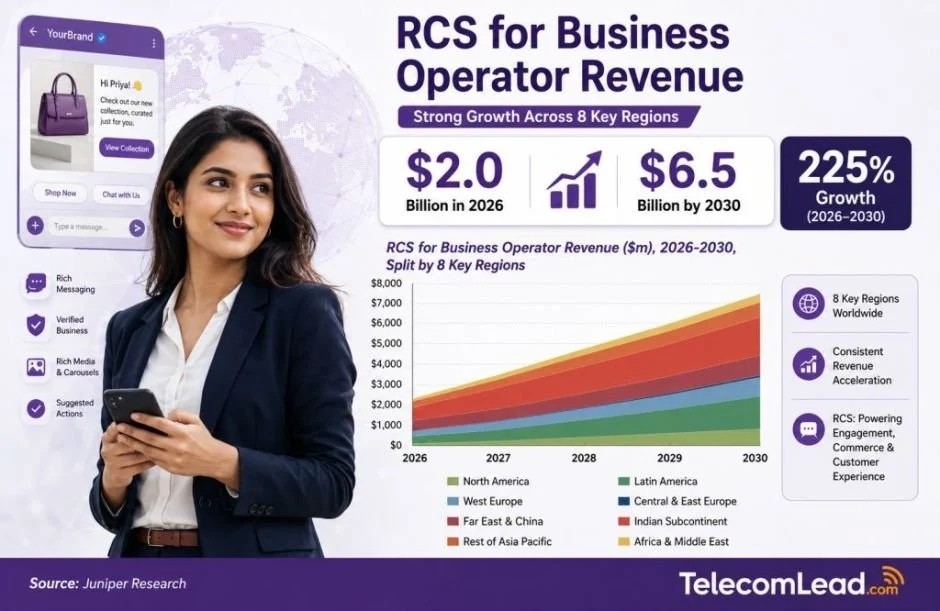
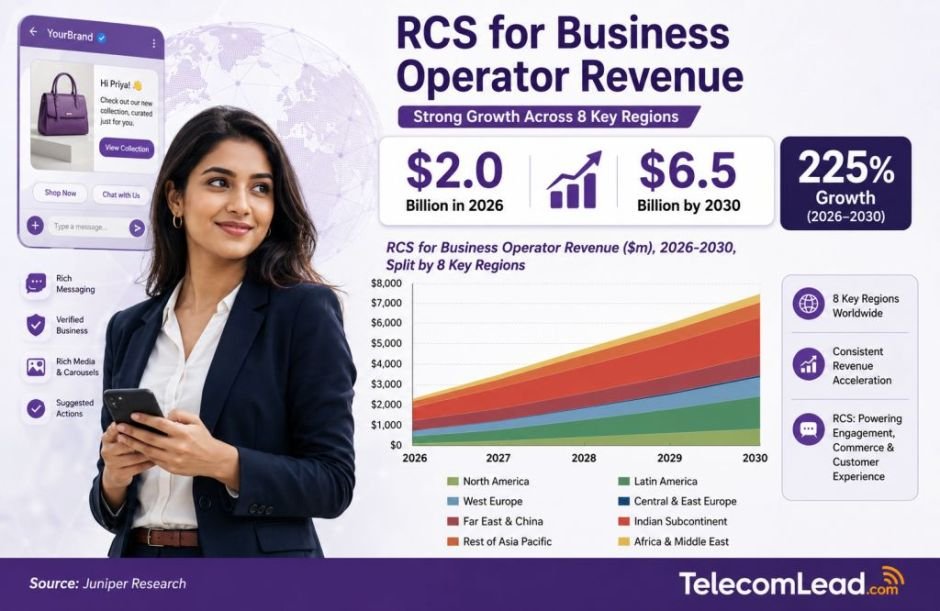
The financial implications for telecom operators are equally profound. Juniper Research projects that revenue generated from RCS for Business will witness an impressive climb, escalating from an estimated US$2 billion in 2026 to over US$7 billion by 2030. This indicates a significant opportunity for operators to capitalize on the evolving demands of the enterprise communication sector.
A Timeline of Growth: Key Milestones and Projections
The trajectory of RCS adoption is marked by significant milestones and optimistic projections, painting a clear picture of its burgeoning importance in the enterprise messaging ecosystem.
Early Adoption and Operator Revenue Surge
Even in the near term, the impact of RCS is expected to be substantial. Juniper Research anticipates that mobile operator RCS for Business revenue will witness a robust increase, climbing from US$1.2 billion in 2025 to a projected US$3.1 billion by 2027. This rapid growth underscores the immediate value proposition of RCS for businesses and the accelerating adoption rates.
The market for RCS for Business is geographically diverse, spanning eight key regions: North America, Latin America, Western Europe, Central & Eastern Europe, the Far East & China, the Indian Subcontinent, Rest of Asia Pacific, and Africa & the Middle East. This global reach signifies the universal appeal and applicability of RCS for businesses seeking to enhance their customer engagement strategies.
Strategic Migration: From SMS to Richer Interactions
A key strategic imperative for telecom operators lies in facilitating the migration of high-volume SMS use cases to RCS. Initially, the focus will be on critical applications such as authentication and transactional notifications. Once enterprises become accustomed to the reliability and enhanced security of RCS for these fundamental needs, the natural progression will be towards adopting richer marketing and conversational messaging capabilities.
RCS offers a distinct advantage over standard SMS by supporting verified sender identities, enabling the inclusion of rich media like images and videos, facilitating the use of interactive cards, and allowing for more dynamic and engaging messaging formats. These features collectively create a significantly stronger value proposition for enterprises looking to differentiate themselves and build deeper customer relationships.
Authentication: The Catalyst for SMS-to-RCS Migration
The security and trust associated with authentication processes are emerging as one of the most immediate and compelling drivers for RCS adoption. Traditional SMS-based One-Time Passwords (OTPs) can be susceptible to delays and, more critically, spoofing attempts, eroding customer confidence.
Banks, logistics companies, and a wide array of other enterprises can leverage verified RCS OTPs to significantly reduce the risk of spoofing, thereby bolstering customer trust and security. Furthermore, the faster and more reliable delivery of RCS messages can minimize instances of repeat OTP requests caused by SMS delays, leading to a smoother and more efficient user experience.
This model of enhanced verification extends beyond OTPs to encompass crucial banking alerts, delivery notifications, and other high-volume transactional communications. By ensuring verified identities in these interactions, businesses can proactively mitigate fraud risks and provide a more secure communication channel for their customers. Juniper Research’s recommendation for communication service providers to prioritize these relatively straightforward SMS migrations before upselling to branded marketing and conversational RCS services highlights a pragmatic approach to market penetration and revenue generation.
Sectoral Shifts: Retail Leads, but Healthcare and Banking Skyrocket
While retail has historically been the dominant vertical for business messaging, its share of RCS traffic is expected to see a relative decline as other sectors experience more rapid growth. Juniper Research forecasts that retail will still account for a significant portion, over 30 percent, of business RCS messages by 2030, down from over 37 percent in 2026.
However, the most dramatic growth is anticipated in other sectors. Healthcare messaging is projected to experience an extraordinary surge of over 1,000 percent through 2030. Similarly, banking RCS traffic is expected to increase by more than 600 percent. In contrast, retail traffic, while substantial, is forecast to grow by a more modest figure of just over 200 percent.
These figures underscore a crucial evolution: RCS adoption is expanding beyond mere promotional campaigns and penetrating sectors where verification, robust security, and real-time customer interaction are paramount. This broadening appeal signifies RCS’s versatility and its capacity to address critical business needs across diverse industries.
North America’s Rapid Ascent and Evolving Pricing Models
North America has emerged as a frontrunner in RCS adoption, experiencing one of the fastest increases in RCS availability. The penetration of RCS for Business-capable mobile devices in the region has seen a remarkable surge, jumping from 40.3 percent in 2024 to an impressive 86.5 percent by 2025.
This widespread availability has translated into explosive growth in business RCS traffic within the United States. In the US alone, business RCS traffic leaped from 494 million messages in 2024 to a colossal 3.2 billion in 2025, representing a growth rate exceeding 500 percent. Google’s reporting of over 1 billion RCS messages exchanged daily by US users in May 2025 further solidifies the increasing scale and momentum of the RCS ecosystem.
In response to this burgeoning market, US telecom operators are actively developing differentiated pricing models for RCS. These models are designed to segment services based on message type, moving away from a one-size-fits-all SMS tariff. For instance, in January 2026, RCS Rich Authentication and utility pricing was established at approximately US$0.0045 across major carriers like AT&T and T-Mobile, with slight variations for Verizon and others. These prices are competitive when compared to WhatsApp’s comparable marketing price of US$0.0250, while RCS Rich Media marketing prices were higher, ranging from US$0.0060 to US$0.0135, showcasing the varied value propositions. This segmentation allows operators to monetize the distinct features and benefits offered by RCS for different use cases, reflecting a more sophisticated approach to enterprise messaging revenue.
India: A Booming RCS Market and Strategic Partnerships
India is rapidly establishing itself as one of the largest and most dynamic RCS markets globally. The number of RCS for Business-capable subscribers in India has seen consistent growth, increasing from 640.0 million in 2024 to 696.1 million in 2025, and is projected to reach a substantial 824.8 million by 2026. This translates to significant growth rates of 8.8 percent and 18.5 percent in consecutive years.
Key strategic partnerships are further accelerating this growth. Apple’s collaboration with Jio in August 2025 to introduce RCS on iPhones for Jio users has expanded the addressable base beyond Android devices, a crucial step in achieving widespread adoption. Additionally, Bharti Airtel’s partnership with Google in December 2025 to offer RCS and integrate it with Airtel’s advanced AI-enabled spam filtering capabilities highlights a focus on enhanced user experience and security. These developments position India as a critical testing ground for verified enterprise messaging, authentication, and the burgeoning field of conversational commerce.
Google’s Role in Shaping the Indian RCS Landscape
Recognizing the immense potential and the need for responsible growth, Google has implemented controls to manage promotional RCS traffic in India. These regulations are designed to ensure message relevance and maintain a positive user experience. High-reputation agents are permitted to send up to 8 initial messages per user, medium-reputation agents up to 4, and low-reputation agents up to 2. Furthermore, limits are imposed on the number of unique users within a rolling 28-day period, ranging from 300 million for high-reputation agents to 1 million for low-reputation agents. These controls underscore the increasing importance of sender reputation, explicit user consent, and message relevance as RCS becomes a significant channel for commercial marketing.
AI and P2A: Expanding RCS Beyond Basic Messaging
The future of RCS extends far beyond simple person-to-person or person-to-business messaging. The concept of Person-to-Application (P2A) messaging holds the potential to transform RCS into a comprehensive platform for customer service, product discovery, and direct sales. Consumers will be able to initiate conversations through various touchpoints, including Google Search, deep links, QR codes, and Google Ads, seamlessly guiding them into interactive RCS experiences.
Artificial intelligence (AI) will play a pivotal role in further monetizing RCS, enabling the automation of customer service conversations, personalized product recommendations, and streamlined sales interactions. For telecom operators, this necessitates the development of more sophisticated pricing models that go beyond simple per-message billing. Factors such as conversation duration, the method of initiation, and message volume will become crucial components of these new pricing structures.
The transition to this more advanced RCS ecosystem will also be supported by a new wave of vendors offering essential tools. These include SMS-to-RCS migration solutions, AI-assisted content creation platforms, and robust verification services, all designed to facilitate a smooth and efficient adoption process for businesses.
RCS: A Multibillion-Dollar Enterprise Messaging Opportunity for Telecom
In conclusion, Juniper Research’s comprehensive study, which analyzed over 160,000 datapoints across 61 countries and evaluated 17 RCS for Business vendors across key sectors like retail, banking, healthcare, travel, hospitality, and telecom, unequivocally points to RCS becoming a major enterprise messaging opportunity for the telecom industry.
The central strategic advantage for operators lies in their ability to guide enterprises away from the basic functionalities of SMS towards more secure, verified, and interactive communication channels. The initial migration wave will focus on authentication and notification traffic, followed by the adoption of branded marketing, conversational messaging, P2A interactions, and ultimately, AI-powered customer engagement.
With global business RCS traffic projected to more than quadruple from 125 billion messages in 2026 to over 485 billion by 2030, and telecom operator revenue from RCS for Business anticipated to more than triple from US$2 billion to over US$7 billion within the same period, RCS is rapidly evolving into a multibillion-dollar enterprise messaging platform. This presents an unprecedented opportunity for the telecom industry to not only retain its relevance in the digital communication landscape but to thrive by providing innovative and value-driven solutions for businesses worldwide.