New Delhi, India – August 28, 2026 – Reliance Jio, the undisputed leader in India’s mobile subscriber base, continues to maintain its national dominance with a staggering 506.03 million subscriptions as of July 2026. However, a deeper dive into the granular data reveals a far more complex and competitive battlefield across the nation’s 22 distinct telecom service areas. While Jio commands the largest share of the pie nationally, its leadership falters in 11 key regions, where it trails behind its primary rivals, Bharti Airtel and Vodafone Idea. This nuanced picture underscores the vital importance of analyzing telecom performance on a circle-by-circle basis, rather than relying solely on aggregated national figures.
The latest report from the Telecom Regulatory Authority of India (TRAI) for July 2026 highlights a dynamic market where subscriber numbers, while growing, are also being fiercely contested. Jio’s overall market share stands at a robust 39.29 percent, a slight edge over Bharti Airtel’s 38.01 percent. Airtel, with 489.49 million subscriptions, trails Jio by approximately 16.54 million users. Vodafone Idea, the third major player, holds a significant 15.6 percent of the market. Despite Jio’s national supremacy, the regional data paints a picture of strong competition, with Airtel demonstrating considerable strength in several key urban and semi-urban circles.
The Shifting Tides: National Dominance vs. Regional Strongholds
While Reliance Jio’s national subscriber count is a testament to its aggressive expansion and attractive pricing strategies, the reality on the ground in individual telecom circles tells a different story. The TRAI data unequivocally shows that national leadership does not automatically translate into dominance across all operational territories.
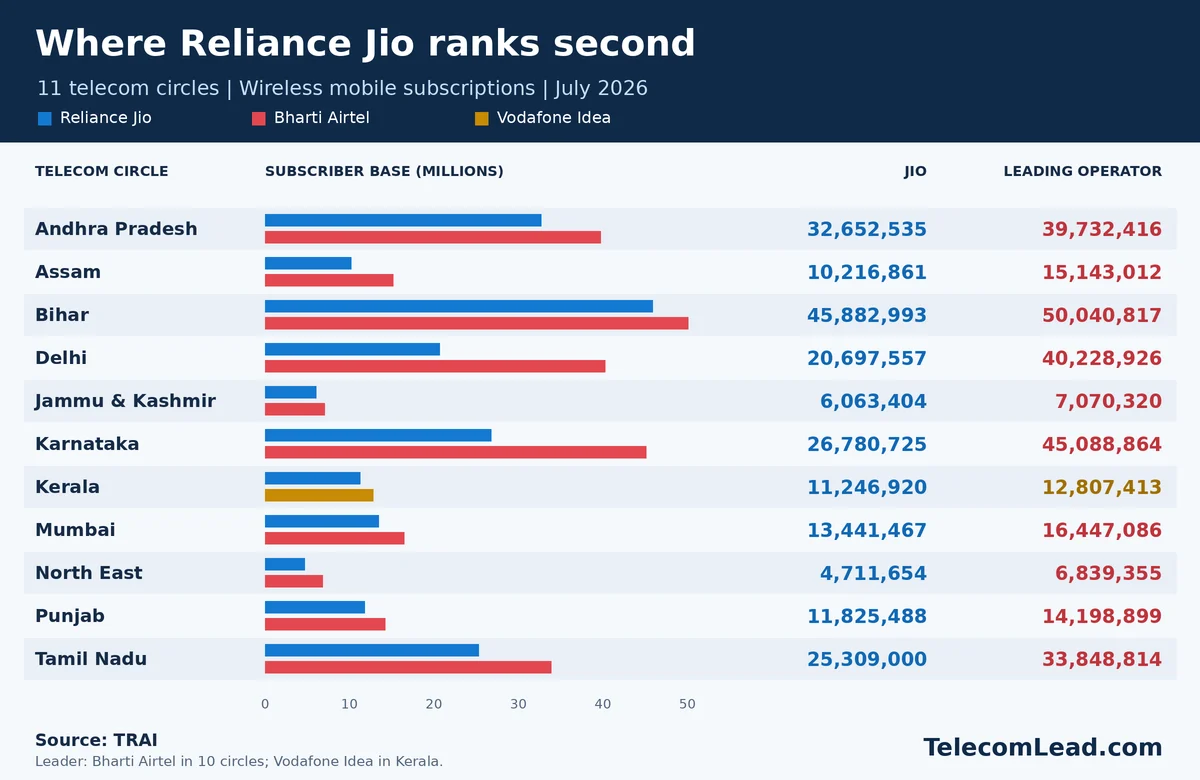
In a significant portion of India’s 22 telecom service areas, Jio finds itself in the runner-up position. The data reveals that Bharti Airtel has secured the top spot in 10 of these circles, showcasing its deep-rooted presence and customer loyalty in these regions. Furthermore, in a noteworthy exception that highlights the fragmentation of market leadership, Vodafone Idea retains the top position in the southern state of Kerala. This distribution of power across different circles underscores the varied consumer preferences, competitive landscapes, and operational strengths of each telecom operator in specific geographic markets.
Airtel’s Strategic Dominance in Key Metros and States
Bharti Airtel’s strategic advantage is most pronounced in several of India’s most populous and economically significant regions. The data clearly indicates that Airtel maintains substantial leads in the highly competitive circles of Delhi, Karnataka, and Tamil Nadu. These are not merely peripheral markets; they represent major consumption hubs and innovation centers, where subscriber acquisition and retention are critical for overall market share.
The capital city of Delhi stands out as a prime example of Jio’s regional challenges. Here, Airtel boasts an imposing subscriber base of 40.23 million, a figure that is nearly double Jio’s 20.70 million. This significant gap of 19.53 million subscribers in Delhi alone illustrates the formidable challenge Jio faces in capturing market share in such densely populated and technologically advanced urban centers.
Karnataka, another economically vibrant state, mirrors this trend. Airtel holds an impressive lead of 18.31 million subscriptions, with its subscriber count at 45.09 million compared to Jio’s 26.78 million. Following closely is Tamil Nadu, where Airtel enjoys an advantage of 8.54 million subscribers. The southern region continues to be a strong pocket for Airtel, with Andhra Pradesh also recording a substantial gap of 7.08 million in Airtel’s favor.
Beyond these southern strongholds, Airtel’s leadership extends to other important regions. The northeastern state of Assam sees Airtel leading Jio by 4.93 million subscribers, followed by Bihar with a 4.16 million advantage. Even in the bustling metropolis of Mumbai, Airtel has carved out a lead of 3.01 million. The company also holds a competitive edge in Punjab (2.37 million), the North East (2.13 million), and Jammu & Kashmir (1.01 million), demonstrating a broad-based strength across diverse geographical and demographic segments.
Vodafone Idea’s Lingering Strength in Kerala
In a remarkable display of resilience, Vodafone Idea has managed to retain its leadership in the Kerala telecom circle. This region represents a unique scenario where Jio, despite its national prominence, trails behind not only Vodafone Idea but also Airtel. Vodafone Idea commands a subscriber base of 12.81 million in Kerala, giving it a lead of approximately 1.56 million over Jio’s 11.25 million. Airtel follows with 9.84 million subscribers, and BSNL, the state-owned operator, is also a significant player with 9.03 million users.
While Vodafone Idea’s leadership in Kerala is a significant point of distinction, the TRAI data also hints at a narrowing gap. During July 2026, Jio saw a net gain of 53,101 subscriptions in Kerala, while Vodafone Idea experienced a net loss of 14,831 subscribers. This trend, if sustained, could indicate a future shift in the competitive dynamics of this southern circle.

Jio’s Conquest of the Remaining Territories
Despite its setbacks in several key circles, Reliance Jio asserts its dominance in the remaining 11 out of the 22 telecom service areas. These include the commercially significant regions of Gujarat, Haryana, Himachal Pradesh, Kolkata, Madhya Pradesh, Maharashtra, Odisha, Rajasthan, Uttar Pradesh East, Uttar Pradesh West, and West Bengal. This broad sweep across a majority of the country’s telecom circles is what underpins Jio’s national leadership.
The battle for subscribers in these regions is often fierce, with even narrow margins indicating intense competition. The data for Himachal Pradesh exemplifies this, where Jio’s subscriber count of 3,639,396 was just 2,185 more than Airtel’s 3,637,211. Such razor-thin margins highlight the constant effort required by operators to maintain their subscriber base and attract new users, even in regions where they hold a lead.
National Growth and the Evolving Subscriber Landscape
The overall Indian wireless mobile subscriber base continues its upward trajectory, reaching a staggering 1.288 billion in July 2026. The sector witnessed a healthy growth of 5.54 million subscribers during the month. This overall expansion is a positive indicator for the industry, reflecting increasing digital penetration and the growing demand for mobile services across the country.
In terms of monthly subscriber additions, Bharti Airtel demonstrated a slightly stronger performance in July, adding 2.69 million new subscribers. This figure marginally surpassed Jio’s addition of 2.45 million subscribers during the same period. While these monthly figures can fluctuate, they provide insights into the immediate growth momentum of the operators.
Implications for the Indian Telecom Sector
The granular analysis of the July 2026 TRAI data offers critical insights into the intricate dynamics of India’s telecommunications market. It is clear that the narrative of national leadership alone is insufficient to capture the full competitive picture.
For Reliance Jio, the challenge lies in replicating its national success in regions where Airtel has established a strong foothold. This will likely involve targeted marketing strategies, network enhancements in specific circles, and potentially revised service offerings to appeal to the local consumer base. The company’s ability to penetrate these Airtel strongholds will be crucial for consolidating its overall market dominance.
Bharti Airtel’s performance underscores its robust operational capabilities and strong brand equity in key markets. The company’s sustained leadership in 10 circles suggests a deep understanding of regional consumer needs and a successful strategy for customer acquisition and retention. Airtel’s focus will likely be on defending these strongholds while also looking for opportunities to expand its reach in other circles.
Vodafone Idea, despite its smaller national market share, continues to demonstrate its ability to compete effectively in specific regions, as evidenced by its leadership in Kerala. However, the declining subscriber numbers in Kerala and the consistent gains by Jio and Airtel nationally highlight the ongoing challenges the operator faces in maintaining and growing its subscriber base across the country. Its future success will depend on its ability to consolidate its operations, improve its network quality, and offer competitive services.
The ongoing competition between these three major players is a boon for Indian consumers, driving innovation, better service quality, and more competitive pricing. As India continues its digital transformation journey, the performance of these telecom giants in each individual circle will be a key indicator of the sector’s health and the evolving preferences of the nation’s vast mobile user base. The battle for the Indian telecom subscriber is far from over, and the intricacies of regional competition will continue to shape its future.