For over a decade, India held a paradoxical position in the global digital economy. It was the world’s undisputed titan of app downloads, serving as the primary growth engine for tech giants looking to scale their user bases. Yet, for developers and venture capitalists, it remained a notoriously difficult landscape to monetize. The "volume over value" narrative dominated the discourse—until now.
Recent data from market intelligence firm Sensor Tower reveals that the tide has decisively turned. In the second quarter of 2026, India’s mobile app market generated a record $345 million in consumer spending, marking a staggering 35% increase year-over-year. This shift signifies that India is no longer merely a playground for free-tier users; it is maturing into one of the world’s most dynamic markets for premium digital services.
The Structural Shift: From Volume to Value
The surge in revenue is not merely an incremental bump; it represents a fundamental change in consumer behavior. While quarterly app downloads have plateaued at approximately 6.3 billion since 2023, the revenue generated per download has more than doubled over the past three-and-a-half years.
This growth trajectory stands in stark contrast to the global trend. While markets like the United States saw a 3% decline in app revenue during the same period, India posted the fastest growth rate among major global economies. Even as other emerging markets like Mexico (up 30%) and Turkey (up 25%) showed promise, India’s velocity of monetization has established it as a critical pillar for global app publishers.
Chronology of a Digital Revolution
The transition of the Indian market did not happen overnight. It is the culmination of a multi-year infrastructural evolution:
- 2020–2022 (The Foundation): The pandemic accelerated digital adoption, but monetization remained elusive due to friction in payment processing.
- 2023 (The Pivot): Revenue growth began to decouple from download volume as subscription models (SaaS) gained traction in the Indian market.
- 2024–2025 (The Integration): The widespread adoption of India’s Unified Payments Interface (UPI) and localized digital wallet integration effectively eliminated the "payment barrier." Users, who were previously hesitant to share credit card details or navigate complex billing cycles, began paying for services with a single tap.
- 2026 (The Current Surge): The "Generative AI" boom acted as a catalyst, pulling users toward premium subscription tiers and cementing the trend of paying for productivity and entertainment.
Supporting Data: What’s Driving the Wallet?
The composition of spending in India has undergone a radical shift. Historically, gaming dominated the revenue charts. Today, non-gaming apps account for a massive 68% of total mobile app revenue, up from 58% just three years ago.
The AI Dominance
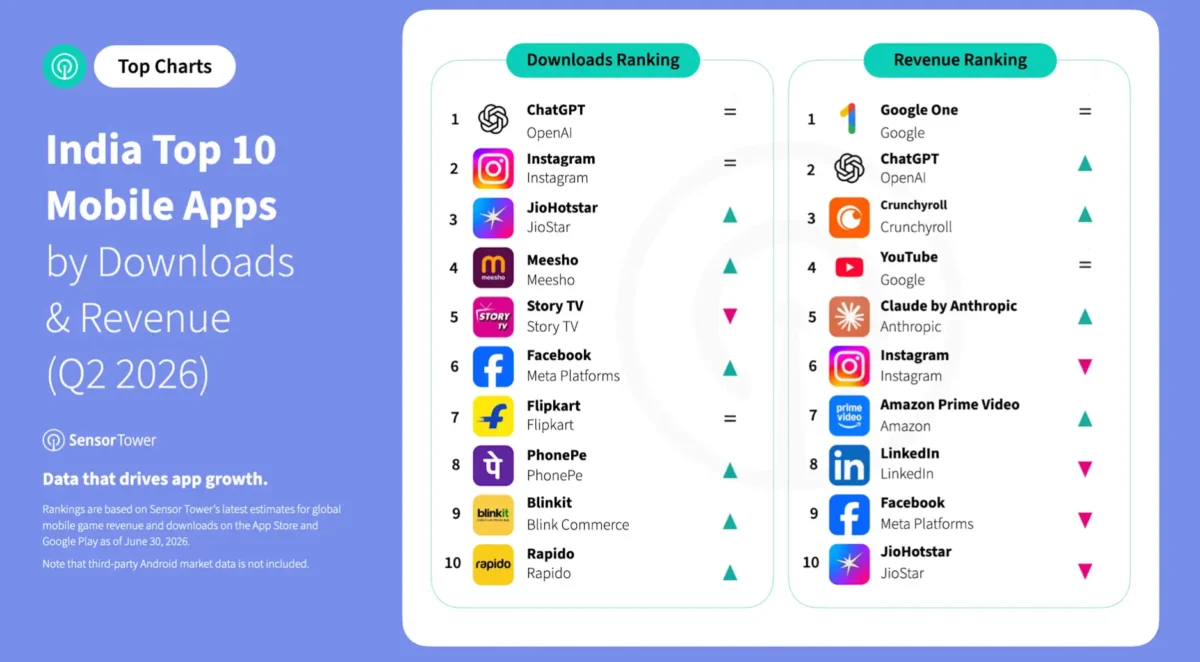
Generative AI is currently the crown jewel of this growth. OpenAI’s ChatGPT and Anthropic’s Claude collectively command 83% of the AI app revenue share in India. While Appfigures notes that the initial "gold rush" fervor has seen a slight cooling, the numbers remain formidable. ChatGPT, for instance, continues to generate an estimated $60,000 per day in India, proving that high-utility tools have found a sustainable place in the average Indian user’s monthly budget.
The Subscription Economy
The "Platform Era" has arrived. Google One has emerged as the highest-grossing mobile app in the country, highlighting a shift toward cloud storage and ecosystem-wide subscriptions. Furthermore, streaming services such as Amazon Prime Video, Crunchyroll, Sony LIV, and JioHotstar have seen robust increases in consumer spending. Even in the gaming sector, which is experiencing a global downturn, India bucked the trend with a 3.7% revenue increase quarter-over-quarter.
Perspectives from Industry Analysts
The transformation is being closely monitored by industry experts who view India’s current trajectory as a bellwether for emerging markets.

Eve Chen, an insights analyst at Sensor Tower, characterizes the current landscape as a "rapidly evolving mobile market." According to Chen, the primary driver is the reduction of friction. "The wide adoption of digital payments, including UPI, has allowed developers to seamlessly convert free users into paid subscribers," Chen noted in an interview with TechCrunch. "India is no longer just the world’s largest market by downloads; it is emerging as one of the fastest-growing markets for monetization."
However, not all industry watchers are entirely bullish on the pace. Ariel Michaeli, founder and CEO of Appfigures, offers a more tempered perspective. While acknowledging the "staggering" figures, he notes that the explosive growth witnessed during the initial AI hype cycle has settled into a more sustainable, albeit slower, pace. "The numbers are still significant, but we are seeing the market move from an impulsive subscription phase to a more mature, value-conscious phase," Michaeli observed.
Implications for the Global Tech Ecosystem
For global developers, the implications are profound. India is no longer a "check-the-box" region for localization; it is a primary revenue target.
1. The "Subscription-First" Mandate
Developers who once focused on ad-supported models in India are now pivoting to subscription-based tiers. The success of global platforms like Google One and streaming giants proves that if the content is premium and the payment mechanism is frictionless, the Indian consumer is willing to pay.
2. The Gap Remains, But the Trajectory is Key
It is essential to maintain perspective. India’s revenue per download is still a fraction of that in the United States ($4.60), South Korea ($3.90), or Japan ($6.10). However, experts argue that the trajectory is more important than the current absolute level. As disposable income rises and the digital ecosystem matures, the gap is expected to narrow over the next decade.
3. Localization is the New Competitive Advantage
The rise of platforms like Sony LIV and JioHotstar demonstrates that local content remains king. International apps that fail to integrate local payment methods or offer localized, tiered pricing structures risk being sidelined by domestic competitors that understand the nuances of the Indian consumer’s price sensitivity.
Conclusion: The Road Ahead
The "India Story" in the app economy has moved into its second chapter. The first chapter was about connectivity and scale—getting a billion people online. The second chapter is about value, engagement, and the normalization of digital payments.
As the market continues to evolve, the challenge for developers will be to maintain this momentum. With a massive, young, and increasingly tech-literate population, India represents a long-term play. The record-breaking figures of Q2 2026 serve as a clear signal to the world: the era of the "free" Indian app market has ended, and the era of the premium, subscription-driven economy has officially begun.