

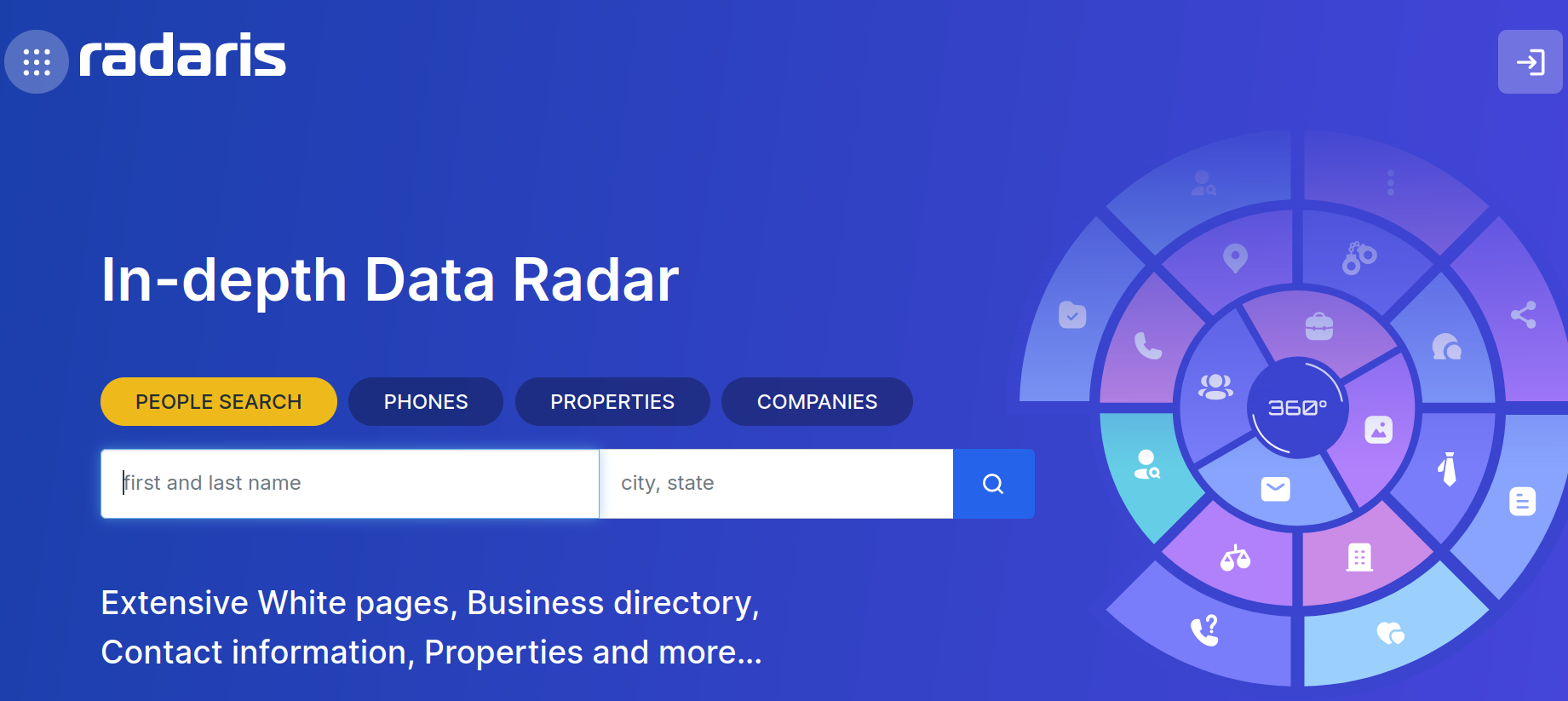
The landscape of online privacy in the United States shifted dramatically this month as a long-running battle between accountability advocates and the shadowy world of "people-search" data brokers reached a decisive, albeit temporary, conclusion. Radaris.com, a notorious fixture in the consumer data brokerage industry, has been stripped of its primary domain name by a New Jersey court. The seizure follows years of evasive legal maneuvering and systemic failure to comply with "Daniel’s Law," a stringent privacy statute designed to protect the safety of law enforcement officials and government personnel.
The court’s order, which effectively shuttered the front door of a sprawling data-mining operation, represents a rare victory in an industry that has historically thrived on anonymity, shell companies, and the exploitation of regulatory loopholes.
The Genesis of a Legal Conflict
In February 2024, Atlas Data Privacy Corp—a private entity dedicated to enforcing data removal mandates—filed suit against Radaris. The litigation centered on New Jersey’s Daniel’s Law, named in honor of Daniel Anderl, the son of a federal judge who was murdered in 2020 by a disgruntled litigant who had easily tracked the judge’s home address via the internet.
The law is unequivocal: it mandates that commercial data brokers must remove the personal information of judges, law enforcement officers, and their families from their databases upon request. Failure to do so carries a penalty of $1,000 per violation. For Radaris, which built a business model on the commodification of this very information, the law posed an existential threat. Rather than complying, the company allegedly adopted a strategy of stonewalling, shell games, and legal intimidation.
A Chronology of Evasion and Deception
The history of Radaris is marked by a deliberate opacity that has frustrated regulators and plaintiffs alike.
- 2017: Radaris faced a class-action lawsuit where it was hit with a $7.5 million default judgment after failing to appear in court. When the plaintiffs attempted to seize the Radaris domain, the company finally surfaced, fighting the transfer on the grounds that the specific legal entity named in the suit did not own the domain.
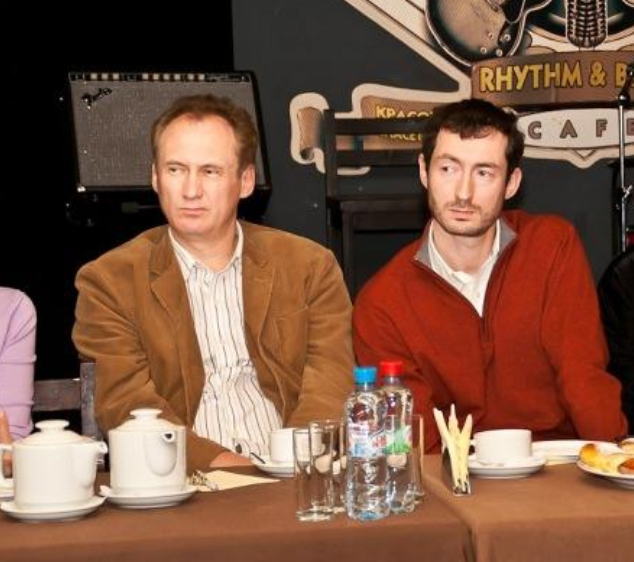
- Early 2024: Atlas Data Privacy Corp initiated its litigation. Shortly thereafter, investigations revealed that the company was managed by Russian-born brothers Igor and Dmitry Lubarsky, who operated from Massachusetts while masking their ownership through a labyrinthine structure of foreign entities.
- March 2024: Following a detailed exposé by KrebsOnSecurity regarding the Lubarsky brothers, Radaris’s legal representation threatened defamation lawsuits, insisting the site was owned by Ukrainians living in Ukraine—a claim that would later be dismantled by the company’s own internal documents.
- June 2025: After the initial case stalled, Atlas re-filed, casting a wider net to include the myriad sister companies connected to the Radaris ecosystem.
- August 2026: A New Jersey judge, citing a pattern of bad-faith delays and failure to appear, ordered the transfer of Radaris.com and over a dozen associated domains to the plaintiffs.
Throughout this period, Radaris utilized what Atlas CEO Matt Adkisson calls the "island-hopping phase." Whenever a legal entity was cornered, the company would simply dissolve the entity and migrate its assets to a new shell company registered in the Marshall Islands, the Seychelles, or the British Virgin Islands.
The Shell Game: Unmasking the Operations
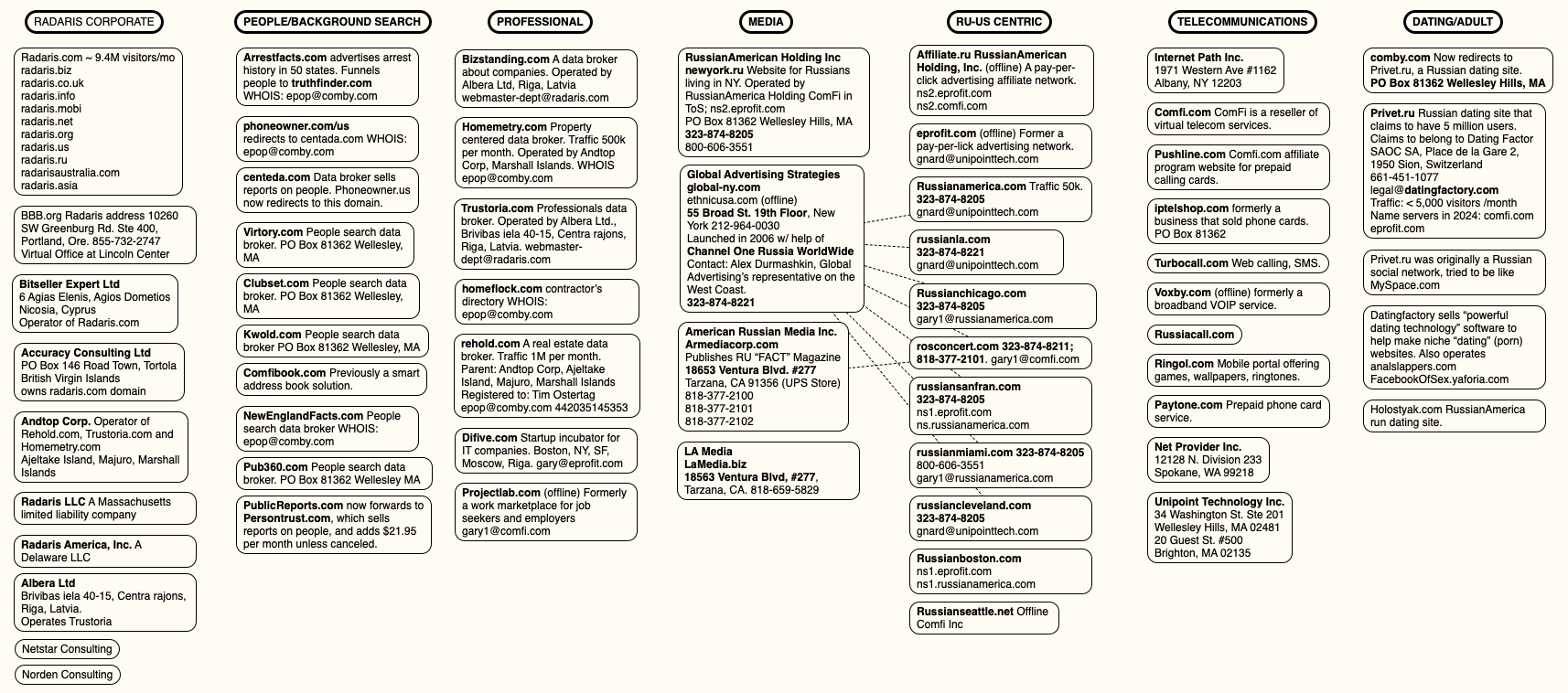
The true scale of the operation was only revealed through the discovery of over 10,000 internal emails and documents during the litigation. These records confirm that Radaris was never a decentralized network of independent firms, but rather a single, Boston-area operation disguised as a global conglomerate.
The emails detail a centralized hub managing brands such as Veripages, alongside a host of others. These entities shared the same banking infrastructure, technical support, and virtual office addresses. Perhaps most damningly, the documents reveal that Radaris had been employing a fictitious CEO named "Gary Norden." The company issued press releases and solicited investment under this invented identity, a detail their own attorney, Val Gurvits, eventually admitted in court.
Financial records suggest the operation was highly lucrative, with Radaris.com pulling in an estimated $42,000 monthly, while its partner site, Veripages, generated roughly $45,000. Further complicating the ecosystem is the industry’s "self-licking ice cream cone" effect: Radaris was found to be partnering with privacy-removal services like Onerep. In a perverse cycle, companies that profit from publishing data are often the same ones selling "protection" services to help users remove it.
Official Responses and Legal Defense
When contacted for this report, the legal team representing the Radaris interests remained defiant. Victor Worms, the attorney currently assigned to the case, argued that the New Jersey court’s judgment is fundamentally flawed.
"We have made a motion to vacate that default judgment on the grounds that it is void since a non-entity has no legal capacity to sue or be sued," Worms stated. He further claimed that the transfer of the domain name constitutes a violation of constitutional due process, asserting that his clients intend to pursue every available appellate avenue to reclaim the digital assets.
Conversely, the plaintiffs view the seizure as a necessary intervention. Raj Parikh, a partner at PEM Law and lead counsel for Atlas, noted that the company had survived for a decade by winning through attrition. "Plaintiffs’ attorneys tired of the procedural games and just gave up," Parikh explained. "We were acutely aware of the threat this website posed to law enforcement officers… and decided early on to commit whatever time and resources were necessary."
The Broader Implications for Privacy
The seizure of Radaris.com is a milestone, but it is unlikely to be the final word in the data broker wars. The industry is currently mounting a massive constitutional counter-attack against Daniel’s Law. At least 70 lawsuits have been moved to federal courts, with brokers arguing that such laws violate the First Amendment by restricting the dissemination of "publicly available" information.
The legal climate is volatile. While 14 states have adopted versions of Daniel’s Law, other jurisdictions, such as West Virginia, have seen their versions struck down as unconstitutionally broad. The issue is destined for the U.S. Supreme Court, where the tension between individual safety and the "right to publish" public records will be put to the ultimate test.
Privacy expert Justin Sherman, author of the forthcoming book The Middlemen, emphasizes that the fundamental problem is the lack of a comprehensive federal privacy law. "The average person can look at Daniel’s Law and have a perfectly normal reaction, which is that everyone should be covered, not just police and judges," Sherman said. "But we don’t need more wake-up calls. We’ve had eight million wake-up calls already."
The "public" nature of the records these brokers scrape—including marriage certificates, property filings, and motor vehicle registrations—creates a massive loophole that most state laws fail to address. Without federal legislation that regulates how these "public" records are aggregated and monetized, companies like Radaris can simply pivot to new domains or business models.
Conclusion: A Digital Pyrrhic Victory?
As of today, Radaris.com greets visitors not with personal dossiers, but with a notice of the court-ordered transfer. For those targeted by the site, the reprieve is welcome. However, the case underscores a systemic vulnerability in the American digital infrastructure.
The Radaris saga reveals that in the current regulatory vacuum, the only entities capable of checking the power of massive data brokers are those with the resources to endure years of litigation. Until Congress acts to modernize data privacy protections, the battle for personal sovereignty in the digital age will continue to be fought in individual courtrooms, one domain seizure at a time. The collapse of the Radaris empire serves as a warning to the industry, but as the constitutional challenges to Daniel’s Law mount, it is clear that the fight over who owns our digital identities is only just beginning.