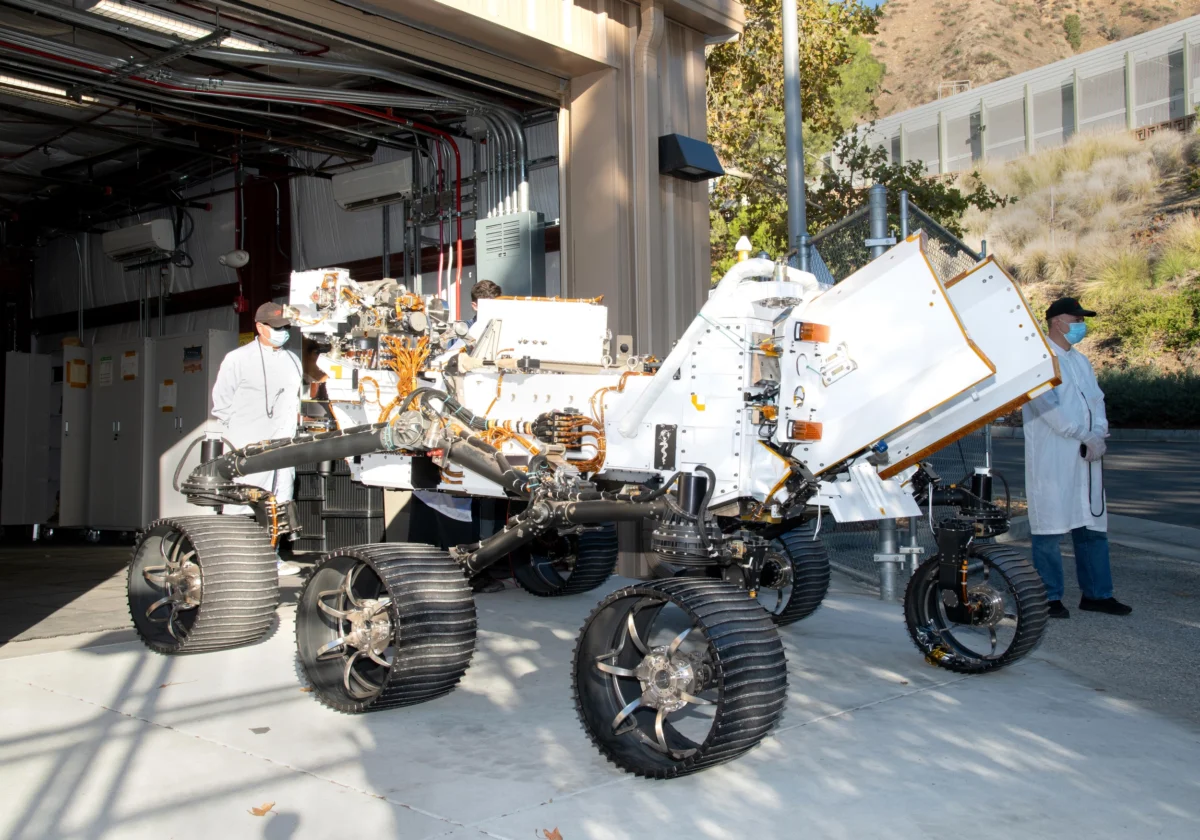
WASHINGTON — A bold proposal by NASA leadership to repurpose an Earth-bound Mars rover engineering model into a fully operational lunar explorer has ignited a fierce debate within the aerospace and planetary science communities. While agency leadership frames the project as a common-sense, cost-effective way to secure rapid achievements on the lunar surface, independent analysis warns that the conversion could cost upwards of $1 billion, potentially draining resources from long-established scientific priorities and stalling future exploration of the outer solar system.
The controversy centers on "PROMISE" (Polar Rover for Observation, Mapping and In-Situ Exploration), a conceptual mission that would adapt existing hardware from Mars rover testbeds for a high-stakes deployment to the lunar south pole.
Main Facts
At the heart of the debate is the feasibility of converting OPTIMISM (Operational Perseverance Integration for Monitoring and Intervention under Simulated Environments)—the full-scale engineering model of the Mars Perseverance rover currently housed at the Jet Propulsion Laboratory (JPL) in California—into a flight-ready lunar vehicle.
NASA Administrator Jared Isaacman announced the PROMISE initiative on June 30, describing it as part of an aggressive strategy to "raid the pantry" of NASA’s various research centers for existing payloads and hardware that can support the agency’s lunar base goals. Proponents of the plan argue that because the physical structure and mobility systems of the rover already exist, the mission can be assembled quickly and cheaply, providing an unprecedented heavy-rover capability to the lunar south pole.
However, a detailed cost and technical assessment published on July 30 by The Planetary Society presents a sharply contrasting reality. Written by Casey Dreier, the organization’s chief of space policy, the report estimates that the development, launch, and initial one-year operation of PROMISE would cost between $723 million and $1.33 billion. Furthermore, the analysis projects that the rover would not be ready for launch until the early 2030s, challenging the narrative of a rapid, low-cost "win" for the agency’s lunar program.
The core tension lies in the fundamental physical differences between a ground-based test vehicle and a spacecraft certified to survive the vacuum, radiation, and extreme thermal swings of the Moon, alongside the controversial reallocation of scarce nuclear power resources.
+---------------------------------------------------------------------------------+
|                           THE PROMISE ROVER DEBATE                              |
+---------------------------------------------------------------------------------+
|                                                                                 |
|   NASA LEADERSHIP VISION                                 PLANETARY SOCIETY      |
|   (Jared Isaacman)                                       (Casey Dreier)         |
|                                                                                 |
|   • "Raid the pantry" for hardware                       • Estimated cost:      |
|   • Utilize decaying Pu-238 fuel                          $723M - $1.33B        |
|   • Fast-track lunar base support                        • No launch until 2030s|
|   • "Less debate, more frequent wins"                    • Diverts critical RTG |
|                                                           from outer planets    |
|                                                                                 |
+---------------------------------------------------------------------------------+
Chronology
The unfolding timeline of the PROMISE proposal highlights a rapidly evolving policy debate:
- June 30: NASA officially announces it is considering the PROMISE mission. At an event awarding nearly $600 million in lunar lander contracts, NASA Administrator Jared Isaacman introduces the concept of converting Mars rover engineering models to expedite lunar surface operations.
- July 21: During a session at the NASA Exploration Science Forum, Louise Prockter, director of NASA’s planetary science division, reveals that the highly anticipated call for proposals for the next New Frontiers planetary science mission has been delayed. She cites ongoing assessments regarding the availability of nuclear power and organizational restructurings as key factors.
- July 30: The Planetary Society publishes its independent policy and cost analysis of the PROMISE proposal. The report concludes that the mission is far from a "freebie" and warns of severe consequences for both current Mars operations and future planetary science.
- July 31: Administrator Isaacman takes to social media to publicly push back against The Planetary Society’s cost estimates, asserting that if the project costs even a fraction of their low-end projection, it will be canceled, while simultaneously defending the logic of utilizing existing hardware and decaying nuclear fuel assets.
Supporting Data and Technical Challenges
The primary point of contention between NASA leadership and space policy analysts is whether an engineering model like OPTIMISM can be transformed into a spaceflight-qualified vehicle without a ground-up redesign.
The Cost of Space Qualification
Ground-based engineering models are built to replicate the physical dimensions, weight distribution, and software behaviors of their off-world twins, but they are not constructed to survive spaceflight. According to The Planetary Society’s analysis, OPTIMISM lacks several critical, highly expensive components required for deep space:
- Space-Rated Electronics: Ground models often use commercial-off-the-shelf (COTS) components that are not hardened against the intense radiation of deep space and the lunar surface.
- Vacuum-Compatible Systems: Lubricants, seals, and structural adhesives used on OPTIMISM are designed for Earth’s atmospheric pressure and would fail or outgas in the hard vacuum of the Moon.
- Scientific Payload: OPTIMISM carries mockups and functional equivalents of instruments designed for testing software, but it does not possess flight-qualified scientific instruments. Outfitting the rover with a new suite of lunar sensors would require hundreds of millions of dollars in instrument development and integration.
The Thermal and Gravity Regimes
Mars possesses a thin carbon dioxide atmosphere that allows for convective cooling, and its temperatures, while cold, are far more moderate than those of the Moon. The lunar south pole experiences extreme temperature swings, dropping to below -230°C (-380°F) in permanently shadowed regions (PSRs) and during the 14-day-long lunar night.
To survive, PROMISE would require an entirely redesigned thermal management system, including specialized insulation, heaters, and radiators that OPTIMISM simply does not have. Additionally, the rover’s chassis and suspension—designed for Earth’s gravity during testing and Mars’ 0.38g—would have to be recalibrated and verified for the 0.16g environment of the Moon.
The Nuclear Fuel Bottleneck
Perhaps the most critical technical and logistical hurdle is the rover’s power source. Perseverance and Curiosity rely on Multi-Mission Radioisotope Thermoelectric Generators (MMRTGs), which convert heat from the radioactive decay of Plutonium-238 (Pu-238) into electricity.
Pu-238 Decay Profile & Power Loss
=================================
Year 0: [████████████████████] 100% (Fresh Fuel)
Year 5: [██████████████████░░] ~90%  (Significant decay; urgency to launch)
Year 10:[████████████████░░░░] ~80%  (Reduced output for deep space)
NASA currently possesses only a single unallocated spare MMRTG. Utilizing this sole spare for PROMISE introduces several compounding issues:
- Launch Certification: Integrating an MMRTG onto a commercial lunar lander and certifying the launch vehicle for nuclear payloads is an incredibly complex, highly regulated, and expensive legal process.
- Fuel Decay: Pu-238 decays at a rate of approximately 2% per year. While this decay supports the argument to use the fuel sooner rather than later, diverting it to a lunar mission permanently deprives other programs of nuclear power.
Official Responses
The debate has exposed a philosophical divide within the space agency, contrasting the "move fast" commercial-style philosophy of the current leadership with the methodical, consensus-driven approach of NASA’s scientific divisions.
NASA Leadership: Jared Isaacman
In his July 31 rebuttal, NASA Administrator Jared Isaacman strongly rejected the billion-dollar price tag, emphasizing that the project would be structured to avoid runaway costs:
"Launch and landing costs are a reality for any mission, so setting those aside, if PROMISE costs even 20% of your low-end estimate, we simply will not fly it."
Isaacman defended the pragmatism of the "pantry-raiding" strategy, pointing to the financial waste of letting existing assets sit idle. He argued that the decaying state of the nation’s Pu-238 supply demands immediate action:
"It would be crazy not to take advantage of hardware taxpayers have already invested hundreds of millions of dollars in, along with Pu-238 that continues to decay and lose roughly 2% of its potential each year. How much of this Pu-238 do you want to waste waiting for a mission that does not even exist?"
He concluded by advocating for a cultural shift in how NASA plans missions, favoring rapid execution over prolonged deliberation:
"I understand the community sometimes likes to take a long time to reach consensus, but under this administration, we can just do things and put wins on the board for the Moon Base and all the science and discovery it will enable. In my humble opinion, less debate and more frequent wins make it easier to advocate for more resources to do more science."
NASA Planetary Science Division: Louise Prockter
While leadership pushes for rapid deployment, the managers of NASA’s scientific portfolio are grappling with the systemic impacts of resource diversion. Speaking at the NASA Exploration Science Forum on July 21, Louise Prockter, director of the planetary science division, acknowledged that nuclear power constraints are already disrupting long-term planning.
Addressing the delays in the New Frontiers planetary science call—which funds highly competitive, medium-class missions to targets like Saturn’s moon Titan, Venus, or the outer planets—Prockter noted:
"We’re also looking at availability of nuclear power. We’re still working to understand the implications of that. Several missions on the list certainly would benefit from nuclear power… We are investigating whether we will have nuclear power for that list [of candidate missions]. That may make a difference to it, but we should have that information out fairly soon."
Implications
The outcome of the PROMISE debate will have far-reaching consequences for the future of U.S. space exploration, impacting active Mars operations, upcoming planetary science, and the overarching strategy of the Artemis-era lunar program.
Diverting the Spare MMRTG: Trade-Offs
┌─────────────────────────────────────────┐
│              SPARE MMRTG                │
└────────────────────┬────────────────────┘
                     │
          ┌──────────┴──────────┐
          ▼                     ▼
┌───────────────────┐ ┌───────────────────┐
│   PROMISE ROVER   │ │   NEW FRONTIERS   │
│   (Lunar South)   │ │  (Outer Planets)  │
├───────────────────┤ ├───────────────────┤
│ • Heavy lunar cap.│ │ • Uranus/Neptune  │
│ • Rapid deployment│ │ • Titan/Enceladus │
│ • High risk/cost  │ │ • Decade planning │
└───────────────────┘ └───────────────────┘
Risk to Active Mars Missions
If OPTIMISM is stripped, modified, and launched to the Moon, the Mars Perseverance mission will lose its primary ground-based testing asset.
For major planetary rovers, Earth-bound twins are not luxury items; they are critical operational tools. When Perseverance encounters hazardous terrain, mechanical anomalies, or software glitches on Mars, engineers at JPL write and test troubleshooting sequences on OPTIMISM first to ensure they do not permanently disable the multi-billion-dollar rover on Mars. Depriving Curiosity and Perseverance of their physical testbeds significantly increases the operational risk for these ongoing flagship missions.
Consequences for Outer Solar System Exploration
The decision to allocate the single remaining spare MMRTG to a lunar rover could effectively freeze U.S. exploration of the outer solar system for a generation.
Unlike missions to the Moon or Mars, where solar power is a viable option, missions to the outer solar system—such as probes to Uranus, Neptune, or the icy moons of Jupiter and Saturn—cannot operate on solar energy due to the extreme distance from the Sun. These missions must use nuclear power.
If the current spare MMRTG is consumed by the PROMISE mission, any future New Frontiers mission requiring nuclear power will be delayed indefinitely until the Department of Energy can produce and package enough new plutonium-238 to build another generator—a process that takes years and costs hundreds of millions of dollars.
A Philosophical Shift in Space Exploration
Ultimately, the battle over the PROMISE rover represents a fundamental clash of institutional philosophies:
- The Traditional Science Paradigm: Prioritizes decades of international scientific consensus, rigorous peer review, and risk-mitigated engineering to ensure high-value scientific returns. This community fears that politically motivated, ad-hoc missions like PROMISE will cannibalize budgets meant for carefully planned planetary flagships.
- The Agile Exploration Paradigm: Prioritizes speed, cost efficiency, and opportunistic engineering to build momentum and establish an early presence on the lunar frontier. This faction believes that the traditional process is too slow to support the urgent geopolitical and operational timelines of the Artemis lunar base program.
As NASA navigates this internal divide, the fate of the PROMISE rover will serve as a bellwether for whether the agency’s future lies in highly calculated deep-space science or rapid, infrastructure-driven lunar exploration.