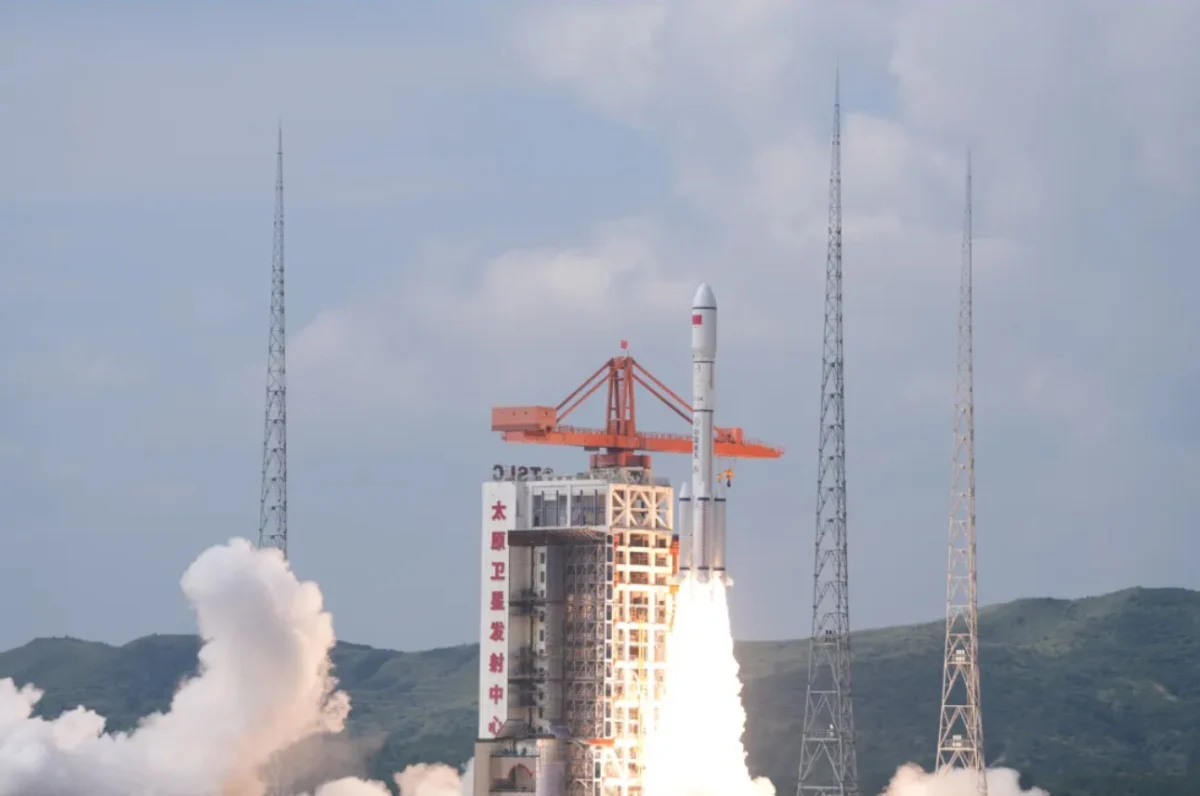
In a rapid sequence of launches that highlights its expanding space logistics and orbital capabilities, China successfully deployed a pair of highly classified satellites into an unprecedented orbit while simultaneously upgrading its geostationary data relay network.
The back-to-back missions, executed within hours of each other on July 29 and 30, 2026, underscore Beijing’s aggressive push to achieve a record-breaking launch cadence. They also demonstrate a concerted effort to enhance both military intelligence-gathering and real-time space communications.
Main Facts
The two successful launches represent critical milestones for China’s state-owned aerospace apparatus:
- The TJS-27A and TJS-27B Mission: On July 30, 2026, at 0100 UTC (9:00 p.m. EDT on July 29), a Long March 6A rocket lifted off from the Taiyuan Satellite Launch Center in northern China. It successfully delivered two classified payloads, designated Communication Technology Test Satellites 27A and 27B (TJS-27A and TJS-27B), into a unique medium-altitude orbit. The satellites were developed by China’s leading space contractors: TJS-27A by the China Academy of Space Technology (CAST) and TJS-27B by the Shanghai Academy of Spaceflight Technology (SAST).
- The Tianlian-3 (01) Mission: Just hours earlier, on July 29, 2026, at 1150 UTC (7:50 a.m. EDT), a Long March 7A rocket launched from the Wenchang Satellite Launch Center on Hainan Island. The rocket carried Tianlian-3 (01), the first of China’s third-generation data relay satellites, into a geosynchronous transfer orbit (GTO).
- Launch Milestones: These flights marked the 52nd and 53rd successful orbital launches for China in 2026. This trajectory keeps the country on pace to exceed 100 launches in a single calendar year for the first time in its history. Additionally, the Long March 7A flight represented the 50th successful mission launched from the Wenchang spaceport since its inaugural flight in 2016.
Chronology
The events of late July 2026 highlight a remarkably compressed operational schedule for the China Aerospace Science and Technology Corporation (CASC) and its subsidiary academies:
July 23, 2026: The Prelude
China launches the Tianlian-2 (06) data relay satellite aboard a Long March 3B rocket from the Xichang Satellite Launch Center. During its ascent, the launch vehicle is struck by lightning. Despite the atmospheric disturbance, the rocket successfully inserts the second-generation relay satellite into its planned orbit, ensuring the continuity of the current-generation tracking network.
July 29, 2026 (1150 UTC): Launch of Tianlian-3 (01)
- 07:50 a.m. EDT: The Long March 7A, a three-stage liquid-propellant launcher, lifts off from the coastal pads of the Wenchang Satellite Launch Center.
- Post-Launch: CASC declares the mission a complete success after the Tianlian-3 (01) satellite is tracked in its targeted geosynchronous transfer orbit. The deployment marks the formal debut of China’s third-generation space-based tracking and data relay system.
July 30, 2026 (0100 UTC): Launch of TJS-27A and TJS-27B
- 09:00 p.m. EDT (July 29): The Long March 6A, featuring a liquid-propellant core stage augmented by four solid rocket boosters, lifts off from the Taiyuan Satellite Launch Center.
- Post-Launch: CASC officially confirms the successful deployment of the TJS-27A and TJS-27B satellites. State media reports state the payloads will be used for "satellite communication, broadcasting, television, and data transmission."
- Later on July 30: The United States Space Force’s space tracking assets locate the two satellites in a medium Earth orbit (MEO) with an altitude of approximately 1,153 kilometers and an orbital inclination of 64.8 degrees.
Late August 2026: Looking Ahead
The Wenchang Satellite Launch Center prepares to host the launch of the Chang’e-7 robotic lunar mission, which will target a landing near the south pole of the Moon.
Supporting Data
The technical parameters of these missions reveal significant developments in Chinese satellite bus technology, orbital mechanics, and overall launch architecture.
Orbital Parameters and Mission Profiles
| Satellite / Mission | Launch Vehicle | Launch Site | Observed Orbit | Primary Contractor |
|---|---|---|---|---|
| TJS-27A | Long March 6A | Taiyuan | ~1,153 km altitude, 64.8° inclination | CAST |
| TJS-27B | Long March 6A | Taiyuan | ~1,153 km altitude, 64.8° inclination | SAST |
| Tianlian-3 (01) | Long March 7A | Wenchang | Geosynchronous Transfer Orbit (GTO) | CAST |
Evolution of the Tianlian Relay Constellation
The Tianlian system functions as China’s equivalent to the U.S. Tracking and Data Relay Satellite System (TDRSS). It provides continuous telemetry, tracking, and high-bandwidth data transmission for low-Earth orbit (LEO) spacecraft, most notably the Tiangong space station and crewed Shenzhou missions.
Tianlian-1 Series (First Gen) ──> Launched on Long March 3C (First launch: 2008)
Tianlian-2 Series (Second Gen) ─> Launched on Long March 3B (DFH-4 bus; First launch: 2019)
Tianlian-3 Series (Third Gen) ──> Launched on Long March 7A (DFH-4E enhanced bus; First launch: 2026)
The transition to the third-generation Tianlian-3 architecture brings several notable upgrades:
- Satellite Bus: Upgraded from the standard DFH-4 bus to the DFH-4E (Enhanced) platform.
- Transmission Capabilities: Equipped with advanced high-frequency transponders and multi-user parallel data transmission systems, significantly increasing the volume of real-time data the constellation can handle simultaneously.
- Operational Lifespan and Power: Improved solar array efficiency and onboard electric propulsion systems, extending the operational life of the spacecraft.
Official Responses
The discrepancy between official state pronouncements and independent orbital observations has once again highlighted the secretive nature of China’s military space program.

Chinese State Declarations
Following both launches, CASC issued highly standardized press releases. For the TJS-27A/B mission, CASC stated that the satellites are:
"…mainly used for satellite communication, broadcasting and television, data transmission and other services, and to carry out related technology experiments and verifications."
No detailed schematics, payload descriptions, or specific orbital destinations were provided for the TJS-27 pair, a practice consistent with previous military-adjacent launches.
Western Analyst Assessments
Independent space trackers and military analysts quickly challenged the routine "communication testing" cover story.
Jonathan McDowell, an astrophysicist and prominent orbital tracker, noted on the social media platform X that the orbit of TJS-27A and B strongly resembles those used for electronic intelligence (ELINT) gathering:
"TJS 27A and 27B, launched on Jul 30, are being tracked by Space Force in an 1155 km, 63.4 deg orbit characteristic of time-delay-of-arrival electronic intelligence (NOSS type) satellites."
McDowell further observed a notable shift in China’s naming conventions for this particular orbital regime:
"China’s earlier missions in this orbit were given a Yaogan rather than TJS cover name."
Implications
The dual launches carry deep strategic implications for space surveillance, military communications, orbital debris mitigation, and China’s long-term lunar ambitions.
1. Advanced Space-Based Surveillance (ELINT and SIGINT)
The deployment of TJS-27A and TJS-27B into a 1,153-kilometer orbit at a 64.8-degree inclination points to an expansion of China’s space-based maritime and signals intelligence capabilities.

Satellites in this orbital configuration typically operate in pairs or triplets to perform Time-Delay-of-Arrival (TDOA) calculations. By measuring the fractional differences in the time it takes for a radio frequency or radar signal to reach different satellites in a coordinated formation, the system can precisely triangulate the location of military emitters, such as naval vessels or air defense radars, across the globe.
Historically, China designated such electronic intelligence satellites under the "Yaogan" (remote sensing) series. Reclassifying these assets under the "Tongxin Jishu Shiyan" (TJS) label suggests either a reorganizational shift within the People’s Liberation Army (PLA) space architecture or an effort to obscure the expanding scope of their signals intelligence (SIGINT) network.
The TJS series has a history of dual-use and counter-space activities. For example, the TJS-3 satellite, launched in 2018, made headlines after releasing a small sub-satellite that performed close-approach inspection maneuvers near several U.S. geostationary satellites.
2. High-Bandwidth Support for Crewed and Deep-Space Missions
The deployment of Tianlian-3 (01) ensures that China’s geostationary relay network can support increasingly complex operations. As the Tiangong space station operates at full capacity with rotating crews, and as China prepares for robotic and crewed lunar missions, the demand for uninterrupted, high-throughput data pipelines has grown exponentially.
The Tianlian-3 series’ parallel data transmission capabilities will allow Beijing to maintain continuous contact with multiple assets simultaneously—such as a Shenzhou crewed spacecraft, the Tiangong station, and deep-space tracking assets—reducing communication blackouts to near zero.
3. Space Traffic Safety and the Long March 6A Debris Issue
While the Long March 6A rocket is a highly capable hybrid launcher—utilizing liquid-propellant core stages and solid rocket boosters—it remains a source of concern for international space safety organizations.
The launcher has a history of orbital debris generation. On multiple occasions, its upper stages have suffered post-mission fragmentation events, leaving clouds of high-velocity space debris in highly congested low-Earth orbits. Analysts will closely monitor the upper stage of the July 30 launch to see if design modifications have successfully resolved this fragmentation vulnerability.
4. Wenchang’s Evolution and Lunar Ambitions
The successful 50th launch from Wenchang highlights the spaceport’s transition from a new facility into the primary engine of China’s heavy-lift and deep-space programs. Unlike China’s older, landlocked launch sites (Jiuquan, Taiyuan, and Xichang), Wenchang’s coastal location allows rockets to be shipped by sea, bypassing rail width restrictions. It also ensures that spent booster stages fall harmlessly into the ocean rather than populated inland areas.
Wenchang is currently undergoing massive infrastructure expansions to support China’s next-generation launch vehicles:
- The Long March 10: A heavy-lift rocket designed to launch the Mengzhou crewed spacecraft and Lanyue lander for China’s planned crewed lunar landings before 2030.
- The Long March 9: A super-heavy-lift vehicle comparable to NASA’s Space Launch System (SLS) and SpaceX’s Starship, intended for launching massive space infrastructure and deep-space exploration payloads.
With the upcoming launch of the Chang’e-7 lunar south pole probe, Wenchang is poised to remain the focal point of the international race to establish a permanent presence on the Moon.