
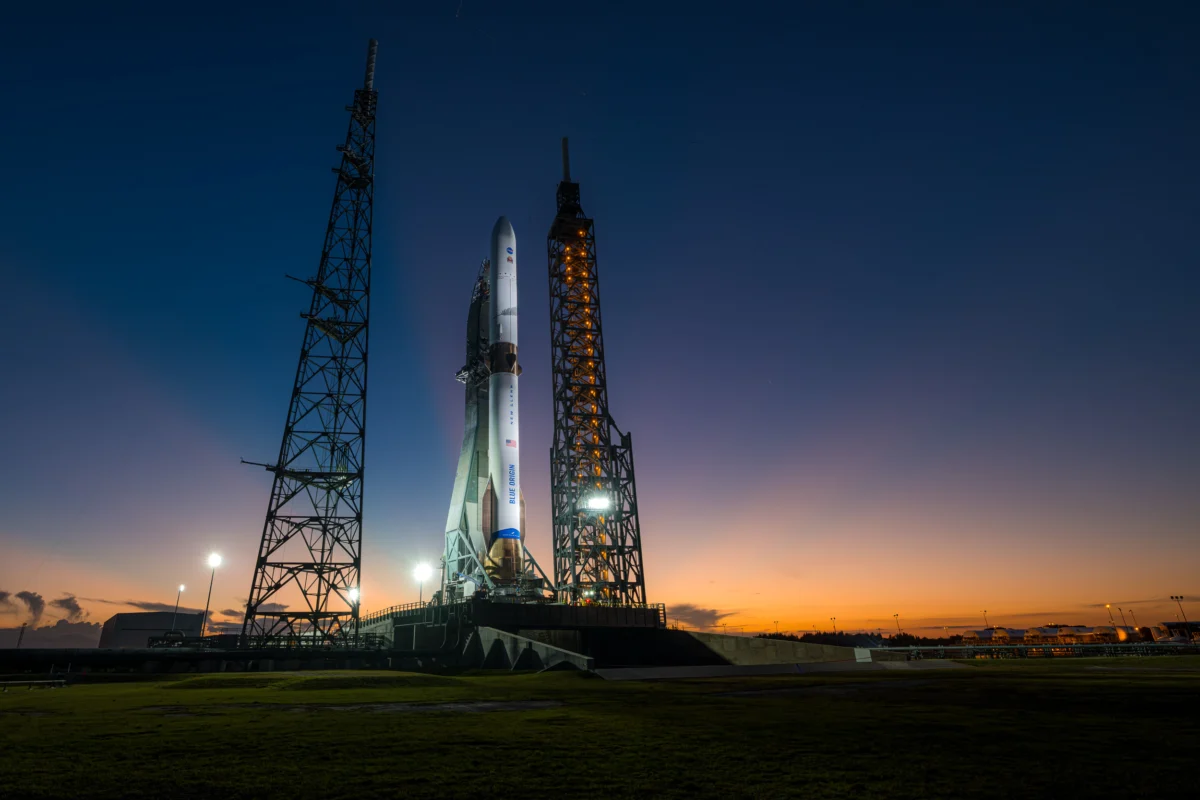
WASHINGTON — In a move that underscores the U.S. military’s deepening commitment to transforming global logistics through spaceflight, the Air Force Research Laboratory (AFRL) has significantly expanded its partnership with Blue Origin. The service has added $11.7 million to an existing contract with the aerospace firm, aiming to explore how commercial heavy-lift rockets can be leveraged to transport military supplies and equipment to any point on the globe in under an hour.
The contract modification, officially announced on July 31, dramatically scales up an initial $1.3 million agreement awarded to Blue Origin last year. This brings the total value of the research initiative to approximately $13 million, with work scheduled to run through October 2027.
Rather than funding immediate test launches, the expanded agreement remains focused on rigorous systems engineering, technical studies, and mission requirements definition. The goal is to determine how Blue Origin’s massive orbital infrastructure—most notably its New Glenn launch system—can be integrated into the Pentagon’s rapid-response logistics network.
Main Facts of the Expanded Agreement
The newly expanded contract is administered under the AFRL’s Rocket Experimentation for Global Agile Logistics (REGAL) program. REGAL serves as the primary contractual and technical pipeline through which the U.S. Air Force and U.S. Space Force evaluate commercial aerospace proposals for point-to-point (P2P) rocket cargo delivery.
Key parameters of the updated contract include:
- Financial Scope: An increase of $11.7 million, raising the total contract ceiling from $1.3 million to approximately $13 million.
- Timeline: The performance period is extended, with final technical deliverables and system analyses expected by October 2027.
- Scope of Work: The contract is strictly analytical and conceptual. Blue Origin will define the technical, mechanical, and operational parameters required to adapt its commercial launch systems for military logistics. This includes analyzing payload integration, rapid launch site operations, and destination survival requirements.
- Focus Vehicle: Research will center on the capabilities of Blue Origin’s New Glenn rocket, a heavy-lift launch vehicle designed for high flight rates and reuse.
By expanding this contract, the AFRL is deepening its understanding of how commercially developed, reusable rockets can serve national security interests without the Department of Defense (DoD) bearing the entire financial burden of developing a bespoke military launch vehicle.
Chronology of U.S. Military Rocket Cargo Initiatives
The concept of using rockets to deliver cargo across intercontinental distances is not new, but the rapid commercialization of space has recently transformed it from science fiction into a viable military research program.
[2020–2021] ----------------> [2023] --------------------> [Jan 2025] -------------> [May 28, 2026] ----------> [July 31] -------------> [Oct 2027]
USTRANSCOM signs              Blue Origin enters         New Glenn               New Glenn pad            AFRL adds $11.7M        Target for Blue Origin
early CRADAs; AFRL            REGAL program with         successfully            anomaly at LC-36;        to REGAL contract;      to complete systems
launches Rocket Cargo         initial $1.3M award.       debuts orbital          rocket grounded          total value reaches     engineering studies.
Vanguard program.                                        flight.                 temporarily.             ~$13 million.
The Vanguard Genesis (2020–2022)
The modern push for rocket cargo began in earnest when U.S. Transportation Command (USTRANSCOM) initiated Cooperative Research and Development Agreements (CRADAs) with commercial space leaders like SpaceX and Exploration Architecture (XArc). Recognizing the potential, the Air Force designated "Rocket Cargo" as one of its elite "Vanguard" programs—high-priority research efforts designed to deliver game-changing capabilities to the warfighter.
Blue Origin’s Entry and Initial Award (2023–2024)
As the AFRL formalized its acquisition strategy, it established the REGAL program to onboard a wider variety of commercial launch providers. Blue Origin entered the program with an initial $1.3 million contract aimed at studying how its heavy-lift architectures could align with the military’s rapid-delivery concepts.

New Glenn’s Operational Debut and Setbacks (2025–2026)
Blue Origin’s heavy-lift rocket, New Glenn, made its highly anticipated orbital debut in January 2025. The vehicle successfully completed three orbital missions, demonstrating its structural integrity and the performance of its liquefied natural gas (LNG)-powered BE-4 engines.
However, the test program suffered a setback on May 28, 2026, during a pre-flight static-fire test at Cape Canaveral’s Launch Complex 36 (LC-36). An anomaly during the hot-fire sequence caused significant damage to the launchpad’s ground support equipment, grounding the vehicle. Blue Origin has since restructured its launchpad maintenance and operations approach, aiming to return New Glenn to flight status before the end of 2026.
The Contract Expansion (July 31)
Despite the temporary grounding of New Glenn, the AFRL signaled its long-term confidence in Blue Origin’s architecture by finalizing the $11.7 million contract modification on July 31, extending the research horizon into late 2027.
Supporting Data: Technical Hurdles of Point-to-Point Rocket Cargo
While the prospect of delivering 100 tons of cargo to any location on Earth in 45 minutes is strategically attractive, the engineering and logistical challenges are immense. The REGAL program’s research is structured to systematically address these hurdles.
1. Payload Survivability and Environmental Control
Standard military cargo is designed to be transported via cargo aircraft (such as the C-17 Globemaster III) or container ships, which expose payloads to relatively mild acoustic, vibrational, and gravitational loads. Rocket launches, by contrast, subject payloads to extreme g-forces, intense acoustic vibrations, and rapid thermal fluctuations during atmospheric re-entry. Blue Origin must design specialized payload adapters and environmental control systems within New Glenn’s 7-meter fairing to protect sensitive military hardware, medical supplies, or humanitarian aid.
2. Austere Landing and Rapid Recovery
For military logistics to be truly "agile," cargo rockets cannot rely solely on pristine, highly instrumented launchpads and landing zones. Research must address how a rocket or a deployable cargo capsule can safely land in austere environments—such as remote Pacific islands or forward operating bases—without damaging the cargo or endangering personnel on the ground. Furthermore, the military must design rapid-unload mechanisms that do not require specialized heavy cranes or gantries.
3. Economic Viability vs. Traditional Liftoffs
To be a viable component of the military’s logistics portfolio, rocket cargo must offer a defensible cost-to-speed ratio. While it will never compete on a dollar-per-pound basis with traditional sealift or standard airlift, the DoD must determine the specific scenarios (e.g., delivering a critical radar component to a broken-down air defense system in a conflict zone) where the extreme speed justifies the premium cost of an orbital launch.
The REGAL Competitive Landscape
Blue Origin is not the sole beneficiary of the military’s interest in space-based logistics. The AFRL has distributed REGAL awards to a diverse group of defense tech and aerospace firms, creating a competitive ecosystem:
| Company | Core Platform Focus | Strategic Angle |
|---|---|---|
| Blue Origin | New Glenn | Reusable heavy-lift, massive volume capacity (7m fairing) |
| Rocket Lab | Neutron / Electron | Medium-lift, rapid-call launch capabilities, composite materials |
| Sierra Space | Dream Chaser / Cargo Pods | Runway-landing lifting body, precise runway delivery of payloads |
| Anduril Industries | Autonomous Software / Integration | Command-and-control software, mission planning, and modular payloads |
Official Responses and Stakeholder Perspectives
The expansion of the REGAL contract reflects a shared vision between military planners and commercial aerospace executives, though both parties acknowledge the steep developmental curve ahead.

In previous discussions regarding the Rocket Cargo Vanguard program, AFRL leadership emphasized that the military does not intend to own or operate its own fleet of cargo rockets. Instead, the service wants to act as a commercial customer, buying transit services on commercial vehicles just as it does with commercial cargo airlines through the Civil Reserve Air Fleet (CRAF).
"Our goal with REGAL is to understand how we can plug into the incredible wave of commercial space innovation," an AFRL program representative noted regarding the initiative. "By working with companies like Blue Origin, we can co-develop standards that make commercial rockets inherently compatible with military logistics needs, rather than trying to retrofit these massive systems after the fact."
Blue Origin has maintained a strong commitment to its national security space launch (NSSL) ambitions. Despite the setback at LC-36 on May 28, 2026, company spokespersons have reiterated that their infrastructure recovery plans are progressing rapidly. In a recent update, Blue Origin outlined a revised launchpad management strategy designed to increase operational resilience and ensure that New Glenn is ready to support both commercial payloads and national security missions by the end of the year.
Strategic and Operational Implications
The expansion of Blue Origin’s REGAL contract carries profound implications for the future of global power projection and military deterrence, particularly in contested environments.
Overcoming the "Tyranny of Distance" in the Indo-Pacific
The U.S. military’s primary logistical challenge in the modern era is the vast expanse of the Pacific Ocean. In a potential conflict in the Indo-Pacific, traditional supply lines—dependent on slow-moving cargo ships and vulnerable aerial refueling tankers—would face severe threats from long-range adversary missiles.
A point-to-point rocket cargo capability would allow the joint force to bypass traditional geographic chokepoints and air defense networks entirely. By launching a payload into a suborbital or low-Earth orbit trajectory, the military could deliver critical munitions, spare parts, or medical supplies directly to isolated island outposts in a fraction of the time it would take a jet aircraft to fly there, with virtually zero risk of interception during transit.
[Traditional Logistics: Days/Weeks]
Factory Depot ---> Sea Port ---> Container Ship ---> Contested Harbor ---> Forward Base (High Risk of Interdiction)

[Rocket Cargo Logistics: < 1 Hour]
Factory Depot ---> Spaceport ---> Suborbital Trajectory ---> Direct Drop to Forward Base (Zero Interception Risk)
Humanitarian Assistance and Disaster Relief (HADR)
Beyond high-intensity conflict, P2P rocket cargo could revolutionize international disaster response. In the immediate aftermath of a catastrophic earthquake, tsunami, or nuclear accident, the first 24 hours are critical for saving lives. A rocket-delivered cargo capsule could deploy emergency communication arrays, water purification systems, and high-priority medical supplies directly into disaster zones where runways have been destroyed or blocked by debris.
Catalyzing the Commercial Space Economy
By injecting millions of dollars into studies of this nature, the U.S. government is effectively de-risking the development of high-cadence, heavy-lift commercial spaceflight. The requirements established under the REGAL program—such as rapid payload integration, automated pre-flight checks, and robust landing systems—will inevitably feed back into the commercial sector, driving down the cost and increasing the reliability of space access for commercial customers worldwide.
As Blue Origin works toward returning New Glenn to the launchpad later this year, the technical foundation laid by this $13 million AFRL contract will ensure that when the massive rocket does fly regularly, its potential will extend far beyond satellite deployment, paving the way for a new era of ultra-rapid global logistics.