
By Industry Analysis Desk
In the rapidly evolving landscape of satellite communications and RF sensing, the ability to maintain high-gain, multibeam connectivity across vast frequency ranges has long been the "holy grail" of antenna design. This week, MatSing, a leader in advanced antenna solutions, announced a proprietary manufacturing breakthrough that promises to shift the paradigm for large-format Luneburg Lenses. By overcoming the historical material and structural hurdles that have plagued the technology, MatSing has transitioned the Luneburg Lens from a theoretical engineering ideal into a scalable, high-performance platform for the modern era.
The Core Innovation: Solving the Scale-Performance Paradox
At its essence, the Luneburg Lens is a gradient-index lens that focuses electromagnetic waves to a point or, conversely, collimates waves from a point source into a parallel beam. While the physics of the lens has been well-understood since Rudolf Luneburg first described the concept in 1944, the practical application in large-format, high-frequency radio frequency (RF) environments has been stifled by manufacturing limitations.
The challenge is one of precision. To function correctly at higher frequencies—particularly in the Ka-band—the dielectric constant of the lens material must vary precisely from the center to the outer surface. As the aperture size of the lens increases to accommodate better gain and resolution, even microscopic variations in material density or composition can introduce significant phase errors. These errors lead to signal degradation, loss of gain, and poor beam quality, effectively rendering large-scale lenses impractical for commercial or defense applications.
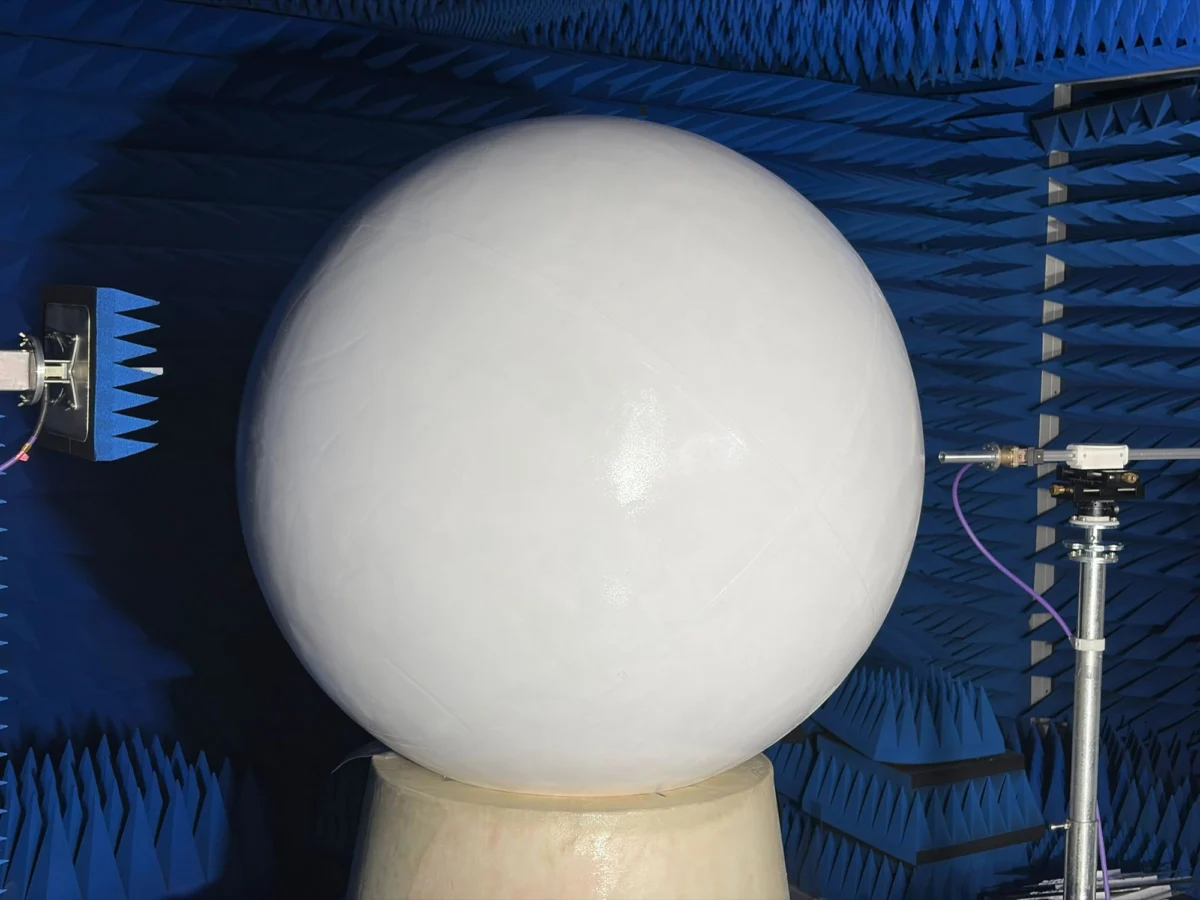
MatSing’s breakthrough lies in a novel, proprietary manufacturing process that enables the scalable production of lenses exceeding 50 wavelengths in aperture. By mastering the consistency of material properties across large volumes, the company can now produce lenses ranging from 0.5 meters to 2.4 meters, capable of operating from L-band through Ka-band frequencies.
A Brief History: From Theoretical Geometry to Real-World RF
The journey of the Luneburg Lens from a mathematical curiosity to a foundational component of modern satcom infrastructure is a testament to the slow but steady maturation of material science.
The 1940s–1970s: The Theoretical Era
In the mid-20th century, the Luneburg Lens was primarily a topic for academic researchers. The lens offered the theoretical advantage of being able to provide a 360-degree field of view with multiple beams, but the materials required to create the necessary gradient index were difficult to fabricate, heavy, and prone to environmental degradation.
The 1980s–2010s: Early Commercialization and Limitations
As satellite communications began to expand, the demand for multibeam antennas grew. However, traditional parabolic reflectors dominated the market. While parabolic dishes are effective for single-beam tracking, they struggle with "look-angle" limitations and require complex mechanical steering. Luneburg lenses remained a niche solution, often relegated to high-end radar systems or laboratory experiments because they were either too small to be useful or too expensive to manufacture at scale.
2026: The MatSing Inflection Point
With the rise of LEO (Low Earth Orbit) and MEO (Medium Earth Orbit) constellations, the industry has faced a "gateway crisis." Ground stations must now track dozens of satellites simultaneously while maintaining high-speed links. MatSing’s announcement this week marks the point where the Luneburg Lens enters the "industrialization" phase, allowing these lenses to be produced with the consistency required for carrier-grade infrastructure.
Technical Specifications and Operational Capabilities
MatSing’s new platform is designed for versatility. By utilizing a wide-aperture design, the system inherently supports multi-satellite gateway operations, allowing a single lens to serve multiple constellations simultaneously without the mechanical fatigue associated with traditional tracking dishes.
Key Performance Metrics:
- Aperture Range: 0.5m to 2.4m, accommodating various gain requirements from compact mobile units to massive teleport installations.
- Frequency Versatility: Operation spanning the L-band (used for GPS and mobile satellite services) through the Ka-band (used for high-throughput broadband and military communications).
- Beam Quality: Superior focused RF coverage, ensuring minimal side-lobe interference and maximum signal integrity, which is essential for high-capacity data throughput.
- Simultaneity: The ability to transmit and receive signals across a range of directions and frequencies simultaneously, effectively replacing the need for multiple dish installations at a single site.
Official Perspectives: The Engineering Challenge
The complexity of this manufacturing feat cannot be overstated. According to Leo Matytsine, executive vice president of MatSing, the primary hurdle has always been the maintenance of material uniformity at scale.
"Even small material variations can introduce phase errors as aperture size increases, significantly reducing gain and beam quality," Matytsine explained in the company’s announcement. "This MatSing manufacturing breakthrough overcomes these challenges, transforming the large-format Luneburg Lens from a laboratory concept into a practical engineering platform delivering superior performance and efficiency."
By achieving this "laboratory-to-field" transition, MatSing is essentially offering satellite operators a way to reduce their physical footprint. Instead of deploying forests of antennas to cover different orbital slots, operators can now utilize high-aperture Luneburg lenses to achieve the same—or better—connectivity with significantly less infrastructure.
Broader Implications for the Satellite and Defense Sectors
The implications of this technology extend far beyond standard satellite teleports. The capability to utilize large-format, high-gain lenses opens new doors in several critical domains:
1. The LEO/MEO/GEO Gateway Revolution
Modern satellite operators are moving toward "software-defined" networks. MatSing’s lenses provide the hardware equivalent of this agility. Because the lens can track multiple satellites at once without moving, the latency associated with mechanical gimbal systems is effectively removed. This is a game-changer for high-frequency trading, real-time command and control, and low-latency internet services.
2. Defense and Passive RF Sensing
In the defense sector, the ability to monitor multiple frequency bands simultaneously is vital for Electronic Warfare (EW) and signals intelligence. Large-format Luneburg lenses can act as "staring" antennas, providing persistent coverage of an entire sky hemisphere. This allows for superior threat detection and tracking compared to scanning radar, which can suffer from "blind spots" during the rotation cycle.
3. Radio Astronomy and Deep-Space Comms
The high gain and beam quality afforded by these lenses make them ideal for the next generation of radio telescopes and deep-space ground stations. As we look toward missions involving lunar and Martian relays, the requirement for high-gain, reliable, and wideband communications will grow exponentially.
4. Airborne and Maritime Satcom
For vessels and aircraft, space is at a premium. The compact, high-performance nature of the Luneburg lens allows for a lower profile on the deck of a ship or the fuselage of an aircraft while providing the high-throughput connectivity required for modern "connected" operations.
Conclusion: The Path Ahead
MatSing’s announcement is not merely about a new manufacturing process; it is about the unlocking of a dormant technology that is now ready to support the high-demand, high-frequency future of the global satellite industry.
As the industry moves toward a more integrated, software-driven architecture, the physical layer—the antenna—remains the critical interface between the digital and physical worlds. By solving the manufacturing constraints of the Luneburg lens, MatSing has provided the industry with a powerful new tool to navigate the complexities of multi-orbit connectivity.
Whether it is in the vast desert of a satellite teleport, the deck of an aircraft carrier, or a remote research station in the Arctic, the next generation of RF coverage will likely be shaped by these high-precision, large-format lenses. As production scales, we can expect to see these systems integrated into the core architecture of the next major satellite constellations, signaling a new era of efficiency and capacity in global communications.