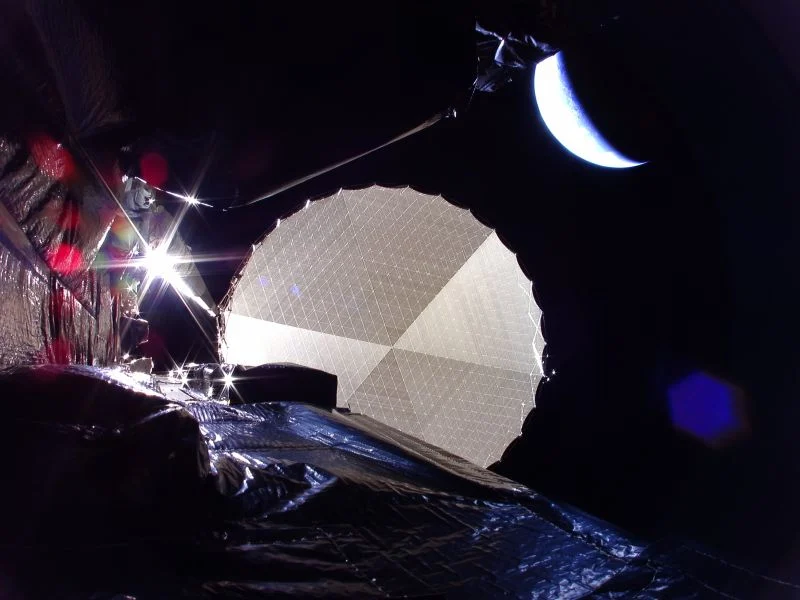
In a significant milestone for space-based telecommunications infrastructure, L3Harris Technologies has officially confirmed the successful in-orbit deployment of its premier perimeter truss reflector. The hardware, integrated into the ViaSat-3 Flight 3 satellite, was launched into space by SpaceX in late April. This deployment marks a critical advancement in the satellite’s ability to provide high-capacity broadband services across the Asia-Pacific region, further solidifying the capabilities of Viasat’s ambitious trio of Geostationary Orbit (GEO) satellites.
The successful unfurling of the reflector—a complex, high-precision engineering feat—represents a paradigm shift in how large-aperture antennas are packaged and deployed in the harsh vacuum of space. By combining miniaturized stowage with high-gain performance, L3Harris is effectively redefining the limits of satellite broadband throughput.
The Main Facts: A Leap in Antenna Engineering
The ViaSat-3 program is widely regarded as one of the most sophisticated efforts to bridge the global digital divide. The third satellite in this series is designed to deliver unprecedented data capacity to the Asia-Pacific theater. At the heart of its communication capability lies the L3Harris-manufactured perimeter truss reflector.
Unlike traditional solid reflectors, which are limited by the physical size of a launch vehicle’s fairing, the L3Harris perimeter truss reflector utilizes a deployable mesh architecture. This mesh surface is meticulously tensioned to create a parabolic shape capable of focusing Ka-Band signals with extreme precision.
The primary technical achievement here is the balance between size and efficiency. While the reflector provides a massive aperture necessary for high-throughput satellite (HTS) operations, it is engineered to be 30% more compact than industry-standard equivalents. This reduction in volume during the launch phase allows for more efficient payload configurations, enabling satellites to carry more fuel or additional mission-critical hardware without exceeding the constraints of the launch vehicle.
Chronology of the Mission
The journey to orbit and the subsequent activation of the reflector followed a rigorous, multi-stage timeline that highlights the complexity of modern satellite operations.
Pre-Launch Integration
Months prior to the April launch, the L3Harris reflector underwent extensive thermal vacuum (TVAC) testing and vibration simulation at the Viasat and integration facilities. Given that the reflector must deploy flawlessly after the intense acoustic and mechanical loads of a SpaceX Falcon Heavy or Falcon 9 launch, every joint, tether, and mesh segment was subjected to exhaustive stress analysis.
The April Launch
In late April, SpaceX successfully executed the launch mission. Following the initial orbital insertion, the ViaSat-3 satellite underwent a period of "bus checkout," during which the satellite’s propulsion systems and power arrays were stabilized.
Deployment Sequence
Once the satellite reached its designated operational altitude in GEO, the team initiated the deployment sequence. The perimeter truss reflector, which remains tightly stowed in a "folded" configuration during transit to avoid damage, was slowly extended using a series of synchronized motorized actuators. The unfolding process is a "one-shot" maneuver; there is no margin for error. L3Harris confirmed that the deployment was nominal, with the reflector locking into its operational geometry to form the required parabolic surface.
Ongoing Commissioning
Following the physical deployment, the satellite began the calibration phase. This involves aligning the antenna’s feed horns with the reflector’s focal point to ensure the signal beam is perfectly directed toward the designated coverage areas in the Asia-Pacific region.
Supporting Data: Why Surface Precision Matters
To understand the magnitude of this achievement, one must look at the physics of Ka-Band communications. Ka-Band operates at high frequencies, which are highly sensitive to surface irregularities. Any deviation in the reflector’s curvature—even by a few millimeters—can result in signal scattering, leading to reduced data rates and increased latency.
The Engineering Advantage
- Aperture Size vs. Weight: By utilizing a perimeter truss design, L3Harris has maximized the "gain" of the antenna. Gain is a measure of an antenna’s ability to direct radio waves in a specific direction. Higher gain means the satellite can communicate with smaller, less expensive user terminals on the ground.
- Surface Accuracy: L3Harris’s proprietary mesh technology is designed to maintain its shape under the varying thermal conditions of space. As the satellite moves in and out of the Earth’s shadow, it experiences wild temperature swings. The perimeter truss is designed to compensate for thermal expansion and contraction, ensuring the mesh remains taut and accurate.
- The 30% Compactness Factor: The reduction in stowage volume by 30% is not merely a space-saving metric; it is a financial and operational one. It allows operators to launch larger aperture systems on smaller, more cost-effective rockets, or conversely, to fit larger antennas into standard fairings than were previously possible.
Official Responses: Insights from L3Harris Leadership
The success of the deployment was met with significant enthusiasm from the engineering teams at L3Harris. Nate Krejca, the general manager of Mission Critical RF at L3Harris, emphasized the long-term implications of this hardware for the broader satellite industry.
"This reflector is 30% more compact than the industry standard perimeter truss reflectors while maintaining exceptional surface precision," Krejca stated. "Focusing signals with near-perfect accuracy is the cornerstone of our design philosophy. By maximizing data capacity, we are directly enabling superior broadband performance for users who, until now, may have been underserved by traditional terrestrial or satellite networks."
Krejca’s comments underscore a shift in the satellite manufacturing sector: the transition from "good enough" performance to "high-precision" performance as the demand for high-definition streaming, cloud computing, and real-time data access continues to surge globally.
Implications: A New Era for Asia-Pacific Connectivity
The deployment of the ViaSat-3 Flight 3 reflector has far-reaching implications for the telecommunications landscape in the Asia-Pacific region.
1. Closing the Digital Divide
The Asia-Pacific region is characterized by diverse topography, ranging from dense urban centers to remote islands and mountainous terrain. Providing reliable, high-speed broadband via fiber-optic cable is often economically unfeasible in these regions. The high-capacity capabilities of the ViaSat-3 satellite, powered by the L3Harris reflector, offer a viable, immediate solution for connecting these isolated populations.
2. Market Competitiveness
The success of this mission elevates L3Harris’s position in the global satellite supply chain. As competition between satellite operators intensifies, the ability to provide more data per megahertz of spectrum is the ultimate competitive advantage. Operators now have a proven hardware solution that enhances their business case, potentially lowering the cost-per-bit for end-users.
3. Future-Proofing Satellite Design
The success of this compact, high-precision reflector design sets a new industry benchmark. As we look toward the future—with the rise of LEO (Low Earth Orbit) mega-constellations and advanced GEO satellites—the demand for foldable, lightweight, yet highly accurate antennas will only grow. L3Harris has demonstrated that it can scale its perimeter truss technology to meet the demands of a modern, data-hungry world.
4. Technical Reliability and Risk Mitigation
For Viasat, the successful deployment of this reflector is a risk-mitigation victory. The failure of a primary antenna deployment is a "mission-ending" event for any communications satellite. The fact that the L3Harris system functioned exactly as predicted validates the extensive testing protocols and digital twin simulations used in the design process. It provides confidence for future iterations of the ViaSat-3 series and other similar missions relying on high-gain aperture technology.
Conclusion
The successful deployment of the L3Harris perimeter truss reflector on the ViaSat-3 Flight 3 satellite is more than just a successful engineering exercise; it is a vital step toward a more connected world. By optimizing the physical structure of the antenna to achieve unprecedented accuracy and compactness, L3Harris has provided a crucial link in the chain that will bring high-capacity broadband to the Asia-Pacific region.
As the satellite begins its operational life, the eyes of the aerospace industry will be on the performance metrics returned from orbit. If the early data holds true, this technology may become the new standard for GEO satellite missions, effectively raising the ceiling on what satellite-based communication can achieve. Through the marriage of cutting-edge materials science and precision mechanical engineering, L3Harris Technologies has once again proven that the most critical innovations in telecommunications often occur in the silent, vacuum-sealed reaches of space.