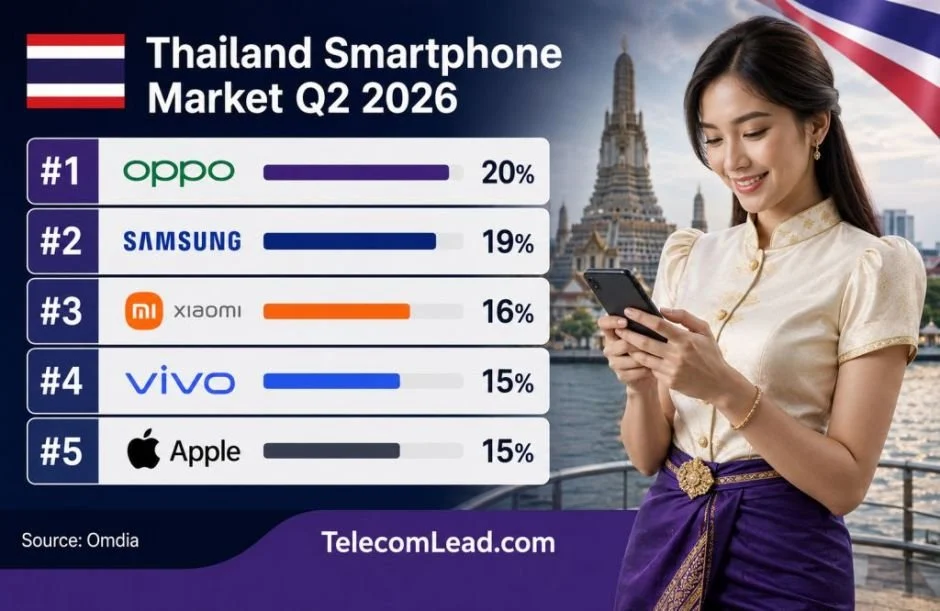
Bangkok, Thailand – August 15, 2026 – The Thai smartphone market has solidified its reputation as one of Southeast Asia’s most intensely competitive landscapes. In the second quarter of 2026, the top five vendors were separated by a mere five percentage points, showcasing a fiercely contested battle for market share. OPPO emerged victorious, clinching the top spot with a 20 percent shipment share, narrowly ahead of Samsung’s 19 percent. Xiaomi secured third place with 16 percent, while vivo and Apple found themselves in a tie for fourth, each holding a 15 percent share. This data, compiled by the renowned market research firm Omdia, paints a picture of a dynamic and highly balanced market where leadership can shift rapidly.
The dominance of these five players is undeniable, collectively accounting for a substantial 85 percent of Thailand’s smartphone shipments during the period. This leaves a relatively modest 15 percent for other significant brands such as HONOR, realme, Transsion, and a host of smaller players. The tight margins between the leading contenders highlight the effectiveness of their respective strategies and the discerning nature of the Thai consumer. OPPO’s lead over Samsung was a razor-thin one percentage point, with Samsung holding a three-point advantage over Xiaomi, underscoring the intense competition at every tier of the market.
Android Ascendancy and Chinese Influence
A significant trend emerging from the Q2 2026 data is the continued strength of Android-based vendors. OPPO, Samsung, Xiaomi, and vivo, all operating on the Android platform, combined to command an impressive 70 percent of the total shipments. This Android dominance is further amplified by the substantial influence of Chinese manufacturers. The three leading Chinese brands in the top five – OPPO, Xiaomi, and vivo – collectively controlled a commanding 51 percent of the market. This gives them a significant 32-percentage-point advantage over their closest Android competitor, Samsung, illustrating the formidable presence of Chinese innovation and market penetration in Thailand.
OPPO Secures a Narrow Victory Amidst Shifting Regional Fortunes
OPPO’s victory in Thailand, with a 20 percent market share, is a testament to a multifaceted approach that combines strong product portfolios, aggressive marketing, and a well-established distribution network. The company’s popular Reno and A-series smartphones continue to resonate with Thai consumers, supported by robust online promotional activities and attractive trade-in programs. These initiatives have proven effective in driving sales and solidifying OPPO’s leading position in this key Southeast Asian market.
However, OPPO’s performance in Thailand stands in stark contrast to its broader Southeast Asian trajectory. Regionally, OPPO experienced a significant downturn in shipments during Q2 2026, with a 41 percent drop to 3.1 million units. This decline led to a decrease in its overall Southeast Asian market share, falling from 21 percent in Q2 2025 to 16 percent in Q2 2026. This regional contraction is largely attributed to OPPO’s strategic withdrawal from the ultra-low-cost smartphone segment. Shipments in the sub-$100 price bracket plummeted by an astonishing 96 percent, and sales in the $100-$199 range saw a 25 percent decrease.
To mitigate the impact of these lower-volume entry-level sales, OPPO is strategically shifting its focus towards its more premium Reno smartphones. The Reno16 5G, priced at approximately THB 19,999 for the 8GB+256GB configuration, exemplifies this strategy. The company has deployed aggressive promotional campaigns for the Reno16 family, including discounts of up to THB 9,000. Further incentives, such as a THB 500 coupon, gifts valued at up to THB 3,798, and trade-in bonuses reaching THB 4,000 for the Reno16 F 5G, have been offered. When combined, these offers can provide a significant value proposition, though the exact eligibility and availability of each incentive may vary. This strategic pivot underscores OPPO’s effort to maintain its market standing by emphasizing higher-margin devices and leveraging promotional firepower to drive adoption.
Samsung: A Consistent Contender with Broad Market Appeal
Samsung, a perennial powerhouse in the global smartphone arena, secured a strong second position in Thailand with a 19 percent market share. Its proximity to OPPO, separated by just one percentage point, highlights its enduring appeal and comprehensive market coverage. Samsung’s success in Thailand can be attributed to its expansive product portfolio, which effectively spans entry-level devices, mainstream offerings, premium flagships, and the increasingly popular foldable segment. This broad approach allows Samsung to cater to a diverse range of consumer needs and price points, a significant advantage in a market as varied as Thailand’s.
While OPPO faced regional headwinds, Samsung maintained its standing as the largest smartphone vendor across Southeast Asia in Q2 2026. Despite a 11 percent decline in regional shipments, totaling 3.9 million units compared to 4.3 million in the previous year, Samsung managed to increase its overall market share from 17 percent to 20 percent. This gain is a direct result of its decline being less severe than that of many competitors, a testament to its resilient market position and strategic adjustments.
Samsung’s market share growth in specific price segments within Southeast Asia is particularly noteworthy. Its share of the $200-$299 category surged from 18 percent in Q2 2025 to an impressive 32 percent in Q2 2026, an increase of 14 percentage points. Omdia’s analysis indicates that Samsung has successfully gained share across the broader sub-$300 market, demonstrating its ability to attract consumers seeking value and performance in mid-range devices.
In Thailand, Samsung’s mid-range offerings like the Galaxy A27 5G, priced at THB 9,999, and the Galaxy A37 5G (8GB+256GB) at THB 13,999, provide compelling options for consumers. The THB 4,000 price difference between these two models offers clear upgrade paths. Beyond competitive pricing, Samsung is actively employing financing and ecosystem incentives to enhance affordability and customer loyalty. The Galaxy A37 5G is available with interest-free installments for up to 10 months, easing the financial burden for consumers. Furthermore, buyers of selected Galaxy devices can avail themselves of a significant 35 percent discount on the Galaxy Ring, reducing its price from THB 14,900 to THB 9,685, a saving of THB 5,215. These strategic initiatives demonstrate Samsung’s commitment to making its devices more accessible and integrated into the consumer’s lifestyle.
Xiaomi: Rising Average Selling Price Signals a Strategic Shift
Xiaomi secured the third spot in the Thai market with a 16 percent shipment share. While this places it four points behind OPPO and three points behind Samsung, its performance is characterized by a significant increase in its average selling price (ASP), which jumped by a remarkable 43.5 percent. This upward trend in ASP is a clear indicator of Xiaomi’s strategic pivot away from the ultra-low-cost segment towards higher-priced devices.
Across Southeast Asia, Xiaomi shipped 3.7 million smartphones in Q2 2026, a 21 percent decrease from 4.7 million units in Q2 2025. Despite this volume reduction, its regional market share remained steady at 19 percent. The substantial increase in its ASP is the second-highest rise among the top five vendors in the region. This rise is fueled by a significant decline in sub-$100 shipments, which fell by 69 percent, coupled with a robust 55 percent increase in shipments within the $100-$199 price bracket. This data clearly illustrates Xiaomi’s deliberate move to focus on its Redmi, POCO, and higher-tier Xiaomi branded devices, targeting consumers willing to spend more for enhanced features and performance.
The Xiaomi 17T, a key model in this strategy, was launched in Thailand with introductory prices of THB 23,999 for the 12GB+256GB variant and THB 27,599 for the 12GB+512GB version. Aggressive promotional pricing subsequently reduced these to THB 19,999 and THB 22,999, respectively. The 256GB model saw a discount of THB 4,000 (approximately 17 percent), while the 512GB version was reduced by THB 4,600 (also about 17 percent). While these introductory discounts are instrumental in challenging OPPO and Samsung and stimulating demand for newer, higher-priced models, they also highlight the substantial promotional investment required to gain traction in an increasingly competitive market as device prices trend upwards.
vivo: Leveraging Operator Partnerships for Growth
vivo captured a respectable 15 percent of Thailand’s smartphone shipments, a performance that places it in a tie with Apple and just one point behind Xiaomi. This market share in Thailand appears to be a bright spot for vivo, as its regional performance shows a different trend. Across Southeast Asia, vivo’s shipments declined by 26 percent to 2 million units in Q2 2026, compared to 2.8 million units a year prior. Its regional market share remained stable at 11 percent.
Similar to OPPO, vivo has significantly reduced its presence in the lowest price category. Its sub-$100 shipments experienced an 88 percent drop, now constituting only 5 percent of its total regional volume, a stark contrast to the 32 percent contribution in Q2 2025. This represents a substantial 27 percentage point decrease in the contribution from ultra-low-cost smartphones.
In Thailand, vivo is actively promoting its V70 5G model, which is priced at THB 17,999 for the 8GB+256GB variant, THB 19,999 for 12GB+256GB, and THB 23,999 for 12GB+512GB. This device boasts competitive features, including ZEISS cameras, a substantial 6,500mAh battery, and 90W fast charging, appealing to consumers seeking advanced mobile photography and power.
A key enabler of vivo’s growth in Thailand is its strategic utilization of operator subsidies. Through partnerships with mobile carriers like True, the vivo V70 5G is being offered from THB 12,499 when bundled with an eligible mobile package. This represents a significant upfront saving of THB 5,500, or approximately 31 percent, compared to the device-only price of THB 17,999. These operator-driven promotions play a crucial role in making vivo’s mid-range and higher-tier devices more accessible to a wider consumer base in Thailand.
Apple: Sustained Premium Demand Bolsters Market Share
Apple, a perennial leader in the premium smartphone segment, also secured a 15 percent market share in Thailand, mirroring vivo’s performance and tying for fourth place. This achievement is particularly significant given that the Thai market is largely dominated by Android vendors. Apple’s consistent share demonstrates the enduring strength of premium smartphone demand in the country, a segment where it operates with minimal direct competition from the Android players in the lower price bands.
The iPhone 17 starts at THB 29,900 in Thailand, positioning it at a considerable premium compared to other devices. For instance, it is THB 9,901 more expensive than the promotional price of the Xiaomi 17T (12GB+256GB). The iPhone 17e is available from THB 22,900, and the iPhone 16 starts at THB 26,900. Despite these higher price points, Apple leverages a combination of competitive trade-in offers and financing programs to make its devices more attainable. The company offers trade-in credits of up to THB 20,000 on eligible devices, which can cover approximately 67 percent of the starting price of an iPhone 17.
Apple’s competitive edge in the Thai market, and indeed globally, lies not only in its premium hardware but also in its robust ecosystem, seamless operating system support, and attractive financing options. These factors are critical for its success, as Apple does not directly engage with the ultra-low-cost price segments where many of its Android rivals derive significant volume. The continued demand for iPhones at these premium price points underscores the aspirational value and brand loyalty associated with Apple products in Thailand.
Regional Downturn Masks Thailand’s Fierce Competition
The intense competition observed in Thailand is occurring against the backdrop of a significant regional downturn in smartphone shipments. Southeast Asian smartphone shipments experienced a sharp 23 percent year-on-year decline in Q2 2026, plummeting to 19.3 million units from 25 million units in Q2 2025, representing a loss of approximately 5.7 million quarterly shipments.
Despite this volume contraction, the market value for smartphones in Southeast Asia reached $6.6 billion, driven by a substantial 31 percent increase in the average selling price (ASP), which rose to $342. This suggests that while fewer devices are being sold, consumers are opting for more expensive models, contributing to a higher overall market value. The $100-$199 price segment saw its contribution to regional shipments increase from 32 percent to 39 percent, indicating a growing demand for mid-range devices.
Looking ahead, Omdia forecasts a further decline in Southeast Asian shipments, projecting a 25 percent contraction to 75.3 million units for the full year 2026. This implies a potential reduction of approximately 25.1 million shipments from the 2025 market of around 100.4 million devices.
In conclusion, Thailand’s smartphone market stands out for its remarkable balance and intense competition. While OPPO currently holds a narrow lead, the landscape is incredibly fluid. Samsung’s consistent performance and broad appeal, Xiaomi’s strategic shift towards higher ASPs, vivo’s effective use of operator partnerships, and Apple’s sustained demand in the premium segment all contribute to a dynamic market where leadership can change hands quickly. The Thai consumer’s discerning choices and the vendors’ adaptive strategies will continue to shape this vibrant and closely watched market in the months and years to come.