
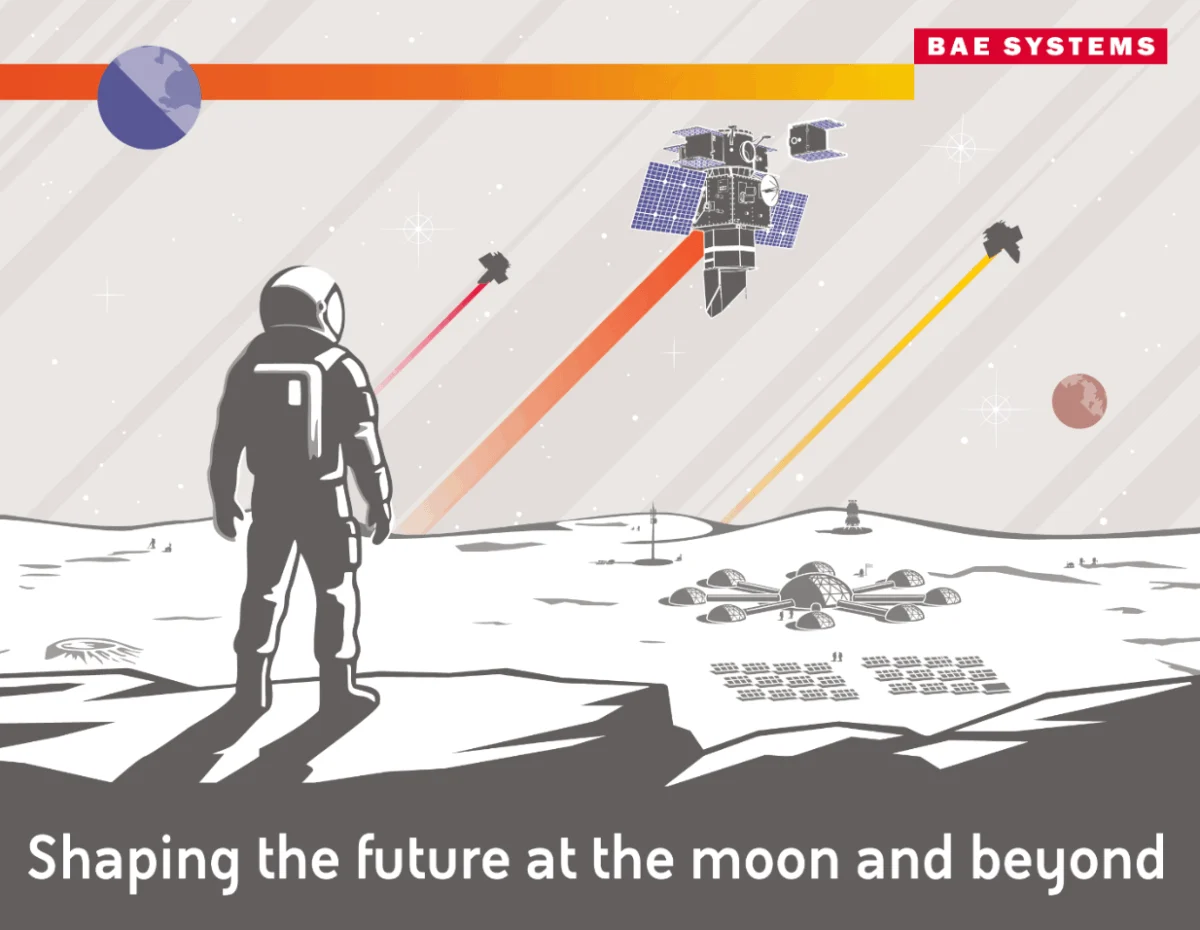
The global space race has entered a transformative new phase. Decades after the historic Apollo 11 landing in 1969, which secured the United States a profound scientific and strategic national security advantage, the focus has shifted from temporary exploration to permanent infrastructure. Today, the United States and its commercial partners are laying the groundwork for a sustainable cislunar economy—the economic and orbital sphere spanning the region between Earth and the Moon.
Achieving this vision requires a delicate balance of legacy expertise and cutting-edge commercial agility. BAE Systems, a major player in aerospace and defense, is positioning itself at the center of this transition. By developing highly maneuverable spacecraft, state-of-the-art lunar instruments, and recruiting a cross-disciplinary workforce, the company aims to ensure the U.S. maintains its competitive edge in deep space.
Main Facts: The Shift to Cislunar Space and BAE’s Strategic Pivot
As NASA advances its Artemis program, the strategic value of cislunar space has become a primary national security and economic priority. Unlike Low Earth Orbit (LEO), which is crowded with commercial communications and imaging satellites, cislunar space represents an uncharted operational environment. Navigating and operating in this region presents unprecedented challenges, including extreme thermal variations, intense radiation, and complex gravitational dynamics.
To address these challenges, BAE Systems has introduced several key initiatives:
- The Ascent™ Spacecraft: The newest addition to BAE Systems’ Elevation™ product line, designed specifically for dynamic space operations. Unlike traditional, single-use satellites, the Ascent spacecraft features high-thrust propulsion and refueling capabilities, allowing it to perform complex maneuvers, transport multiple rideshare payloads, and support long-duration missions in deep space.
- Surface-Ready Lunar Instruments: BAE Systems is adapting its proven Earth-orbiting spectral imaging technologies for the harsh lunar surface. This includes developing specialized instrument suites for the University of Colorado’s L-CIRiS mission and NASA’s LunarVISE mission.
- A Holistic Recruitment Drive: Recognizing that cislunar operations require unprecedented levels of autonomy, BAE Systems is actively recruiting talent from outside the traditional aerospace sector—including software developers, machine learning experts, and automotive engineers—to solve complex systems-level engineering challenges.
Chronology: BAE Systems’ Deep-Space Legacy
BAE Systems’ current cislunar endeavors are built upon a multi-decade foundation of successful deep-space, planetary, and astronomical missions. The company’s methodical approach to space systems engineering is illustrated by a timeline of key milestones:
2004: Deep Impact
BAE Systems contributed to the landmark Deep Impact spacecraft. Launched to study the composition of the interior of comet Tempel 1, the mission successfully released an "impactor" into the comet’s nucleus, providing scientists with the first-ever look beneath the surface of a comet and proving BAE’s capability to support high-precision, deep-space interception missions.
2006: Mars Reconnaissance Orbiter (MRO)
Since entering Martian orbit in 2006, the MRO has revolutionized our understanding of the Red Planet. BAE Systems’ technology has supported this long-lived spacecraft, which continues to provide high-resolution mapping of the Martian surface and acts as a vital communication relay for landers and rovers on the ground.
2009: Kepler Space Telescope
Designed to survey a portion of our region of the Milky Way to discover Earth-size exoplanets, the Kepler Space Telescope relied on BAE Systems’ technological contributions. Before its retirement, Kepler confirmed 2,662 exoplanets, fundamentally altering humanity’s understanding of the prevalence of planetary systems in the universe.
Present: James Webb Space Telescope (JWST)
As the largest, most powerful, and most complex space telescope ever launched, the JWST operates at the second Lagrange point (L2), deep in space. BAE Systems played a critical role in the development of the telescope’s advanced technologies, helping to enable the precise optical alignments and cryogenic operations necessary to capture the earliest stars and galaxies.
Future (August 2026): Nancy Grace Roman Space Telescope
Scheduled for launch in late summer 2026, the Nancy Grace Roman Space Telescope will feature a field of view 100 times greater than that of the Hubble Space Telescope. BAE Systems is actively contributing to this mission, which aims to unravel the mysteries of dark energy, dark matter, and the habitability of distant exoplanets.
[2004: Deep Impact] ---> [2006: Mars Reconnaissance Orbiter] ---> [2009: Kepler Space Telescope] ---> [Present: James Webb] ---> [2026: Nancy Grace Roman]Supporting Data: Technical Innovation and the Cislunar Economy
The transition from scientific exploration to a robust cislunar economy is backed by significant technical and market data. Industry analysts project that the cislunar economy—encompassing lunar mining, satellite refueling, space tourism, and deep-space communications—could generate hundreds of billions of dollars in revenue over the coming decades.
To capture this market, spacecraft must be designed with high levels of operational flexibility. The technical specifications of BAE Systems’ latest offerings reflect this shift:
The Ascent™ Spacecraft Architecture
Traditional satellites are launch-and-leave assets with fixed lifespans determined by their onboard fuel capacity. The Ascent spacecraft, part of the Elevation™ line, is engineered to break this paradigm:
- Maneuverability: Equipped with high-thrust propulsion systems optimized for the deep gravity wells of the Earth-Moon system.
- Refuelability: Built with standardized interfaces to allow in-space refueling, dramatically extending the operational lifespan of the vehicle.
- Payload Versatility: Designed to carry multiple rideshare payloads, reducing the cost of entry for scientific institutions and commercial entities seeking access to lunar orbit.
Spectral Imaging on the Lunar Surface
To map resources like water ice, which can be processed into rocket fuel, precision instrumentation is vital. BAE Systems is adapting its proven Earth-imaging systems for two key lunar missions:
| Mission | Primary Partner | Scientific Objective | BAE Systems’ Contribution |
|---|---|---|---|
| L-CIRiS | University of Colorado Boulder | Thermal infrared imaging of the lunar south pole to map regolith composition and temperature variations. | Highly ruggedized spectral imaging instrument suite adapted for the Moon’s extreme temperature swings. |
| LunarVISE | NASA | Exploration of the Gruithuisen Domes to study rare, non-basaltic volcanic activity on the lunar surface. | Advanced spectroscopic instruments designed to analyze chemical and mineral compositions under harsh radiation. |
Official Responses: Perspectives from Industry Leaders
Leaders from both the public and private sectors emphasize that returning to the Moon is not merely a repeat of the Apollo era, but a stepping stone toward Mars and a theater for global competition.
During a press conference, key space exploration figures emphasized the broader purpose of these costly endeavors.
"I am often asked why we send our astronauts into such a harsh, dangerous, unforgiving environment as space or the lunar surface and at such great cost," noted space exploration leader Jared Isaacman during a May press briefing. "We go for the technology we will pioneer to get there, the science and all we might learn that will make life better back on Earth… and to be very clear, to master the skills for where we will inevitably go next."
BAE Systems executives emphasize that achieving these grand ambitions requires a highly capable industrial base.
"Making that dream a reality will require commercial partners that have proven experience, advanced technology and skilled workers," said John Troeltzsch, Exploration Architect at BAE Systems. "That formula can help the United States maintain its competitive advantage in space."
Troeltzsch also warned that the U.S. is not alone in its lunar ambitions:
"We are in a global competition, and we need to address that. Other countries have well-stated goals and an aggressive timeline that they’re following to accomplish them. It’s exciting to see our customers match that tempo and set forth on a U.S. program to go explore the moon."
Addressing the technical challenges of maintaining a permanent presence on the Moon, Troeltzsch added:
"When you think about day-to-day operations on a moon base, you need some level of autonomy. That requires more computing and really good communications back to Earth."
Christie Bertels, BAE Systems’ Director of Civil Space Business Development, highlighted the necessity of building a diverse, cross-functional workforce to tackle these multi-disciplinary challenges:
"We’re trying to solve the biggest problems we’ve ever tried to solve in space. To do that successfully, you need systems-level thinking experts across disciplines. Space companies who hire engineers and technicians also need to hire business experts, scientists and marketing and communications people. Cislunar exploration is a cross-functional problem, and you need to be able to approach that problem holistically. So, we at BAE Systems are hiring!"
Bertels drew a direct parallel to the historic excitement of the mid-20th century:
"For me, it harkens back to the Apollo era. There’s just so much opportunity right now. For a new person coming into this company or this industry, it’s impossible not to be inspired. We’re building things that will help the United States take the next big leap in space and send humans to Mars someday."
Implications: Geopolitics, Security, and Workforce Evolution
The rapid development of cislunar capabilities carries profound long-term implications across several domains:
1. Geopolitical and Strategic Dominance
Cislunar space is increasingly viewed as the "ultimate high ground" in military and strategic terms. The nation or coalition that establishes the dominant infrastructure in cislunar space—including communications networks, positioning systems, and refueling depots—will dictate the rules of engagement for deep-space transit. With rival nations actively pursuing their own lunar exploration timelines, the speed at which U.S. commercial partners can deploy reliable spacecraft like BAE’s Ascent is directly tied to national security.
2. The Commercialization of Deep Space
The deployment of multi-payload transport vehicles and advanced spectral imaging tools will lower the barrier to entry for commercial space enterprises. By identifying water ice and other volatile resources via instruments like L-CIRiS, private entities can begin planning for "in-situ resource utilization" (ISRU). This will enable the manufacturing of fuel and building materials directly on the Moon, eliminating the incredibly high cost of launching those materials from Earth’s deep gravity well.
3. A Paradigm Shift in Aerospace Recruitment
The complexity of autonomous space operations is changing the face of the aerospace workforce. BAE Systems’ strategy of recruiting mid-career professionals from non-traditional backgrounds, such as the automotive and commercial software sectors, highlights a broader trend. Modern spacecraft are increasingly software-defined. Consequently, skills in machine learning, edge computing, astrodynamics, and autonomous systems are becoming just as vital as traditional aerospace structural engineering.
By offering comprehensive training, mentorship, and a clear sense of purpose, defense and aerospace contractors are positioning themselves to capture top-tier tech talent, bridging the gap between Silicon Valley innovation and deep-space mission assurance.
4. The Stepping Stone to Mars
Ultimately, the technologies pioneered for the cislunar economy are the exact capabilities required for crewed missions to Mars. By mastering autonomous operations, in-space refueling, and long-duration life support on and around the Moon, humanity is building the operational playbook for the multi-year journey to the Red Planet. BAE Systems’ current portfolio represents a critical link in this developmental chain, turning the science fiction of deep-space exploration into a sustainable, industrialized reality.