
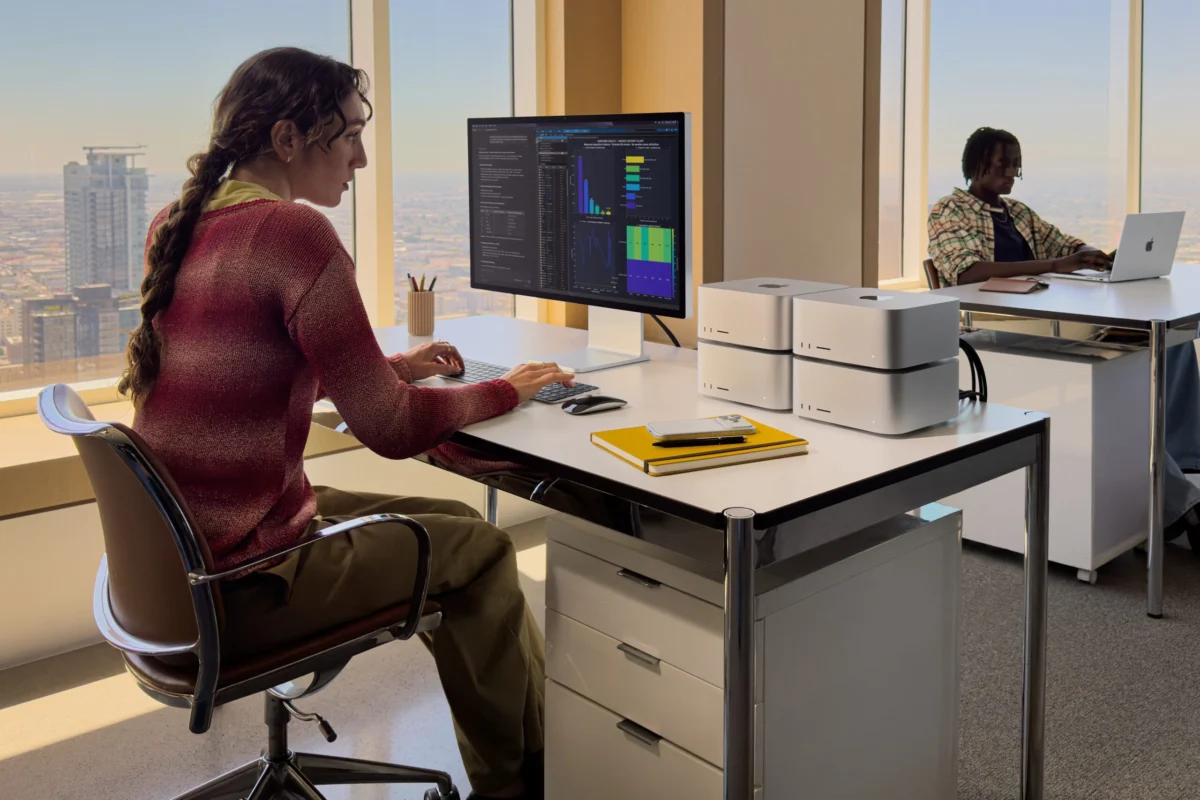
In an era where personal computing has shifted from general-purpose utility to specialized, compute-heavy workflows, Apple’s latest iteration of the Mac Studio stands as a testament to the power of vertical integration. The M5 Ultra-powered Mac Studio is not merely a computer; it is an architectural marvel designed to redefine the boundaries of what a workstation can achieve. While its predecessor, the M3 Ultra, was already an industry leader, the M5 Ultra represents a paradigm shift in AI development, professional video production, and high-fidelity rendering.
Main Facts: A Symphony of Hardware and Silicon
At its core, the Mac Studio remains a deceptively small, 7.7-inch square aluminum enclosure, standing 3.7 inches tall. Yet, within this compact footprint resides the M5 Ultra chip, a quad-die monster built on Apple’s advanced UltraFusion architecture. The test unit provided for this evaluation—a top-tier configuration—boasts a 36-core CPU, an 80-core GPU, 256GB of unified memory, and 4TB of blazing-fast SSD storage.
The I/O capabilities are equally formidable. The front panel offers two USB-C ports and an SDXC card slot, while the rear is a connectivity powerhouse featuring four Thunderbolt 5 ports, two USB-A ports, 10Gb Ethernet, HDMI, and a high-impedance headphone jack. With support for up to eight 6K displays at 60Hz, or four Pro Display XDR units, the machine is designed to serve as the beating heart of high-end production studios. Perhaps most critically for the film and television industry, Apple has introduced native genlock support over USB-C, allowing the machine to synchronize frame rates precisely with professional cinema cameras.
The Chronology of Apple Silicon
To understand the magnitude of the M5 Ultra, one must view it within the timeline of Apple’s silicon journey. Since the transition away from Intel in 2020, Apple has moved with clinical precision.
- 2020: The M1 chip launched, proving that ARM architecture could outperform legacy desktop processors.
- 2022: The M1 Ultra introduced the UltraFusion interconnect, allowing two M1 Max dies to function as one, effectively doubling performance metrics.
- 2023–2024: The M2 and M3 Ultra iterations refined efficiency and neural processing, cementing the Mac Studio’s place as the gold standard for independent creative professionals.
- 2025: The M5 Ultra arrives. It represents a 4.3x increase in AI performance compared to the M3 Ultra and a staggering 10x improvement over the original M1 Ultra.
This trajectory has been marked by a relentless focus on "Unified Memory"—a design philosophy where the RAM is physically integrated into the chip architecture. By eliminating the distance data must travel between the CPU, GPU, and memory, Apple has achieved a level of energy efficiency that is unrivaled in the high-performance computing (HPC) space.
Supporting Data: Benchmarking the Beast
The raw performance of the M5 Ultra is not merely theoretical; it manifests in real-world productivity. During our testing, we subjected the machine to a suite of synthetic and practical benchmarks.
Geekbench 7 & Cinebench Performance
In Geekbench 7, the M5 Ultra recorded scores that place it in a league of its own, particularly in multi-core processing and compute-heavy AI tasks. When compared to the M1 Ultra, the M5 Ultra shows a 1.3x improvement in CPU raw speed, a 1.8x boost in GPU rendering, and the aforementioned 4.3x jump in machine learning capabilities.
Storage Throughput
One of the most significant upgrades is the new storage controller. Using Blackmagic’s Disk Speed Test, we observed write speeds of 13,941 MB/s and read speeds of 11,350 MB/s. These figures are exactly double those of the previous generation, ensuring that the bottleneck in high-resolution video editing is essentially eliminated. The system can now handle up to 33 simultaneous streams of 8K ProRes video without requiring low-resolution proxy files, allowing for a fluid, real-time editing experience that was previously impossible.
Official Responses and Engineering Philosophy
Apple’s stance on the lack of user-serviceable components remains firm. When questioned about the non-upgradable RAM and SSD, company spokespeople reiterate that the current performance levels are only achievable because the memory is an intrinsic part of the Silicon-on-Chip (SoC) architecture.
"To separate the memory from the processor would be to introduce latency that we simply cannot accept," an internal source noted. By treating the entire machine as a single, cohesive unit, Apple achieves thermal efficiency that allows the Mac Studio to run virtually silent, even while performing tasks that would cause a traditional, air-cooled PC with a 900-watt power supply to spin its fans to maximum velocity.
For the professional, the trade-off is clear: you are buying a fixed-performance system that is optimized for its lifespan, rather than a modular system that requires constant tinkering.
Implications for the Industry
The release of the M5 Ultra Mac Studio has profound implications for the professional sector, specifically regarding the decentralization of AI.
The Rise of Local AI
For years, the industry believed that large-scale AI development required massive server farms or cloud-based GPU clusters. The M5 Ultra challenges this. By providing massive memory bandwidth and high-performance neural accelerators in a desktop unit, Apple is enabling engineers to train and run complex LLMs (Large Language Models) locally. This is a massive boon for data privacy and intellectual property, as sensitive corporate data never needs to leave the local network.
The "Headless" Revolution
We tested the Mac Studio in a "headless" configuration—running it remotely via VNC while using a separate, lower-power machine for input. The performance remained flawless. This suggests that the Mac Studio is perfectly positioned to serve as a high-end data server or an AI "vibe-coding" engine that sits in a closet or rack, providing massive compute power to a team of remote or local users.
The Cost of Excellence
At a retail price of $12,299 for the top-spec model, the Mac Studio is not a mass-market device. It is a tool for professionals—video editors, AI developers, and 3D animators—whose time is literally measured in dollars. For these users, the efficiency and speed of the M5 Ultra translate to saved hours, fewer render errors, and the ability to handle projects that were previously too demanding.
However, for the casual user or even the creative hobbyist, the M5 Ultra is undeniably "over-specced." The machine sits at the bleeding edge of current technology, and for those who are not bottlenecked by their current M3-based workflows, the upgrade cycle may not be immediate.
Conclusion: Is the Titan Worth the Price?
The M5 Ultra Mac Studio is a masterclass in engineering. It is quiet, incredibly power-efficient, and holds performance metrics that make it the undisputed king of the desk. While it lacks the modularity that some enthusiasts crave, it replaces that flexibility with raw, optimized power.
If you are a professional operating in the high-stakes world of 8K video, machine learning, or complex 3D simulation, the Mac Studio is not just an expense—it is a competitive advantage. It is a bicycle for the mind, built with enough horsepower to launch a small startup. For everyone else, it remains a tantalizing glimpse into the future of computing: a future where the hardware disappears, and only the performance remains.