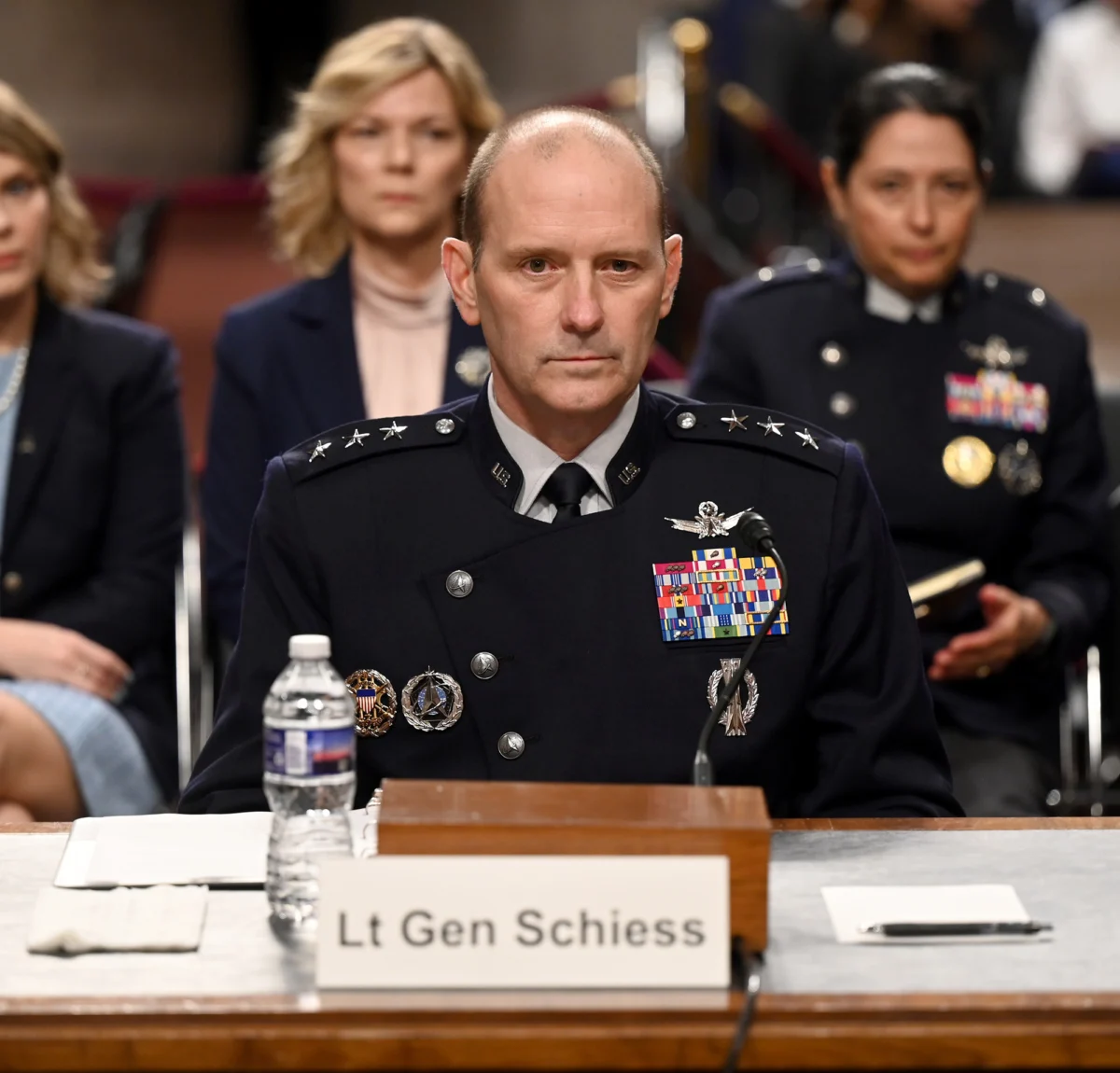
WASHINGTON — In a move that solidifies the leadership of the United States military’s youngest branch during a period of escalating orbital tension, the U.S. Senate on August 6 confirmed Lieutenant General Douglas Schiess as the next Chief of Space Operations (CSO).
Schiess, a seasoned 34-year veteran of missile operations and military spaceflight, will succeed General Chance Saltzman as the Space Force’s top uniformed officer and its representative on the Joint Chiefs of Staff.
Schiess takes command of the six-year-old service at a critical strategic juncture. The Space Force is pivoting from its initial administrative setup to a highly active, combat-ready posture. This transition is fueled by projected budget expansions, a rapid increase in personnel, and an evolving mission set designed to counter the aggressive military space programs of near-peer adversaries, most notably China and Russia.
Main Facts of the Senate Confirmation
The confirmation of Lt. Gen. Douglas Schiess marks a transition in the stewardship of the U.S. Space Force. As the third Chief of Space Operations, Schiess inherits an agency that has successfully established its institutional foundation but now faces the daunting task of operationalizing its capabilities in a highly contested domain.
Key Details of the Transition:
The Appointment: Lt. Gen. Douglas Schiess, currently the Space Force’s Deputy Chief of Space Operations for Operations, has been promoted to four-star general and confirmed as the 3rd Chief of Space Operations.
The Predecessor: He succeeds Gen. Chance Saltzman, who is retiring after 35 years of distinguished military service.
The Mandate: Schiess is tasked with overseeing a massive influx of capital and personnel to field next-generation satellite architectures, secure military communications, and deploy cutting-edge missile warning and tracking systems.
The Strategic Threat: The leadership change comes amid warnings from intelligence and defense officials that China is deploying space-based counter-weapons and surveillance systems at an unprecedented rate.
During his confirmation hearing before the Senate Armed Services Committee on July 16, 2026, Schiess made it clear that the Space Force’s primary focus must shift from organizational establishment to rapid capability deployment.
"It will be the honor of my professional career to lead the Guardians of the United States Space Force," Schiess told the committee. "I will work tirelessly to ensure our Guardians are ready, our capabilities are resilient, our partnerships remain strong, and our service is worthy of the trust placed in us by the American people."
Chronology of a Space-Faring Career
Lt. Gen. Schiess’s career reflects the evolution of modern American military space operations. Spanning more than three decades, his path from a silo-bound missile officer to the head of the Space Force highlights the military’s broader shift from treating space as a passive support domain to recognizing it as an active combat theatre.
[1992] Commissioned as an Air Force Missile Officer
   │
[2010s] Transitioned to Military Launch, GPS, and Satellite Communications
   │
[2015–2017] Commanded the 45th Space Wing (Cape Canaveral)
   │
[2018–2020] Commanded the 21st Space Wing (Missile Warning & Space Surveillance)
   │
[2023–2025] Served as Commander of U.S. Space Forces-Space (S4S)
   │
[Late 2025] Appointed Deputy Chief of Space Operations for Operations
   │
[July 16, 2026] Testified before the Senate Armed Services Committee
   │
[August 6, 2026] Confirmed by the U.S. Senate as the 3rd Chief of Space Operations
Early Career and Tactical Roots
Schiess began his military career 34 years ago as an Air Force missile officer, pulling shifts in underground launch control centers. During this period, the military’s space operations were primarily focused on strategic nuclear deterrence and maintaining baseline satellite communications.
Wing Command and Operational Leadership
As the strategic importance of space grew, Schiess transitioned into orbital operations, mastering military launch logistics, Global Positioning System (GPS) management, and satellite communications (SATCOM). He held several critical operational commands:
The 45th Space Wing (Cape Canaveral, Florida): Schiess managed eastern range launch operations, coordinating both military and commercial launches during the early years of the commercial space boom.
The 21st Space Wing (Peterson Air Force Base, Colorado): Here, Schiess oversaw the military’s premier missile warning and space situational awareness systems, tracking thousands of orbital objects and monitoring global ballistic missile threats.
Executive and Joint Operations Roles
Prior to his confirmation as CSO, Schiess served as the commander of U.S. Space Forces-Space (S4S). In this role, he was responsible for presenting trained and equipped space forces to U.S. Space Command, the unified combatant command responsible for military operations in outer space. In late 2025, he was elevated to Deputy Chief of Space Operations for Operations, placing him at the center of the service’s daily global operations and preparing him for the top job.
Supporting Data: The Strategic and Technological Pivot
Schiess assumes leadership at a time when the Space Force is restructuring its technological assets to counter threats from foreign adversaries. The traditional paradigm of relying on a small number of extremely expensive, highly capable, but vulnerable satellites in Geostationary Orbit (GEO) is being replaced by a resilient, distributed model.
Legacy Space Architecture                Modern Proliferated Architecture
┌──────────────────────────┐             ┌──────────────────────────┐
│  • Few, large satellites │             │  • Hundreds of small sats│
│  • Geostationary Orbit   │     VS      │  • Low Earth Orbit (LEO) │
│  • High-value targets    │             │  • Redundant & resilient │
│  • Multi-year build time │             │  • Rapidly replaceable   │
└──────────────────────────┘             └──────────────────────────┘
The Near-Peer Threat Landscape
In his testimony before Congress, Schiess emphasized that the speed of China’s military space expansion is "breathtakingly fast." Beijing has deployed an array of counterspace technologies designed to disrupt, degrade, or destroy American orbital assets. These threats include:
Direct-Ascent Anti-Satellite (DA-ASAT) Missiles: Ground-launched missiles designed to destroy satellites in Low Earth Orbit (LEO).
Co-Orbital Interceptors: Satellites equipped with robotic arms or kinetic payloads designed to disable American spacecraft.
Electronic and Cyber Warfare: Ground-based jammers and cyber capabilities targeting satellite control links and GPS signals.
Hypersonic Tracking Networks: Advanced space-based sensors designed to track hypersonic glide vehicles, bypassing traditional radar networks.
The Shift to Proliferated Architectures
To counter these threats, the Space Force is investing heavily in proliferated Low Earth Orbit (pLEO) constellations. Rather than relying on a single "exquisite" satellite that would be a high-value target in a conflict, the service is deploying hundreds of smaller, cheaper, and interconnected satellites. If an adversary destroys one node in a pLEO constellation, the network automatically reroutes data, ensuring uninterrupted communications and tracking.
The Commercial Dilemma and Government Boundaries
A key focus of Schiess’s leadership will be integrating commercial space capabilities into military operations. The Space Force has increasingly relied on private launch providers, commercial satellite communication networks, and private space-domain awareness services.
However, during his confirmation hearing, Schiess established a clear boundary regarding offensive capabilities:
"We must defend our nation’s space capabilities so that the Joint Force can project power; we must protect the Joint Force from space-enabled attack; and we must deliver the capabilities that the Joint Force needs to prosecute the full range of its missions."
While endorsing the expanded use of commercial communication and tracking networks, Schiess argued that any spacecraft capable of offensive military operations or active defense must remain under direct government ownership and control. This policy ensures that the legal and strategic responsibilities of kinetic or non-kinetic space combat remain strictly within the chain of command.
Official Responses and Bipartisan Alignment
The confirmation of Lt. Gen. Schiess was met with widespread approval from defense officials, highlighting a consensus on the direction of the Space Force.
Air Force Secretary Troy Meink expressed strong confidence in Schiess’s ability to accelerate the deployment of next-generation defense systems:
"I am incredibly pleased with the Senate’s confirmation of Lieutenant General Doug Schiess as our next Chief of Space Operations. He will lead the service as it accelerates the delivery of next-generation military space capabilities."
Outgoing Chief of Space Operations, Gen. Chance Saltzman, also praised his successor, highlighting the depth of experience Schiess brings to the office:
"Doug is an exceptional leader who has been at the forefront of our national security space efforts for decades. He possesses the strategic vision, operational expertise, and deep commitment to our Guardians required to lead the Space Force into its next chapter."
Members of the Senate Armed Services Committee from both parties also voiced support for Schiess, noting that his operational background is well-suited to handle the growing threats in LEO and GEO orbits.
Implications for Global Space Warfare and Joint Operations
The appointment of Lt. Gen. Schiess will have significant implications for the future of joint military operations, defense procurement, and international deterrence.
Under Schiess, the Space Force is expected to accelerate its organizational overhaul, particularly within its acquisition branch. The service is restructuring its purchasing pipeline around mission-focused Portfolio Acquisition Executives (PAEs). This change aims to eliminate bureaucratic silos, allowing the Space Force to acquire and field new technologies in months rather than decades. By aligning procurement with specific operational missions—such as missile tracking or tactical communications—Schiess aims to keep pace with rapid commercial innovation.
2. Protecting the Joint Force
Modern military operations rely heavily on space-based assets. Precision-guided munitions, troop movements, drone operations, and carrier strike groups all depend on GPS and satellite communications.
Schiess’s mandate extends beyond defending satellites; he must also protect ground, air, and naval forces from space-enabled attacks. This involves developing capabilities to disrupt adversary reconnaissance and targeting satellites, ensuring that U.S. and allied forces can operate globally without being constantly monitored from above.
3. Strengthening Strategic Deterrence
By building resilient orbital architectures and demonstrating a credible capability to defend them, the Space Force aims to deter adversaries from launching attacks in space. If an adversary realizes that attacking American satellites will not disrupt U.S. military communications, the strategic incentive to launch a space strike is greatly reduced.
Furthermore, Schiess is expected to deepen integration with international allies, including the United Kingdom, Australia, Japan, and NATO partners, to build a collective security framework for the space domain.
As Lt. Gen. Douglas Schiess steps into his role as the third Chief of Space Operations, he takes charge of a service that has successfully transitioned from its initial setup phase to an active operational force. With strong support from Congress, defense leadership, and the joint force, Schiess is positioned to guide the Space Force through a critical period of technological advancement and strategic competition, ensuring that the United States maintains its edge in space.