In the rapidly evolving landscape of artificial intelligence, a common narrative persists: the path to a high-paying, high-impact career is a linear climb up a singular mountain. However, after more than a thousand mentoring sessions with data science students, the reality is far more nuanced. Many aspiring professionals arrive with a burning motivation but lack a coherent map. They conflate the roles of machine learning engineers, research scientists, and data product managers, often chasing the wrong skill sets for the wrong goals. This misalignment doesn’t just waste time; it often leads to burnout and a total pivot away from the field entirely.
AI is not a monolithic profession. It is a vast ecosystem that spans complex mathematical research, rigorous software engineering, and strategic problem-solving. To succeed, one must stop chasing a "fictional average" role and start aligning their career path with their innate strengths, background, and tolerance for technical depth.
The Reality of "AI Careers": Beyond the Buzzwords
The confusion surrounding AI career titles is not entirely the fault of the applicant. The industry is currently in a state of rapid definition. A job description for an "AI Engineer" at one firm might involve fine-tuning Large Language Models (LLMs), while at another, it might simply involve stitching together API calls to create a basic chatbot.
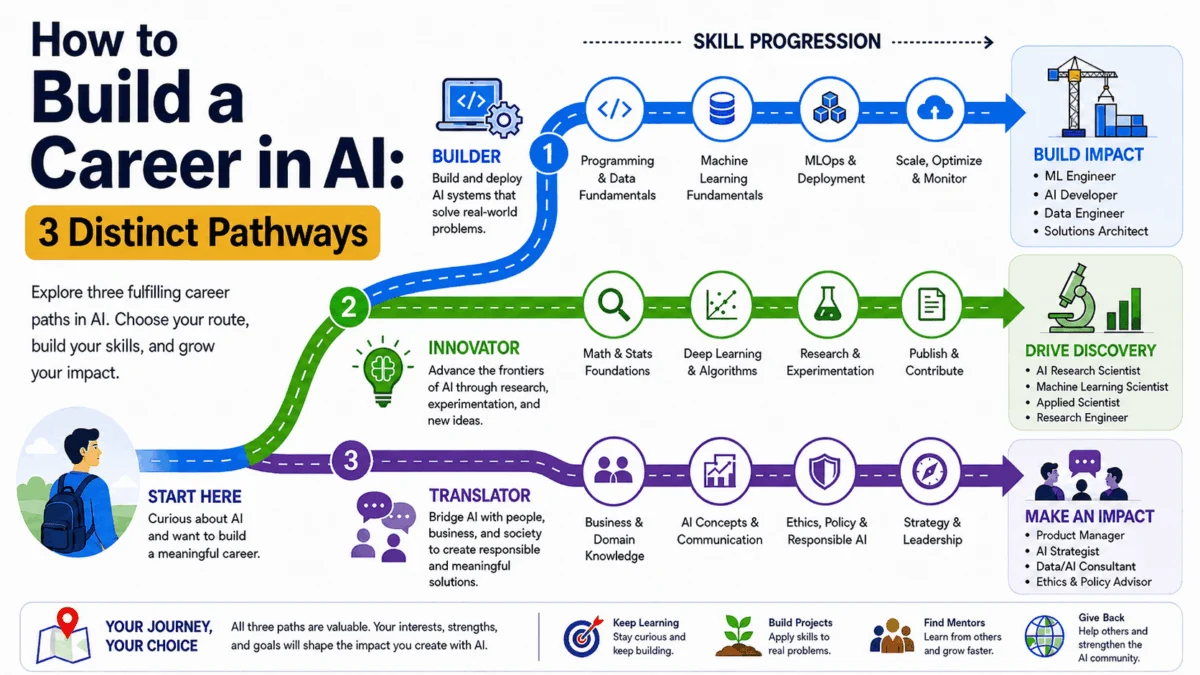
Because companies attach the same titles to vastly different functional requirements, students frequently optimize for a generic, non-existent "ideal" role. This leads to a common failure pattern: candidates who possess deep theoretical knowledge but cannot deploy a model, or conversely, those who can use off-the-shelf tools but lack the underlying logic to troubleshoot them when they fail. Before committing to a multi-year learning plan, candidates must categorize themselves into one of three distinct orientations: The Builder, The Innovator, or The Translator.
Pathway 1: The Builder (Engineering and Deployment)
The Builder is the backbone of the AI industry. These professionals are responsible for taking experimental models—often crafted in notebooks—and transforming them into robust, scalable, and reliable systems.
The Core Objective
Builders focus on writing clean, production-grade code, architecting data pipelines, and maintaining system stability. If you find satisfaction in solving logical puzzles and seeing the direct, tangible impact of the code you ship, this path is your natural home.
The Common Pitfall: Engineering Over Theory
The most frequent mistake I encounter is the belief that being a Builder requires inventing new algorithms. In reality, this role is 80% software engineering and 20% machine learning. I have mentored students with high-performing models who struggled to land jobs because they had never managed model versioning, monitored for data drift, or built a validation layer.
In the eyes of a hiring manager, a model that works on your laptop is a toy; a model that works in a containerized, monitored pipeline is a product. To succeed here, one must master:
- Languages: Python is the non-negotiable standard.
- Frameworks: Proficiency in
scikit-learnfor traditional ML andPyTorchfor deep learning. - Infrastructure: Familiarity with at least one major cloud platform (AWS, GCP, or Azure).
Pathway 2: The Innovator (Research and Science)
If the Builder’s mission is to deploy, the Innovator’s mission is to discover. Innovators work at the cutting edge, attempting to push the boundaries of what is mathematically possible.
The Core Objective
Innovators operate where existing tools end and uncertainty begins. Their work is built upon a foundation of linear algebra, probability, and optimization theory. This is the most academically demanding path and usually requires a high tolerance for abstract, non-linear thinking.
The Common Pitfall: Romanticizing the Research
A common error is to pursue this path simply because the headlines about "AGI" or "Foundation Models" are exciting. Fascination is a prerequisite, but it is not a strategy. Last year, I worked with several students who wanted to become research scientists but lacked the rigorous mathematical training required to read and implement modern research papers.
This path typically necessitates graduate-level study or an apprenticeship within a high-tier research lab. To test your appetite for this level of rigor, I suggest working through the DeepLearning.AI Machine Learning Specialization or the fast.ai courses. If you find yourself gravitating toward the "why" of the math rather than the "how" of the API, you are likely an Innovator.
Pathway 3: The Translator (Product, Strategy, and Ethics)
Often overlooked—and arguably the most critical role in the current market—is the Translator. As AI becomes ubiquitous, companies are realizing they have a surplus of engineers but a deficit of people who can bridge the gap between technical capability and business value.
The Core Objective
Translators possess "technical literacy." They do not need to write production-grade C++ or design neural architectures, but they must understand the limitations of AI: where it succeeds, where it fails, and the ethical risks inherent in deployment.
The Common Pitfall: The "Consolation Prize" Bias
There is an unfortunate cultural bias that views the Translator role as a "lesser" version of engineering. This is a profound error. In many organizations, the ability to identify which problems are solvable with AI—and which are not—is worth far more than the ability to train a model.
For instance, a healthcare professional transitioning into AI does not need to be a coding wizard; their deep domain expertise is an "unfair advantage." They can translate complex clinical needs into technical requirements that a Builder can then execute. If you have a background in business, law, design, or a domain-specific field, do not discard it. Use it to become a translator who brings AI to life in practical, high-value ways.
Implications for Career Planning
The most consistent mistake across a thousand mentorship sessions is choosing a path based on its perceived prestige rather than its fit. Career content often highlights the destination—the high salary, the high-profile company—without detailing the grueling, specialized route required to get there.
A Comparative Framework for Decision Making
| Feature | The Builder | The Innovator | The Translator |
|---|---|---|---|
| Primary Focus | Reliability & Scale | Discovery & Logic | Strategy & Application |
| Ideal Background | Computer Science | Math/Stats/Graduate CS | Domain Expertise/Business |
| Key Skill Set | Software Engineering | Advanced Mathematics | Product Sense/Literacy |
| Daily Work | Debugging/Deployment | Research/Experimentation | Communication/Planning |
Moving Forward: Choosing Your Path
The path you choose should be dictated by your starting point and your long-term goal.
- If you are a Builder: Focus on your engineering fundamentals. Learn how to write tests, build APIs, and manage infrastructure. Do not get distracted by the latest research paper if your deployment pipelines are shaky.
- If you are an Innovator: Prepare for the long haul. Invest in your mathematical maturity. You are not just learning to code; you are learning to contribute to a field that is still in its infancy.
- If you are a Translator: Focus on fluency. Use tools like the Hugging Face LLM Course to understand the capabilities and constraints of modern AI. Your value is in your ability to synthesize information and drive strategic decisions.
Final Thoughts
AI is a vast, open frontier. There is no single "right" way to build a career in this space. You can build the engine as a Builder, design the fuel as an Innovator, or steer the car as a Translator. The most successful professionals I have mentored are those who stopped treating these paths as interchangeable and instead leaned into their unique orientation.
Once you identify which path fits you, the noise of the industry fades. You stop chasing the "fictional average" and start building a tangible, sustainable career. Pick your path, commit to the process, and stay the course. The complexity of the field is the barrier to entry, but your clarity of purpose will be your greatest asset.