In the rapidly evolving landscape of Large Language Model (LLM) deployment, the quest for speed is relentless. As organizations and individual developers look to extract maximum utility from existing GPU infrastructure, the focus has shifted from merely scaling up hardware to refining the software stack. While techniques like quantization, kernel optimization, and specialized inference engines have become standard practice, a more sophisticated approach has emerged: speculative decoding.
Speculative decoding represents a paradigm shift in how we approach LLM generation. Instead of relying solely on a single, monolithic model to generate tokens sequentially—an inherently slow process due to memory bandwidth bottlenecks—speculative decoding employs a "draft-and-verify" strategy. By utilizing a smaller, faster draft model to predict a sequence of tokens, the primary model can then verify these candidates in parallel. This methodology effectively bypasses the serial constraints of traditional inference, significantly boosting throughput without requiring additional GPU clusters.
Among the latest advancements in this field is DSpark, a novel framework developed by DeepSeek. By integrating a parallel backbone with a lightweight sequential component, DSpark offers a sophisticated solution to the limitations of traditional speculative drafting.
The Mechanics of DSpark: Bridging Speed and Accuracy
To understand why DSpark is capturing the attention of the machine learning community, one must first look at the inherent trade-offs in speculative decoding. Traditional parallel drafting models are incredibly fast, as they predict entire blocks of tokens in a single pass. However, these models often suffer from a decline in accuracy; because the draft tokens are generated in parallel, they often lack the contextual awareness required to accurately predict the subsequent tokens in the sequence.
DSpark addresses this "context-blindness" by introducing a hybrid architecture. It combines a parallel drafting mechanism with a sequential component that allows later draft tokens to "attend" to the information generated by earlier predictions within the same block.
Key Technical Innovations
- Hybrid Architecture: By utilizing a parallel backbone for raw speed and a sequential component for context, DSpark maintains the high throughput of parallel generation while significantly improving the accuracy of its draft tokens.
- Confidence-Based Filtering: A standout feature of the DSpark implementation is its ability to estimate the likelihood of draft tokens surviving the verification process. By assigning confidence scores, the system can discard low-confidence candidates before they even reach the primary model. This prevents the "verification tax"—wasting precious compute cycles on tokens that are statistically unlikely to be accepted.
- Seamless Integration: DeepSeek’s integration into
llama.cppallows for dynamic thresholding, giving users the ability to tune the balance between drafting aggression and verification accuracy.
According to preliminary reports from DeepSeek, when deployed alongside the DeepSeek-V4 architecture, DSpark achieved a per-user generation speed improvement of 60% to 85% compared to their previous Multi-Token Prediction (MTP-1) baseline. While these figures represent enterprise-grade deployments, the question remains: how does this technology translate to the local, consumer-grade hardware utilized by developers and hobbyists?
Chronology of a Benchmark: Testing Qwen3-8B
To validate the efficacy of DSpark in a local environment, we conducted a controlled benchmark using the Qwen3-8B model. The objective was simple: establish a baseline for standard autoregressive inference and compare it against a DSpark-accelerated workflow on identical hardware.
Phase 1: Environment Setup and Tooling
The testing environment was built on a Linux-based workstation, ensuring the latest build of llama.cpp was compiled from source with full CUDA acceleration. The build process, utilizing cmake and build-essential, ensured that the target model could offload all layers to the GPU, minimizing latency between the host system and the compute device.
For the purpose of this experiment, we utilized the Qwen3-8B-Q4_K_M GGUF file for the target model and the dspark-Qwen3-8B-Q8_0 GGUF file for the draft model. The use of quantization (Q4 and Q8) is critical, as it mimics the typical constraints of local LLM users who must balance model size with available VRAM.
Phase 2: The Baseline Run
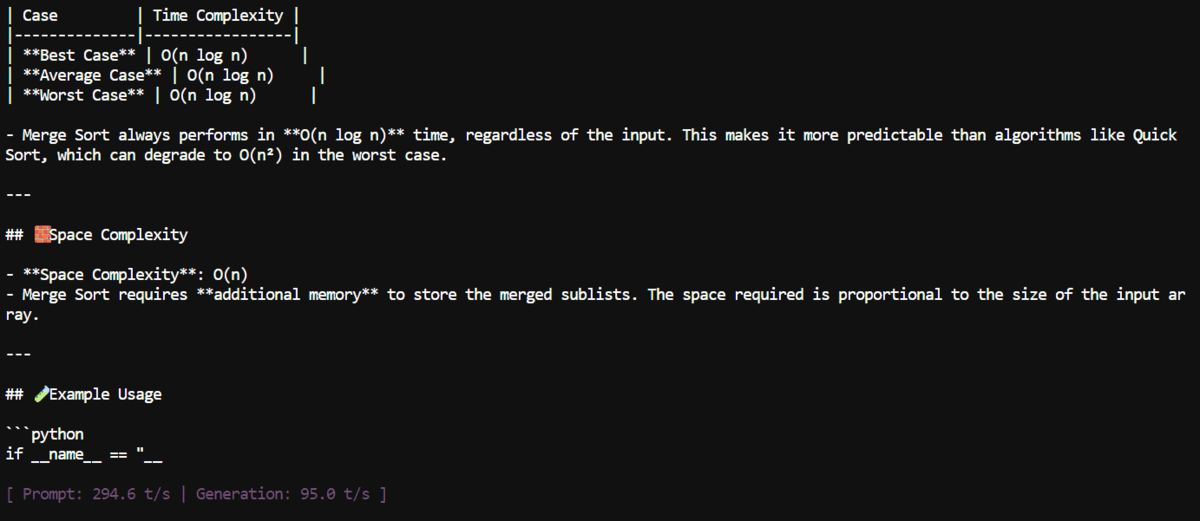
The baseline measurement was executed using llama-cli with a deterministic configuration (--temp 0 --top-k 1). By disabling creative sampling, we ensured that the generation path remained consistent across both the baseline and the DSpark test. The prompt was a complex request for a Python implementation of the merge sort algorithm, chosen for its requirement for both structural code generation and explanatory text.
The baseline result yielded a consistent 95.0 tokens per second (t/s). This serves as our control variable—the standard performance of an optimized 8B parameter model running on a modern GPU.
Phase 3: Activating DSpark
With the baseline established, we reran the exact same prompt using the DSpark draft model. The configuration included specific flags to enable speculative decoding: --spec-type draft-dspark and --spec-draft-n-max 3.

The results were immediate and measurable. The generation throughput jumped to 124.9 t/s. This represents a 31.5% increase in inference speed. While this falls short of the theoretical 85% improvement cited by DeepSeek in their enterprise deployment, it is a significant real-world gain for local users.
Supporting Data: Comparative Analysis
| Configuration | Prompt Speed (t/s) | Generation Speed (t/s) | Performance Gain |
|---|---|---|---|
| Qwen3-8B (Baseline) | 294.6 | 95.0 | – |
| Qwen3-8B + DSpark | 88.0 | 124.9 | +31.5% |
Note: While the prompt processing speed (the time taken to ingest the input) appeared lower in the DSpark run, the primary metric for LLM user experience—the autoregressive token generation speed—showed a clear, significant improvement.
Implications and Future Outlook
The data suggests that DSpark is a powerful tool in the arsenal of local LLM enthusiasts, yet it is not a "magic bullet" for all scenarios.
The MTP vs. DSpark Debate
While DSpark offers superior accuracy due to its sequential component, Multi-Token Prediction (MTP) remains the more ubiquitous and easier-to-implement standard. MTP is natively supported by a broader range of architectures, making it the "plug-and-play" choice for many developers. DSpark, by contrast, requires a specific, compatible draft model, which currently limits its reach.
However, the implications for the future of inference are clear: we are moving toward a tiered system of model execution. The "Drafting Model" vs. "Target Model" relationship allows for a more efficient utilization of VRAM and compute resources. As more model architectures adopt native support for DSpark-compatible drafting, we can expect the gap between "fast, imprecise" and "slow, precise" models to narrow.
Technical Limitations
The current implementation within llama.cpp is still in its infancy. Users may encounter stability issues or bugs when scaling the number of draft tokens (--spec-draft-n-max). Furthermore, the availability of specialized draft models remains the primary bottleneck. Until model repositories like Hugging Face are flooded with DSpark-ready drafts for every major LLM, the technology will likely remain a specialized tool for advanced users.
Conclusion
DSpark represents a sophisticated evolution in the quest for faster, more efficient LLM inference. By blending the raw throughput of parallel drafting with the contextual awareness of sequential modeling, it provides a measurable performance boost on standard consumer hardware.
For developers looking to squeeze the maximum possible performance out of their local deployments, DSpark is an essential technology to monitor. While MTP remains the current industry favorite for its simplicity, DSpark’s ability to "think" before it drafts makes it a superior candidate for complex, high-accuracy generation tasks. As the ecosystem matures and model support widens, we expect DSpark to become a cornerstone of local inference optimization.
About the Author
Abid Ali Awan is a certified data scientist and machine learning researcher. With a background in telecommunication engineering and technology management, Abid focuses on the practical application of AI, bridging the gap between theoretical research and real-world deployment. His current work explores the intersection of graph neural networks and mental health diagnostics.