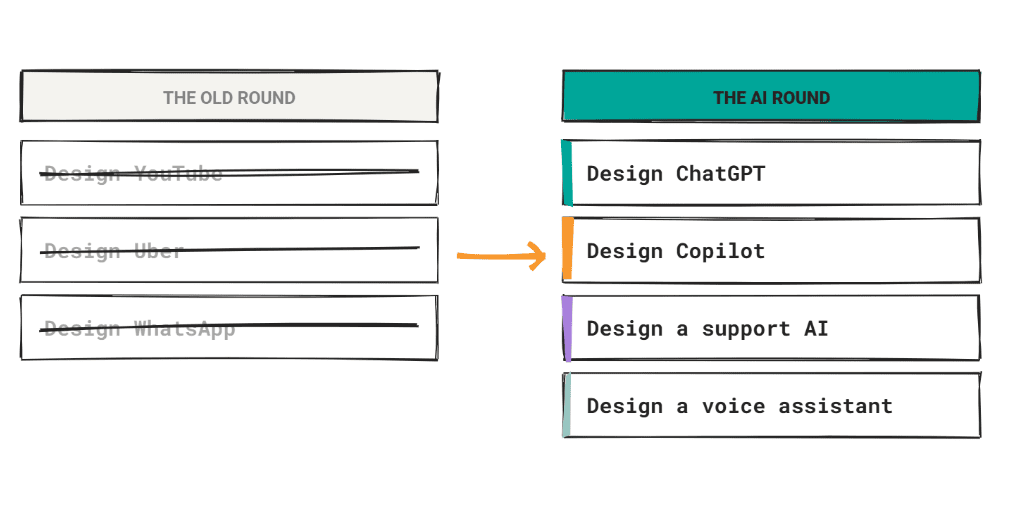
For nearly a decade, the gold standard of technical interviews was defined by the "Big Tech" staples: "Design YouTube," "Design Uber," or "Design WhatsApp." These challenges tested an engineer’s grasp of distributed systems, database sharding, and latency optimization. However, as the industry pivots toward an AI-first paradigm, the interview landscape has undergone a seismic shift. Today’s candidates for AI Engineer, Applied Scientist, and GenAI Engineer roles are no longer asked how to build a video streaming service; they are asked to design ChatGPT, build a customer support agent, architect GitHub Copilot, or construct a robust legal document assistant.
This transition marks a fundamental change in what it means to be a "systems engineer." It is no longer enough to simply know how to call an LLM API. Modern interviews demand that you explain the surrounding architecture, defend trade-offs under intense pressure, and design for the unique, probabilistic nature of Generative AI.
The Evolution of the Technical Interview
The rapid rise of AI hiring has reshaped the entire talent market. According to recent industry data, the role of "AI Engineer" has been ranked the #1 fastest-growing job in the United States for two consecutive years. In 2025 alone, job postings for AI-centric roles surged by 143% year-over-year. LinkedIn data corroborates this growth, showing that 75,000 new US-based AI and machine learning postings were added between 2023 and 2025, with the sector’s share of the total tech market rising from 10% to 50%.
This hiring explosion has moved the goalposts for technical interviews. The focus has shifted from deep, theoretical knowledge of model internals—which is now largely abstracted away by foundation model providers—toward "AI-first" software engineering. Current interview rounds center on how to integrate Large Language Models (LLMs) into production-grade products. This includes designing agentic loops, implementing sophisticated retrieval mechanisms, and managing the harsh economic realities of token-based pricing.
As noted by industry observers and recent interview candidates, the most frequent prompts in the 2025–2026 hiring cycle include designing document-based Q&A systems (RAG), voice assistants, and autonomous coding agents.
What Interviewers Are Actually Evaluating
The core of the modern AI system design interview is a move away from deterministic CRUD (Create, Read, Update, Delete) services toward probabilistic, cost-constrained systems. Unlike traditional systems where a specific input guarantees a predictable output, AI systems involve non-deterministic results.
Interviewers are looking for candidates who can navigate the "Four Horsemen" of AI architecture: Latency, Cost, Quality, and Safety. These factors often pull in opposite directions. A high-quality model might be too slow for real-time customer support, while a low-cost model might lack the reasoning capability required for complex document analysis.
Strong candidates differentiate themselves by explaining the "why" behind each architectural layer. Simply naming a vector database or a reranker is insufficient. A candidate must demonstrate why that specific component is necessary, what its failure modes are, and what the user experience would look like if that component were removed. Senior-level interview reports indicate that evaluators now prefer to drill down into 3–5 specific areas—such as how to handle a spike in hallucination rates or how to optimize a RAG pipeline—rather than taking a superficial pass over a broad range of topics.
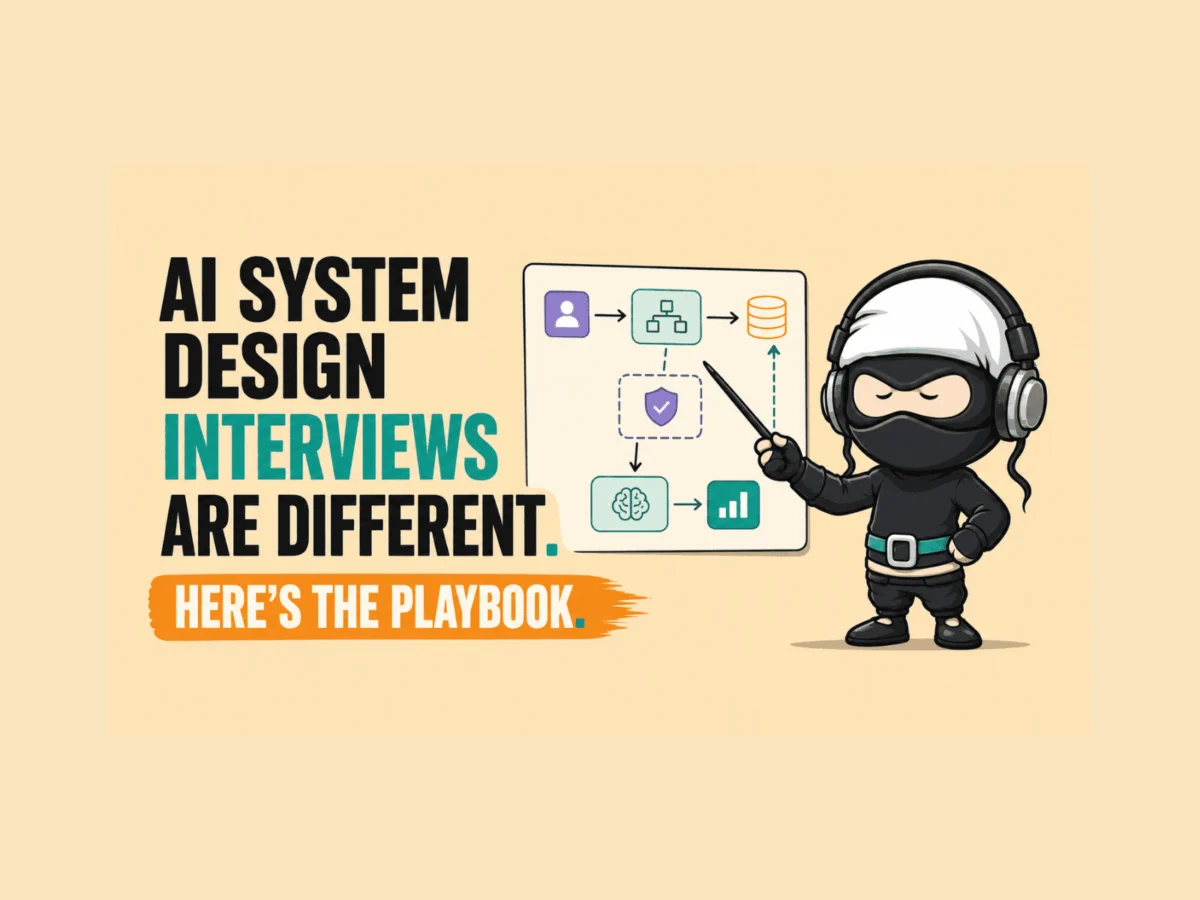
A Repeatable Seven-Step Framework
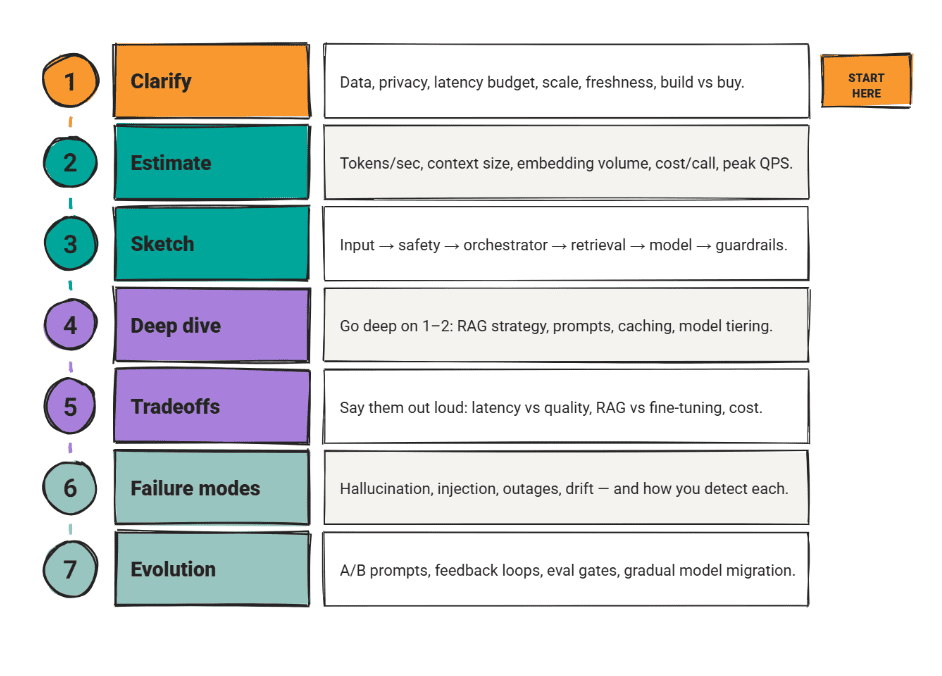
To move away from the trap of memorizing specific answers for every possible prompt, engineers should adopt a reusable, seven-step framework designed to address any AI system design problem:
- Clarify Requirements: Define the scope, user personas, and success metrics.
- Estimate Constraints: Calculate the required scale, throughput, and latency limits.
- Sketch the Architecture: Draw the high-level flow from intake to output.
- Deep Dive into Components: Analyze specific modules like retrieval, routing, or guardrails.
- Evaluate Trade-offs: Explicitly weigh the pros and cons of your chosen model, storage, and latency strategies.
- Plan for Failure: Discuss monitoring, observability, and "what went wrong" scenarios.
- Iterate and Evolve: Describe how the system will scale or improve over time.
The most common point of failure, according to recent feedback, is skipping the first step. Candidates who jump immediately into drawing boxes without first confirming the business requirements often find their design mismatched with the actual problem at hand.
Essential Primitives: The Building Blocks of AI
To succeed in these rounds, you must be able to draw, explain, and defend five core AI primitives:
1. Retrieval-Augmented Generation (RAG)
RAG is the backbone of modern enterprise AI. It involves a query encoder, a retriever that fetches context from a corpus, and a generator that produces a final answer. Production-grade RAG is far more complex than the tutorial version; it includes document chunking, embedding pipelines, vector retrieval, caching, and, crucially, access control to ensure users only see data they are authorized to access. When implemented correctly, RAG can reduce LLM hallucinations by 40% to 71%.
2. Model Routing
In an era where GPT-4-tier models can cost up to $30 per million output tokens, cost management is a technical requirement. A well-designed system uses a router to send routine, low-complexity requests to cheaper, smaller models, while reserving frontier models for tasks that require high-level reasoning. This "routing" strategy, combined with semantic caching and prompt compression, can cut operational costs by 40% to 70% without sacrificing user experience.
3. Guardrails
Safety is not an afterthought; it is an architectural layer. Pre-LLM guardrails handle input validation, PII (Personally Identifiable Information) redaction, and prompt-injection defense. Post-LLM guardrails manage output schema enforcement, refusal policies, and fact-checking against retrieved context. These layers, when properly integrated, can decrease the risk of hallucinations by nearly 90%.
4. Evaluation and Observability
"You cannot improve what you cannot measure." Effective AI systems log not just text, but model versions, tool traces, latency, and cost per request. By using prompt hashes rather than raw text, teams can perform offline "LLM-as-a-judge" evaluations to calibrate against ground truth, while simultaneously tracking online metrics like faithfulness and answer relevance.

5. Agentic Loops
For more complex tasks, you must understand the orchestration of agentic loops: request intake, context assembly, reasoning, action validation, sandboxed execution, and state updates. The key is separating concerns: the LLM handles reasoning, the orchestrator governs flow, the policy engine ensures safety, and the sandbox manages execution.
Real-World Architectures: The Case of GitHub Copilot
Naming a real-world system during an interview adds instant credibility. GitHub Copilot is the gold standard for this. It utilizes a "Fill-in-the-Middle" (FIM) technique, where the system extracts code surrounding the cursor, along with contextual metadata (imports, open files, language headers). This assembled prompt is then routed to a backend that filters for safety before passing it to the model. By citing this, you show you understand that modern AI systems are not just prompts; they are sophisticated data-flow pipelines.
Implications for the Future of Engineering
The shift toward AI system design reflects a broader change in the industry: the transition from building monolithic, rigid software to building dynamic, evolving, and sometimes unpredictable systems. The implications are clear: the next generation of engineers must be as comfortable with probabilistic outcomes as they are with binary code.

As companies continue to integrate generative capabilities, the ability to think critically about the "human-in-the-loop" and the "model-in-the-loop" will separate the developers from the architects. The interview is no longer about finding the "correct" answer; it is about demonstrating the ability to make intelligent, well-defended decisions in an environment where the rules are still being written.
In conclusion, mastering the AI system design interview is about internalizing a process, not a script. By focusing on the seven-step framework and mastering the five core primitives, candidates can transition from being intimidated by open-ended prompts to leading the conversation with confidence and clarity. Whether you are designing the next ChatGPT or a specialized internal tool, the fundamental principles of scale, cost, and safety remain the North Star of system architecture.