In the high-stakes world of machine learning, a "clean run" is often mistaken for a successful project. A data scientist might observe a validation score of 0.83, watch a Jupyter notebook execute from top to bottom without a single red error message, and push the model to production with total confidence. Yet, three weeks later, the model is providing useless predictions.
This is the central paradox of modern AI engineering: unlike traditional software development, where a bug typically manifests as a crash or a traceback, AI workflows are prone to "silent failures." These bugs are insidious because they are mathematically plausible. The APIs involved—from scikit-learn to PyTorch—will happily accept code that violates data, state, shape, or artifact contracts. The system does not crash; it simply calculates a result based on flawed logic, delivering a convincing number that masks a catastrophic underlying error.
The Anatomy of Silent Failures: A Crisis of Trust
The distinction between an "ordinary" Python bug and an AI workflow bug is the difference between a broken light switch and a miscalibrated compass. A broken switch leaves you in the dark; a miscalibrated compass leads you into the wilderness while telling you that you are heading due north.
In AI, a clean execution proves that the code ran, but it says nothing about what the pipeline learned, which rows influenced that learning, or whether the resulting artifact is actually portable. When these invisible errors occur, the "penalty" for the developer is not a stack trace—it is a production model that fails to generalize, drifts into obsolescence, or simply memorizes noise.
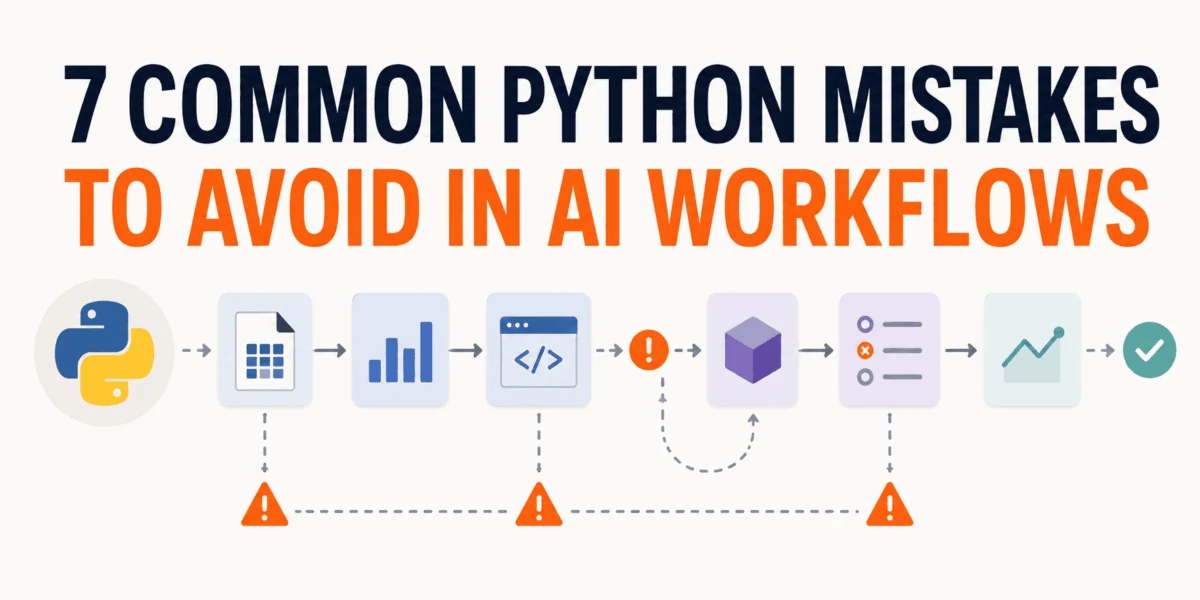
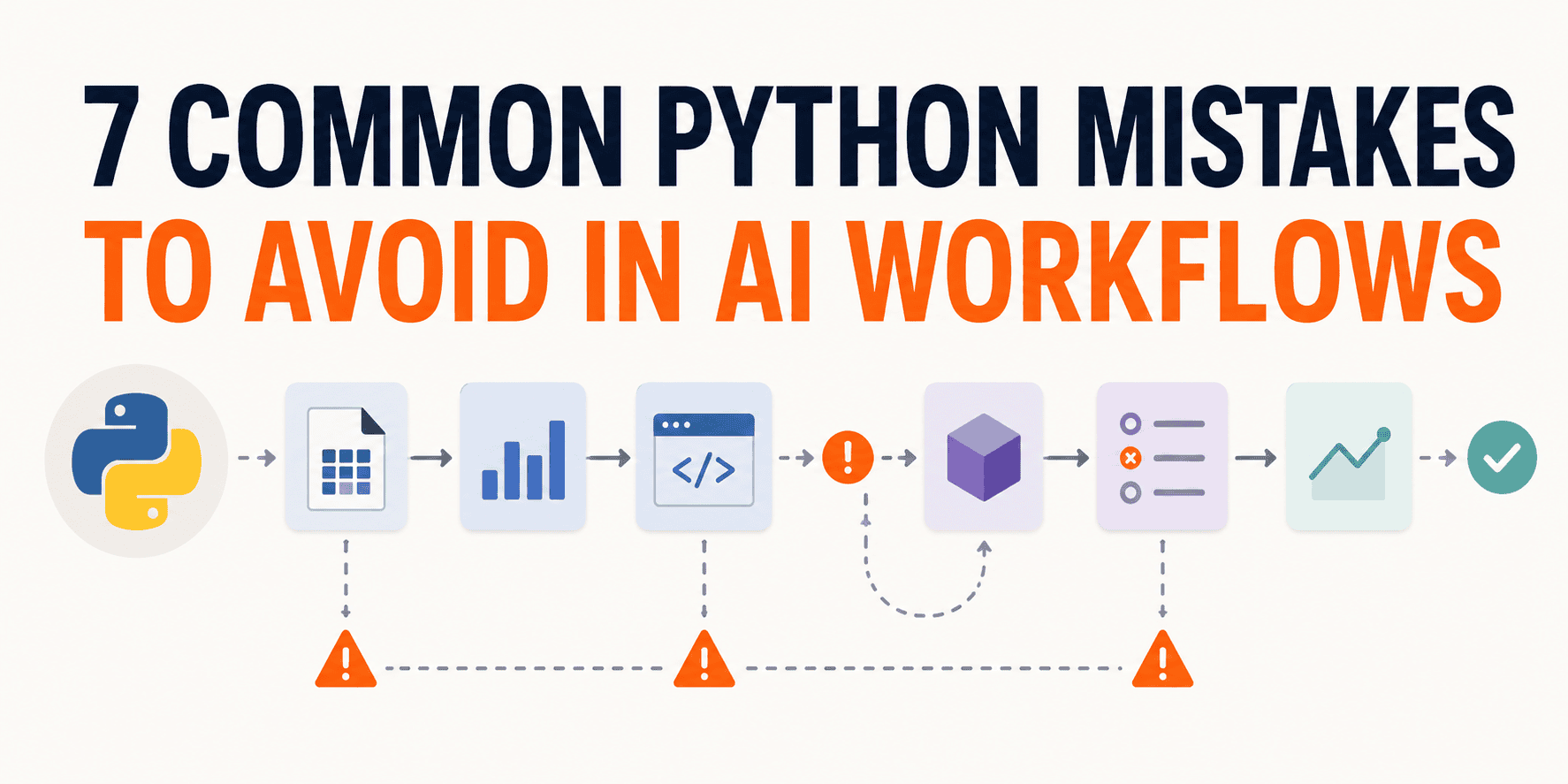
To mitigate this, developers must move from a mindset of "does it run?" to "does it adhere to the contract?" Below is a comprehensive breakdown of the seven most common silent mistakes that haunt AI workflows and the rigorous checks required to catch them.
1. Preprocessing Leakage: Fitting Before Splitting
The most common and damaging silent error is feature leakage. Many practitioners, in an attempt to simplify their code, perform preprocessing—such as scaling, imputation, or dimensionality reduction—on the entire dataset before splitting it into training and testing sets.
The Mechanism of Failure
When you perform a fit() operation on the entire dataset, the transformer "sees" the statistical properties (the mean, standard deviation, or distribution) of the rows that are intended for validation. Consequently, the model gains a "peek" into the future.
Demonstration:
Consider 100 samples of pure random noise with labels assigned by a coin flip. If you use SelectKBest to identify the "best" 20 features across the entire dataset before cross-validating, you will frequently see accuracy scores around 0.80+. This is pure statistical artifacting. By moving the selection inside a scikit-learn pipeline, where each fold fits its own transform only on the training portion, the accuracy drops to 0.49—the honest result for random noise.
The Fix:
- Locate every
fitandfit_transformcall in your codebase. - Explicitly define the rows visible at the moment of execution.
- Ensure that all transformations are encapsulated within a pipeline object that enforces the separation of training and testing data.
2. The Fallacy of Random Splitting in Non-Independent Data
Randomly shuffling data to create train/test splits is a standard procedure, but it is often inappropriate for real-world scenarios.
The Chronology of Bias
If your dataset contains multiple rows belonging to the same entity—such as a specific user, a patient, or a device—a random split will scatter that entity’s data across both the training and validation sets. The model, rather than learning to generalize, simply memorizes the characteristics of those specific entities.
In a synthetic test, a model might score 0.97 on a random split but plummet to 0.89 when using a GroupShuffleSplit. That eight-point gap represents "memorized credit" being refunded.
Supporting Data
- Grouped Data: Use
GroupKFoldorGroupShuffleSplitto ensure that all data from a single entity remains on one side of the split. - Time-Series Data: Use
TimeSeriesSplit. Randomly training on the future to predict the past is a common error that leads to impressive validation scores and immediate failure in live production environments.
3. The Skew of Two-Path Preprocessing
Skew occurs when the preprocessing logic used during training differs, even slightly, from the logic used during inference (serving).
The "Hand-Written" Trap
Developers often build a robust pipeline for training, but then write a quick, separate script for the production serving layer. If the serving function re-learns a scaler on a tiny, five-row batch instead of using the pre-fitted parameters from the training phase, the results will drift silently. A slight difference in feature ordering or handling of missing values can result in predictions that are statistically incoherent.
The Fix:
Ship the fitted pipeline object itself to the serving environment. Create a "fixture" test: pass a single, static input through both the training path and the production path. If the outputs are not identical down to the last decimal point, your serving path is compromised.
4. The Illusion of Reproducibility via Seeding
Setting random.seed(42) is a common habit, but it is often insufficient. Python’s random module, NumPy, and PyTorch all maintain separate random number generators. Seeding one does not guarantee that the others are deterministic.
Implications
True reproducibility is not a seeding problem; it is a recording problem. Even with perfectly seeded libraries, results can vary across hardware (CPU vs. GPU) or software versions. To truly ensure reproducibility, you must record:
- The specific seeds used.
- The exact data snapshot.
- The codebase version (Git hash).
- The complete environment configuration (dependencies and versions).
5. Evaluation State: eval() vs. no_grad()
In PyTorch, the confusion between model.eval() and torch.no_grad() is a frequent source of subtle performance degradation.
model.eval(): Switches layers like Dropout and Batch Normalization to inference mode. If you forget this, your model will behave as if it is still training, leading to stochastic, inconsistent results.torch.no_grad(): Stops the autograd engine from tracking gradients, which saves memory and computation.
The Official Response:
A standard validation loop should include both. Furthermore, after validation, the model must be explicitly switched back to model.train() to ensure that subsequent training epochs function correctly.
6. Broadcasting: The Silent Shape-Shifter
Broadcasting is a powerful feature in numerical computing, but it can be catastrophic when it hides a shape mismatch. If your prediction is shaped [batch, 1] and your target is [batch], many loss functions will silently broadcast the arrays into a [batch, batch] matrix.
This results in a "plausible" loss value that is calculated on the wrong computation. PyTorch may issue a UserWarning, but in many CI/CD pipelines, warnings are ignored. Your tests should be configured to promote these warnings to errors.
7. The Artifact Trust Crisis
Finally, treating a saved model file (a .pkl or .joblib file) as inert, safe data is a major security and reliability risk.
The Security Risk
Pickled models can execute arbitrary code upon loading. Never load an artifact from an untrusted source. Furthermore, library versioning is critical; scikit-learn generally does not support loading models saved under different versions of the library.
The Best Practice:
Every artifact must be accompanied by its "provenance"—the training recipe, the data reference, and the validation score. Before deploying, perform a "smoke test" in the actual serving environment: load the model and verify that a known input produces the expected output.
Conclusion: Making the Workflow Prove Its Boundaries
The silent failures of AI workflows are not just technical glitches; they are systemic risks. Because these errors do not announce themselves through crashes, the onus is on the practitioner to build "proofs" into the pipeline.
By asking four fundamental questions, developers can transition from blind confidence to verifiable trust:
- What did each step learn, and from which rows? (Preventing leakage).
- What code converts raw input at serving, and does it match the training contract? (Preventing skew).
- What state and shape reached the metric? (Preventing broadcasting and state errors).
- Which environment is trusted to load the artifact? (Preventing version and security issues).
A workflow that cannot answer these questions from recorded metadata is not a finished product—it is a promising guess waiting to fail. In the world of AI, silence is not golden; it is a sign that your model is likely lying to you.