By Ayswarya Ashok, Founder and CEO of Halleyx
The UK’s fibre narrative has, for the better part of a decade, been defined by a singular, heroic metric: homes passed. It is a story of heavy machinery, sub-sea cables, and the ambitious rollout of infrastructure that has now reached 24.9 million premises—an impressive 82% of the nation’s housing stock. With 47% of those homes already active on a full-fibre service and Ofcom projecting that 73% of UK homes will have access to at least two gigabit-capable networks by 2028, the industry is justifiably proud of its progress.
For years, the industry’s collective mantra has been, "Can we connect the home?" But as the initial land grab for national coverage begins to plateau, operators are discovering a harsh reality: for Multi-Dwelling Units (MDUs), simply connecting the building is only the beginning of the challenge.
The MDU Paradox: A Single Address, Hundreds of Realities
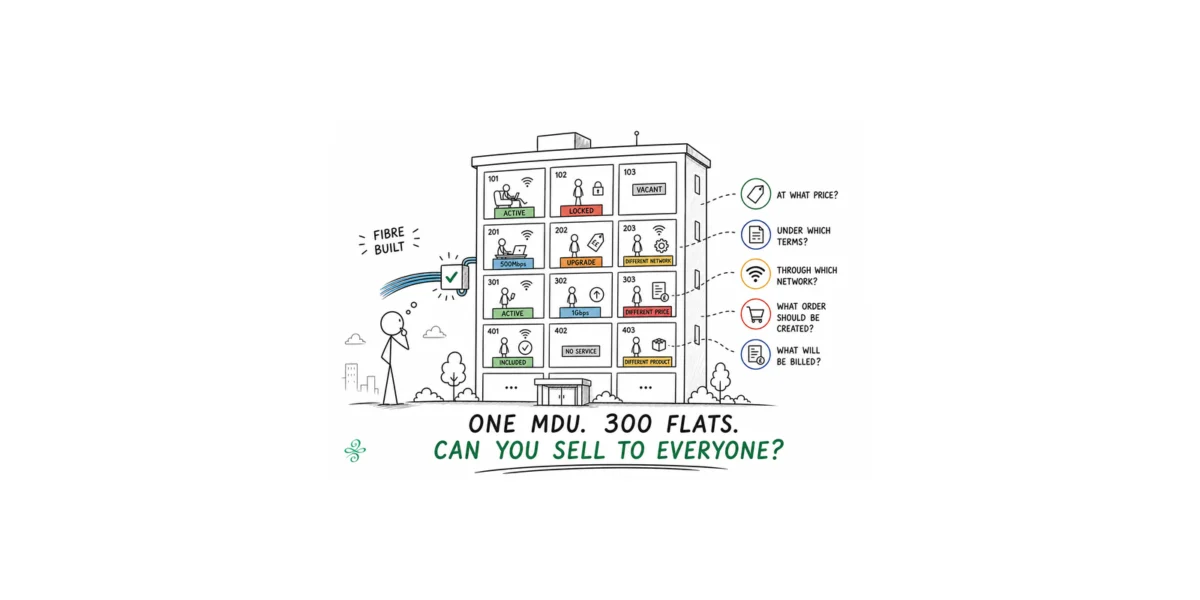
To a network planner, an apartment block is a single point on a map—a "premise" that counts toward the rollout target. However, in the commercial reality of a 300-unit apartment building, that single location actually represents 300 distinct, fluid, and often conflicting realities.
While the physical fibre may terminate in a basement cupboard or a riser, the commercial context of every unit is constantly in flux. In a single building, one unit may house a long-term subscriber, another may be vacant, a third might be subject to a specific building-wide wholesale agreement, and a fourth could be occupied by a resident demanding an immediate upgrade to 1Gbps.
The infrastructure remains static, but the commercial requirements are volatile. When we treat the building as the final unit of analysis, we fail to account for the complex, unit-level lifecycle that defines modern telecom profitability.
The Missing Link: Why Context Must Travel with the Unit
The current standard for telecom operational journeys follows a rigid, linear path: Customer → Product → Order → Service → Billing.
This model assumes a level of simplicity that rarely exists in high-density living. In an MDU, this linear path is interrupted by a foundational layer that the industry has largely ignored: Building → Unit → Customer.
The customer is, by definition, a temporary occupant of the unit. The unit, however, is a persistent asset. Currently, when a resident moves out of Flat 217, the operator’s system often treats the incoming resident as a blank slate. This is a profound error. The operator should already possess a deep "unit intelligence": the network availability, the specific building agreement in place, the eligible propositions, and the commercial rules governing that exact door.
When this context fails to travel with the unit, we create a vacuum where manual intervention becomes mandatory. If a new pricing rule or a network upgrade occurs at the building level, operators currently force their teams to manually reconcile hundreds of individual unit records to ensure compliance. This is not just inefficient; it is a fundamental design flaw in the BSS (Business Support Systems) of many modern fibre providers.
The Anatomy of an MDU Transaction: A Case Study
Consider the resident of Flat 217. They want to upgrade from 500Mbps to 1Gbps. In a well-oiled system, this should be a seamless digital transaction. In reality, it triggers a cascade of internal questions:
- Is this service eligible under the current building-wide agreement?
- Is the 1Gbps tier included in the existing contract, or does it trigger an add-on charge?
- Which network provider is responsible for the fulfillment in this specific building?
- Does this require a new order, or is it a modification of the current one?
- How should the billing system reflect the change?
If the operator cannot answer these questions automatically, they rely on human intervention—customer service agents, billing analysts, and provisioning engineers. Each touchpoint is a cost center, a potential failure point, and a source of friction that diminishes the value of the fibre connection.
Defining "MDU Ready" in the Modern Age
For too long, "MDU ready" has been a technical definition, not a commercial one. It has meant that the cable is pulled and the ONT (Optical Network Terminal) is blinking. I argue that true "MDU readiness" must be redefined as the ability to process a transaction without manual reconciliation.
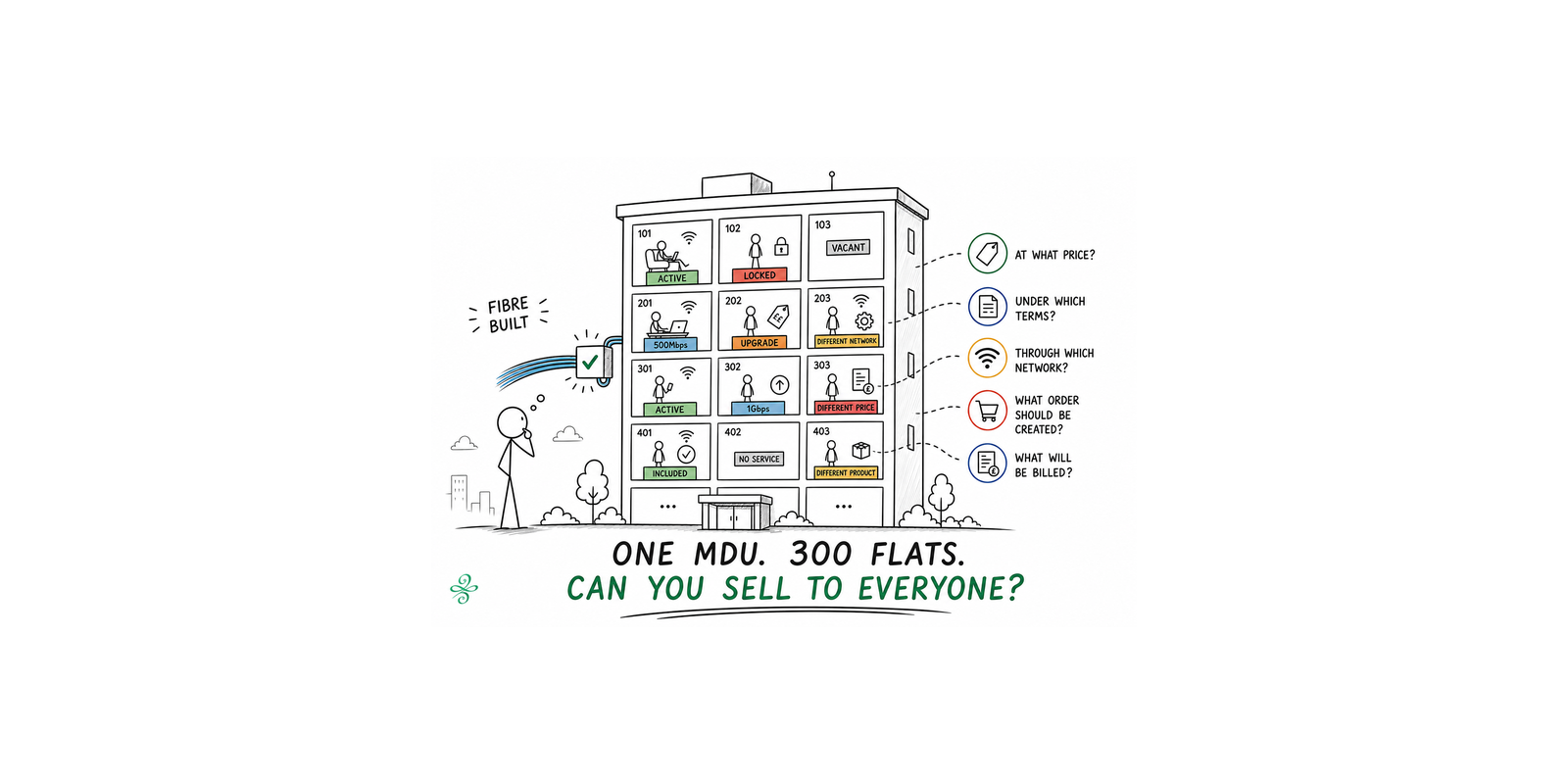
An operator is only truly "MDU ready" when they can take a specific unit and instantly determine:
- Eligibility: Can this product be sold to this unit?
- Pricing: What is the specific price point based on the building’s commercial terms?
- Governance: Which network path governs the delivery?
- Order Flow: What is the correct automated workflow to initiate?
- Billing: What is the downstream financial impact of this transaction?
This consistency must be maintained across the entire journey—from qualification and proposition to order, activation, and billing. If an operator cannot answer these questions at the click of a button, they are not managing a business; they are managing a series of manual workarounds.
Measuring Efficiency: The New Key Performance Indicators (KPIs)
As fibre availability ceases to be a primary differentiator, the battleground for the next phase of the UK fibre story will be operational efficiency. It is time for operators to shift their focus from "homes passed" to "unit-level operational friction."
Operators should begin tracking the following metrics:
- The Manual Override Rate: How many transactions require human intervention to complete?
- Order Correction Frequency: How many orders are flagged for error or manual adjustment?
- Qualification-to-Activation Latency: How long does it take for a unit to go from a commercial inquiry to an active, billable service?
- Billing Integrity: How many billing disputes can be traced back to a failure in the initial commercial decision-making process?
These KPIs tell the real story of how effectively a network converts physical availability into sustainable revenue.
Implications: The Competitive Advantage of Complexity
The UK fibre market is reaching a point of maturity where the "easy" wins are gone. The remaining premises are largely in harder-to-reach or more complex MDU environments. As competition intensifies, the companies that thrive will be those that have mastered the "business behind the network."
When every unit in a 300-home building can have a different customer, a different product, a different price, and a different network agreement, the ability to automate that complexity becomes a massive competitive advantage. It is the difference between a business that scales profitably and one that is crushed under the weight of its own operational overhead.
The Path Forward: A Call for BSS Innovation
The challenge of the MDU is not a lack of data; it is the fact that the data is siloed. The commercial context is not "travelling" with the unit. To solve this, the industry must pivot toward integrated, full-stack BSS solutions that bridge the gap between the physical network and the commercial front-end.
At Halleyx, we have seen firsthand that fibre operators should not have to stitch together multiple legacy systems—one for billing, one for provisioning, one for customer management—that were never designed for the granular complexities of MDU environments. A modern BSS must be designed to be flexible, easily adaptable, and, above all, built for the reality of fibre.
Conclusion: Making Every Unit Count
The "UK fibre story" is currently shifting from a construction project to a customer-retention and monetization project. The infrastructure is largely in place; now, it is time to optimize the business logic that runs on top of it.
If we continue to treat MDUs as simple building blocks rather than collections of individual units with unique commercial footprints, we leave significant revenue on the table. We must stop viewing the MDU as a single, homogenous "premise" and start viewing it as a dynamic ecosystem of units.
The building is connected. The fibre is lit. Now, the industry’s next great challenge is to ensure that every single unit is managed with the precision, speed, and intelligence that the modern digital economy demands. It is time to look beyond the basement and the riser, and start focusing on the unit. Because in the end, it is the unit that carries the customer, and it is the unit that defines the business.
Ayswarya Ashok is the Founder and CEO of Halleyx. An engineer-turned-telecom entrepreneur, Ayswarya brings a practical, operator-first perspective to BSS, having managed complex fibre deployments across Canada and the UK. Halleyx provides a full-stack BSS platform designed to simplify the business of fibre, connecting product, pricing, and billing into a single, cohesive engine. For more insights into the future of fibre operations, join Halleyx at Connected Britain 2026.