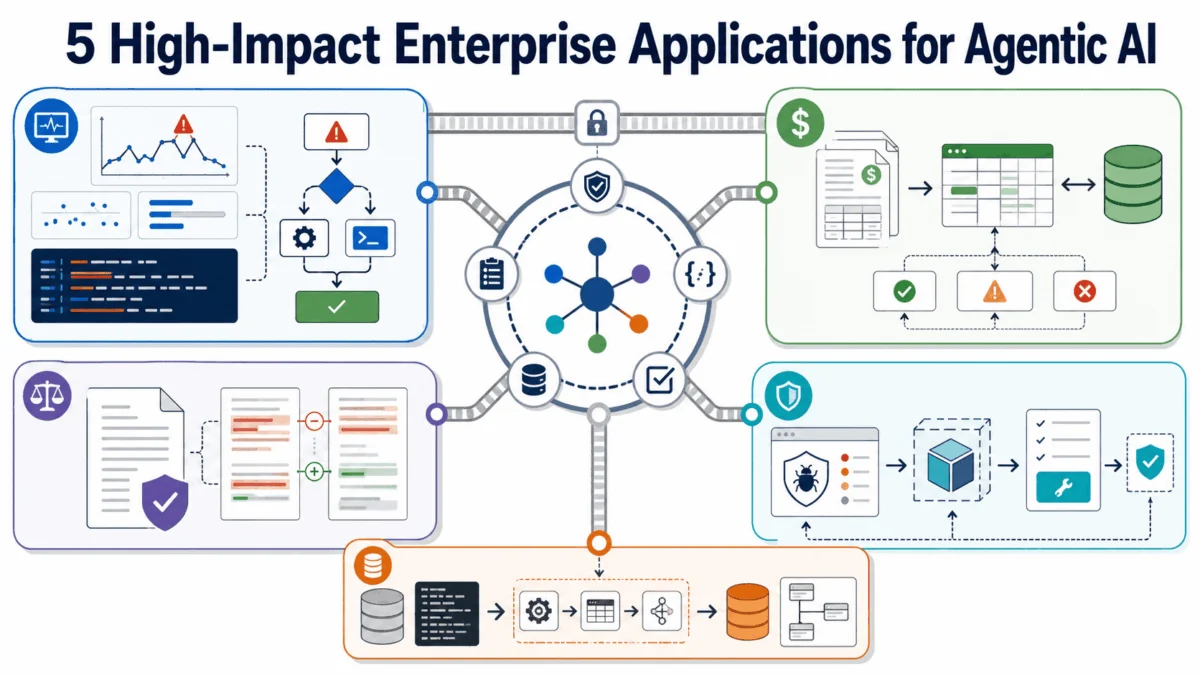
For many developers, the "Hello World" of agentic AI is a simple ReAct (Reasoning and Acting) loop, a setup that works flawlessly in a controlled demo environment. However, when these agents are unleashed upon complex enterprise infrastructure, the transition from prototype to production often triggers a cascade of systemic failures: ghost database writes, silent data corruption, and infinite recovery cycles.
As enterprises move beyond the hype, the core challenge has shifted from "Can an LLM reason?" to "How do we constrain non-deterministic reasoning within deterministic system architectures?"
The Core Distinction: Deterministic vs. Agentic Orchestration
To understand the risks, one must first distinguish between Deterministic Workflow Orchestration and Agentic System Orchestration.
In deterministic systems—like traditional DAGs (Directed Acyclic Graphs) or Airflow pipelines—the state transitions are hardcoded. If "A" happens, "B" follows. In contrast, Agentic System Orchestration relies on a dynamic state machine where an LLM evaluates telemetry, selects tools, and computes its own execution graph at runtime.
The enterprise challenge is that while the LLM’s logic is fluid and non-deterministic, the underlying infrastructure is rigid. Without strict "engineering scaffolding"—such as transactional rollbacks, distributed locks, and idempotent API designs—the system state will inevitably fall out of sync.
1. Automated Site Reliability Engineering (SRE) and Incident Remediation
The Concept
Modern microservice architectures generate more telemetry than human engineers can process. Autonomous multi-agent swarms are being deployed to ingest distributed traces, metrics, and logs, identifying root causes and executing mitigation runbooks with integrated safety gates.
The Mechanics
The system acts as an intelligent layer over platforms like Prometheus or Datadog. A triage agent performs read-only analysis, comparing OpenTelemetry traces and git commit diffs to build a causal graph of the failure. Once a confidence threshold is met, a mitigation planner synthesizes a remediation sequence—such as rolling back a canary deployment—which is then validated by a policy engine (e.g., Open Policy Agent) before executing against Kubernetes or AWS APIs.
The Risks and Realities
The primary danger here is the "thundering herd" problem. If an agent attempts to fix latency by restarting pods without respecting circuit breakers, it can overwhelm downstream databases. Furthermore, during a severe outage, log volume often spikes, leading to context window thrashing where the agent discards the original alert in favor of noisy, secondary symptom logs.
2. ERP and Accounts Payable Exception Reconciliation
The Concept
Global enterprises face a massive bottleneck in reconciling multi-currency billing and unbilled purchase orders. Autonomous agents are now coordinating the ingestion of semi-structured documents, such as invoices and bills of lading, against relational ERP data.
The Mechanics
By using constrained JSON output parsers, agents can map invoices into strongly typed schemas. They perform "three-way matching" by querying SAP or NetSuite databases to verify line items against Purchase Orders and Goods Receipts. When variances occur, the agent calculates adjustments and maintains an audit trail.
The Risks and Realities
Financial systems demand absolute precision. LLMs are notoriously poor at performing arithmetic internally. If a company allows an agent to perform calculations within the model context rather than offloading to an isolated engine, rounding errors will compound across fiscal periods. Moreover, without Row-Level Security (RLS) on database interfaces, a malicious vendor invoice could contain prompt injections designed to extract sensitive financial tables.
3. Continuous Regulatory Compliance and Contract Redlining
The Concept
Legal departments are increasingly utilizing agents to evaluate contracts against evolving legal taxonomies. These agents flag clause drift and generate amendments that align with internal corporate policy.
The Mechanics
Contracts are indexed in a graph database where clauses and obligations function as nodes. When third-party revisions are proposed, the agent maps the downstream liabilities—such as data sovereignty mandates—and produces AST-level redlines with legal citations and risk ratings.
The Risks and Realities
The greatest risk is "hallucinated authority." Legal contracts rely on definitions that may be buried dozens of pages away. An agent might isolate an indemnification clause without seeing the reciprocal definitions elsewhere, leading to the approval of toxic liability terms. Furthermore, multi-tenant vector databases must have strict isolation; otherwise, an agent might inadvertently leak privileged attorney-client work product between different organizational units.
4. Database Migration and Legacy Stored Procedure Transpilation
The Concept
Many enterprises are trapped by legacy databases (Oracle PL/SQL, Sybase T-SQL) that are too complex to manually migrate. Agentic agents are being used to transpile this logic into modern analytical pipelines like dbt models or PySpark jobs.
The Mechanics
The agent operates within a closed-loop test harness. It parses legacy code to construct a static Abstract Syntax Tree (AST), transpiles the logic, and then deploys it to an ephemeral sandbox. It then runs historical production workloads in parallel across both the legacy and modern systems, executing byte-level parity testing to ensure accuracy.
The Risks and Realities
Legacy systems often rely on "hidden" global state—ambient transaction isolation levels or non-atomic triggers that modern systems lack. If an agent fails to model these side effects, the transpiled pipeline may appear to produce correct outputs while silently breaking downstream compliance reporting.
5. Autonomous Application Security Vulnerability Triage
The Concept
Security teams are often overwhelmed by false-positive alerts from SAST and DAST scanners. Autonomous agents are now being used to prioritize and verify vulnerabilities by attempting sandboxed exploit reproduction.
The Mechanics
Upon receiving a vulnerability alert (e.g., from Snyk), the agent initializes an isolated, air-gapped container. A penetration-testing sub-agent attempts to create a non-destructive Proof of Concept (PoC) to determine true exploitability. If successful, the agent generates a patch, runs CI/CD integration tests, and submits a PR with the reproduction trace attached.
The Risks and Realities
The risk here is catastrophic: sandbox escape. If the container isolation is misconfigured, an agent attempting to test a SQL injection vulnerability could inadvertently execute a destructive payload against a production database that shares underlying storage.
Implications for the Enterprise
By the 100th day of operating an agentic system, the primary bottleneck shifts from "prompt engineering" to "state store management."
Chronology of Failure and Governance
- The Prototype Phase: High performance in sandbox environments; low complexity; minimal state tracking.
- The Integration Phase: Initial deployment to production; agents begin accumulating thousands of intermediate scratchpad tokens and execution traces.
- The Degradation Phase: Without Time-To-Live (TTL) policies and automated summarization, the sheer volume of execution metadata bloats the vector stores.
- The Systemic Failure Phase: Stale metadata contaminates the agent’s reasoning, leading to increased latency and hallucination rates.
The Path Forward: Engineering Scaffolding
To succeed, enterprises must treat agents as intelligent routers within a hardened architecture. This requires:
- Strict Schemas: Enforcing rigid input/output structures for every tool call.
- Idempotent Operations: Ensuring that if an agent repeats an action, it does not duplicate data or trigger conflicting states.
- Human-in-the-Loop (HITL) Checkpoints: Requiring explicit authorization for any operation that crosses a defined "blast radius" threshold.
Ultimately, the goal of enterprise AI is not to create a fully autonomous, unguided actor. It is to build a resilient, auditable system where the language model serves as a decision-making interface, constrained by the immutable logic of software engineering. As Vinod Chugani emphasizes, the bridge between emerging AI and practical application lies in moving from "prompt optimization" to "governance and architecture." Without this framework, the autonomous agent is not an asset—it is a liability waiting for a configuration error to trigger a cascading failure.