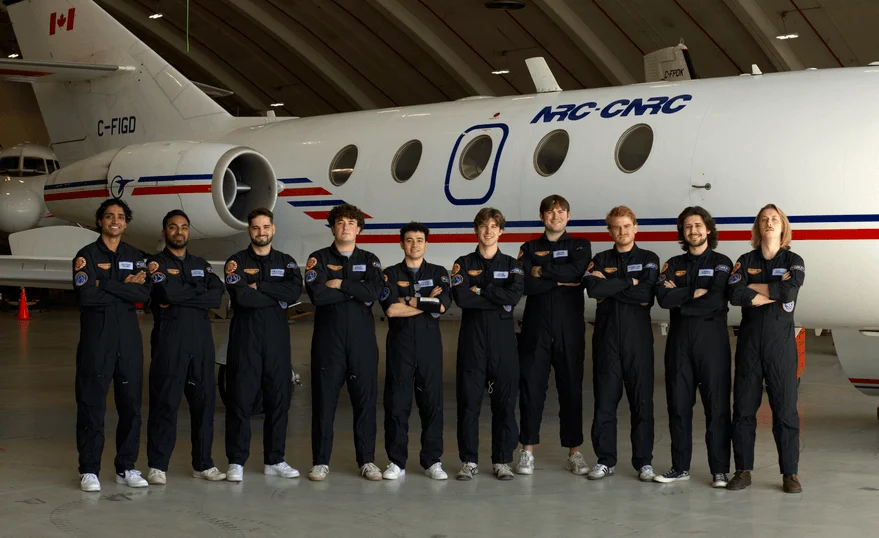
PARIS — New York-based space technology startup Icarus Robotics has successfully completed a series of microgravity flight tests for its advanced, free-flying robotic platform, "Joy." The flight campaign, conducted in Canada with the strategic assistance of retired Canadian astronaut Chris Hadfield, marks a major technical milestone for the company as it prepares to hand over the hardware to NASA in January for a scheduled demonstration mission aboard the International Space Station (ISS) in 2027.
The testing campaign highlights both the rapid maturation of autonomous space robotics and a critical bottleneck facing the United States commercial space sector: a severe domestic shortage of microgravity testing infrastructure. As private capital pours into the development of commercial space stations, orbital manufacturing, and lunar exploration, the physical infrastructure required to test and validate these technologies on Earth remains highly constrained.
1. Main Facts: The "Joy" Microgravity Test Campaign
Icarus Robotics is developing highly dexterous, free-flying mobile robots designed to operate autonomously in orbital and deep-space environments. The company’s flagship robotic platform, named "Joy," is equipped with specialized manipulators designed to perform complex physical tasks that have historically required human extravehicular activities (EVAs).
+-------------------------------------------------------------------+
|                     JOY ROBOTIC PLATFORM: KEY FACTS               |
+-------------------------------------------------------------------+
| Developer:          Icarus Robotics (New York, USA)               |
| Platform Type:      Free-flying autonomous robot                  |
| Key Features:       Dexterous robotic manipulators, sensor suite  |
| Test Location:      Canada (Parabolic flight campaign)             |
| Total Test Time:    22 minutes of cumulative microgravity         |
| NASA Hand-off:      January                                       |
| ISS Demonstration:  Scheduled for 2027                            |
+-------------------------------------------------------------------+
The recent test campaign consisted of four parabolic flights, which yielded a cumulative 22 minutes of microgravity operations. The primary objectives of the campaign were to validate Joy’s core subsystems under weightless conditions, including:
- Flight Controller Performance: Assessing the robot’s active stabilization and attitude control algorithms when operating without gravitational constraints.
- Sensor Suite Integrity: Verifying the accuracy of optical, inertial, and proximity sensors during rapid transitions from hyper-gravity (up to 1.8g) to microgravity.
- Manipulator Dexterity: Testing the physical coordination and force-feedback systems of the robot’s mechanical arms.
- Operational Rehearsals: Training Icarus personnel in flight scheduling, real-time crew coordination, and emergency safety procedures.
Because no commercial parabolic flight providers are currently active in the United States, Icarus Robotics was forced to look abroad. Through a partnership with former Canadian Space Agency (CSA) astronaut Chris Hadfield, the startup secured access to parabolic flight testing facilities in Canada to execute the critical validation campaign.
2. Chronology of the Testing Campaign and ISS Roadmap
The path to the 2027 International Space Station demonstration involves a highly coordinated timeline of engineering milestones, regulatory approvals, and logistical hand-offs.
  [ Conceptual Design & Ground Lab Testing ]
                     │
                     ▼
  [ Parabolic Flight Campaign (Canada) - 22 Mins Microgravity ]
                     │
                     ▼
  [ Post-Flight Data Analysis & Hardware Refinement ]
                     │
                     ▼
  [ NASA Technical Hand-off & Safety Review (January) ]
                     │
                     ▼
  [ Integration & Launch Logistics Manifesting ]
                     │
                     ▼
  [ ISS Deployment & Operational Demonstration (2027) ]
Phase I: Ground Development and Simulation
Prior to the flight campaign, Icarus Robotics spent months conducting hardware-in-the-loop (HIL) simulations and ground-based testing at its New York headquarters. However, Earth-bound laboratories cannot replicate the complex multi-body dynamics of a free-flying robot equipped with moving manipulators. In gravity, the reaction forces generated by a moving robotic arm are absorbed by the ground; in microgravity, those same movements exert forces that can cause the entire robotic body to rotate or drift, requiring sophisticated, real-time compensation from the flight controller.

Phase II: The Canadian Parabolic Flight Campaign (September)
In mid-September, Icarus Robotics announced the successful completion of its Canadian flight campaign. Spanning four flights, the engineering team subjected Joy to dozens of parabolic maneuvers. Each parabola provided approximately 20 to 30 seconds of weightlessness, during which the engineering team executed pre-programmed robotic maneuvers, tested manual override capabilities, and collected high-frequency telemetry data.
Phase III: NASA Hand-off (January)
With the parabolic test data successfully processed, Icarus is entering the final integration phase. In January, the company is scheduled to hand over the Joy platform to NASA. This hand-off initiates a rigorous series of safety reviews, electromagnetic interference (EMI) testing, and offgassing verifications to ensure the hardware is safe for operation inside the crewed environment of the ISS.
Phase IV: ISS Demonstration (2027)
Following successful NASA integration, Joy will be manifested on a commercial cargo resupply mission to the ISS in 2027. Once aboard, the platform will undergo a series of intravehicular activity (IVA) demonstrations to prove its utility in assisting astronauts, conducting autonomous inspections, and performing routine maintenance.
3. Supporting Data: The Microgravity Testing Deficit
The logistical hurdles faced by Icarus Robotics highlight a growing systemic challenge within the domestic aerospace sector. While the United States has experienced an unprecedented boom in launch capacity and commercial space station development, domestic testing and validation infrastructure has failed to keep pace.
The Domestic Parabolic Flight Bottleneck
Historically, American aerospace startups, academic researchers, and NASA centers relied heavily on Zero Gravity Corporation (Zero-G), a Florida-based commercial provider operating a modified Boeing 727-200 known as "G-Force One." However, Zero-G’s operations are currently listed as "temporarily paused" on its website, leaving a significant void in the domestic market.
This suspension of services has forced high-profile space firms to seek international alternatives:
- Starlab Space: The joint venture between Voyager Space, Airbus, Mitsubishi Corporation, and MDA Space has reserved microgravity research flights through the Center for Space and Aviation Switzerland and Liechtenstein to test components for its planned commercial space station.
- Icarus Robotics: Relied on Canadian infrastructure and international coordination to complete its critical flight path.
Emerging Domestic Alternatives
Several domestic startups and government initiatives are working to restore U.S. parabolic testing capabilities, though these platforms are still largely in the developmental or certification phases:

| Provider | Aircraft | Status / Timeline | Target Market |
|---|---|---|---|
| Mu-g Technologies | Dassault Falcon 50 | In development / Preparing for flight | Commercial startups, academic payloads |
| Denmar Technical Services | Boeing 737-700 | Undergoing NASA-funded modifications | NASA payloads, commercial researchers |
| Zero-G Corporation | Boeing 727-200 | Temporarily Paused | Government, commercial, and tourism |
In June, NASA awarded a contract modification to Denmar Technical Services to modify a Boeing 737-700 aircraft to serve as a dedicated reduced-gravity testbed. While this will eventually provide NASA and its contractors with robust domestic testing capabilities, commercial startups often face long lead times and high barriers to entry when attempting to access government-owned flight assets.
4. Official Responses and Industry Perspectives
The successful completion of the parabolic flights has drawn praise from both the leadership of Icarus Robotics and veteran space explorers who view autonomous systems as the next logical step in orbital operations.
Executive Commentary
Ethan Barajas, CEO and co-founder of Icarus Robotics, emphasized the broader strategic implications of the test campaign.
"We had to work with Chris Hadfield to get a capability to do testing," Barajas told SpaceNews, pointing directly to the lack of active, commercial-grade U.S. facilities. "This test marks a turning point—not just for Icarus, but for what’s possible in space robotics. The commercial space era is arriving faster than anyone expected, and the infrastructure to support it has to keep pace."
Barajas expanded on his vision for the platform, framing "Joy" as the precursor to a larger, highly scalable robotic workforce:
"Joy is just the first step toward the robotic workforce that will maintain orbital data centers, assemble complex lunar infrastructure, and ultimately make a sustained, long-term human presence in space economically and operationally viable."
The Astronaut’s Perspective
Colonel Chris Hadfield, whose extensive spaceflight experience includes serving as Commander of the ISS, was instrumental in helping Icarus navigate the logistical and operational hurdles of testing in Canada. Hadfield has long advocated for the integration of advanced robotics to reduce the physical burden and risk associated with human spaceflight.

According to industry observers close to the project, Hadfield’s involvement underscores the critical need for experienced operational guidance when transitioning robotic systems from highly controlled laboratory settings to the unpredictable, dynamic environments of spaceflight.
5. Implications: The Future of In-Space Servicing, Assembly, and Manufacturing (ISAM)
The successful validation of the Joy platform comes at a pivotal moment for the global space economy. As the retirement of the International Space Station looms—currently projected for approximately 2030—the aerospace industry is transitioning toward a decentralized, commercially operated orbital ecosystem.
                      +-----------------------------+
                      |  Traditional Space Economy  |
                      |  - Government-funded ISS    |
                      |  - Astronaut-only maintenance|
                      |  - Single-use satellites     |
                      +--------------+--------------+
                                     |
                                     v
                      +-----------------------------+
                      |   Emerging ISAM Landscape   |
                      |  - Commercial Space Stations|
                      |  - Autonomous Robotic Crews |
                      |  - On-Orbit Servicing & Life |
                      |    Extension of Assets      |
                      +--------------+--------------+
                                     |
                                     v
                      +-----------------------------+
                      |    Future Deep Space Era    |
                      |  - Orbital Data Centers     |
                      |  - Lunar Base Construction  |
                      |  - Asteroid Mining Prep     |
                      +-----------------------------+
Supporting the Transition to Commercial Space Stations
Private consortia are actively developing commercial habitats and research facilities, including Axiom Space’s Axiom Station, Vast Space’s Haven-1, and the Starlab outpost. Unlike the ISS, which has benefited from continuous human occupancy for over two decades, commercial stations may operate with intermittent crew presence or fully autonomous periods.
In these scenarios, free-flying robots like Joy will be indispensable. They can perform continuous safety inspections, detect gas leaks or structural anomalies, and execute preventative maintenance tasks without the high overhead costs associated with life support systems for human crews.
The Rise of Orbital Data Centers
One of the most promising markets for autonomous space robotics is the maintenance of orbital data centers. As high-performance computing (HPC) and edge processing migrate to low Earth orbit (LEO) to process massive volumes of earth observation and telecommunications data, these facilities will require physical maintenance. Robotic platforms equipped with dexterous manipulators will be tasked with swapping out failed server blades, upgrading storage modules, and cleaning thermal radiator surfaces—tasks that are too routine, frequent, and hazardous for human astronauts.
Enabling Lunar Infrastructure Assembly
Looking further outward, NASA’s Artemis program aims to establish a permanent human presence on and around the Moon. Constructing habitat modules, power grids, and communication arrays on the lunar surface represents a monumental engineering challenge. Autonomous, highly mobile robotic systems will be required to perform the initial site preparation, unload heavy payloads from lunar landers, and connect structural interfaces before human crews arrive.
By validating Joy’s control systems and manipulation capabilities in microgravity, Icarus Robotics has positioned itself as a critical player in the emerging In-Space Servicing, Assembly, and Manufacturing (ISAM) sector. However, the startup’s journey also serves as a clear warning to policymakers: if the United States wishes to lead the commercialization of low Earth orbit and the cislunar economy, it must urgently invest in the domestic testing infrastructure required to validate the next generation of space hardware.