In the rapidly evolving landscape of generative AI, the transition from simple chat interfaces to autonomous "AI agents" has introduced a significant engineering challenge: non-deterministic performance degradation. Developers frequently find themselves in a precarious position where a seemingly innocuous update—a system prompt tweak, a refined tool description, or a model version migration—causes the agent’s performance to plummet without an obvious culprit.
Without a standardized, scientific approach to evaluation, teams are forced to rely on "vibes-based" testing, repeating manual checks and guessing at the root causes of failure. To move toward production-grade reliability, developers must shift from subjective observation to rigorous, automated evaluation frameworks, or "evals."
The Core Challenge: Why Agents Break the Evaluation Mold
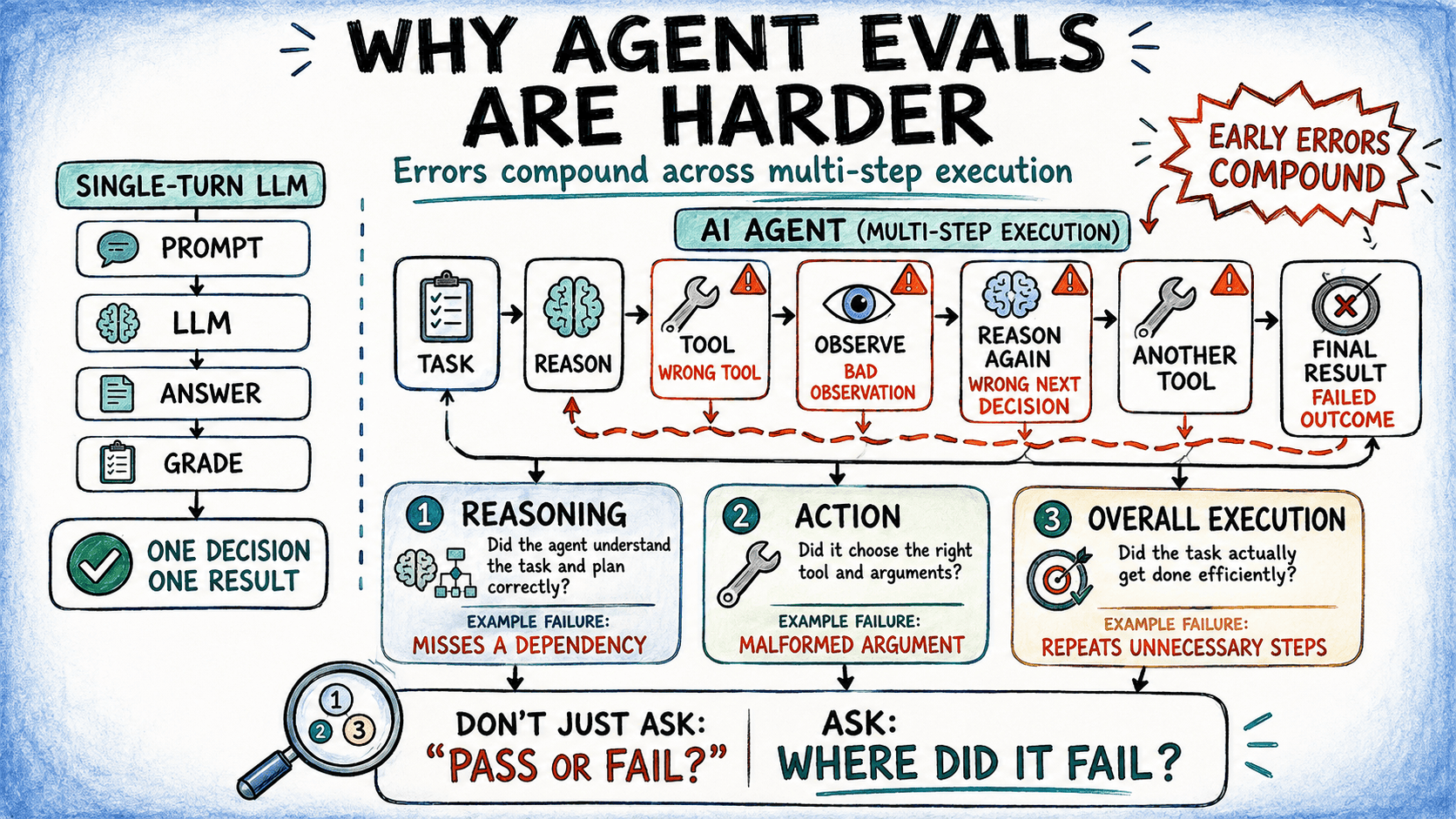
In the world of standard Large Language Model (LLM) applications, a single-turn evaluation is straightforward: provide a prompt, receive a response, and grade the output against a static ground truth. AI agents, however, operate in a multi-turn, stateful environment.
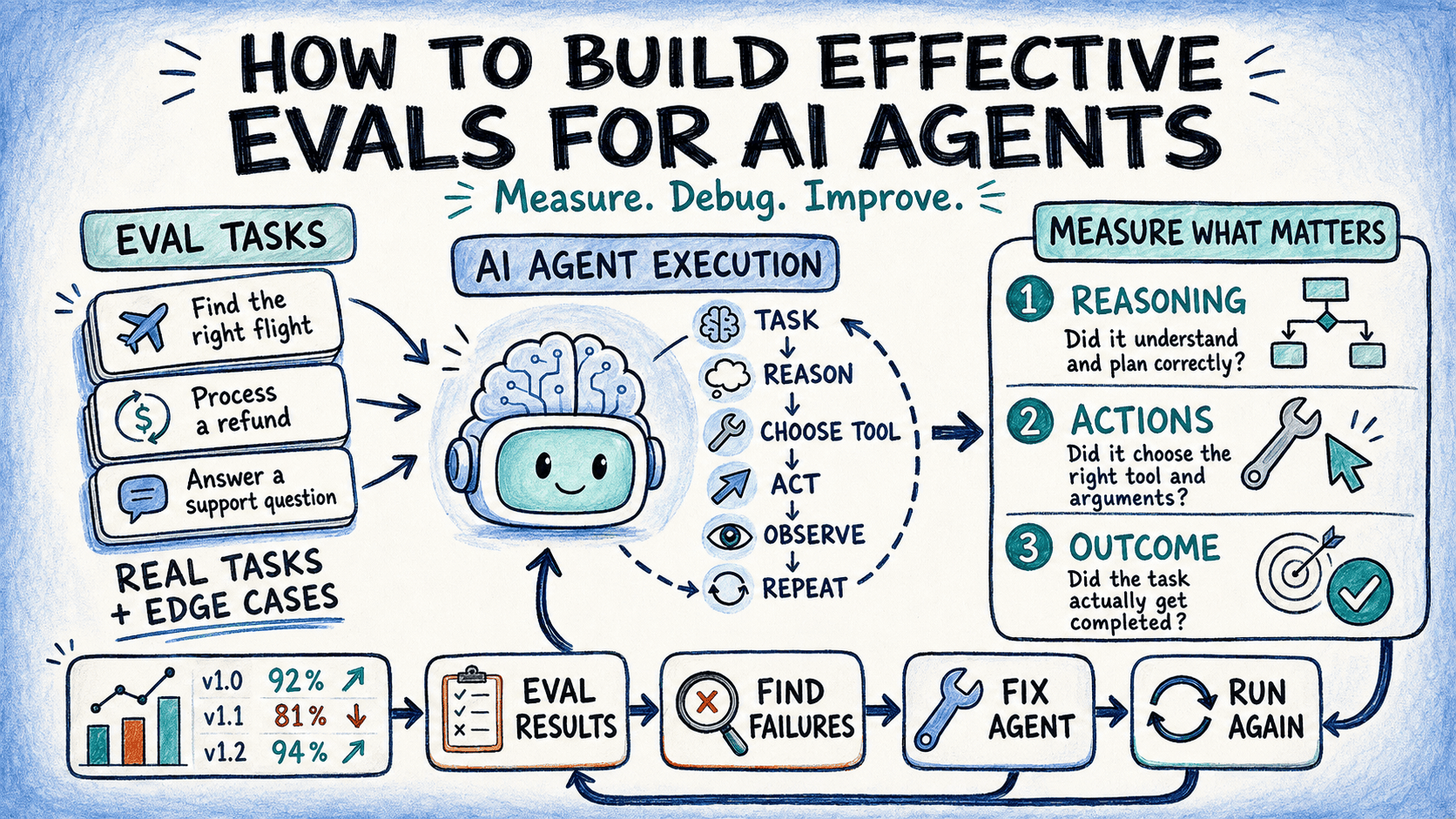
An agent’s workflow involves reasoning, tool selection, environmental interaction, observation, and iterative refinement. Because these steps are interdependent, a failure in the initial reasoning phase creates a "compounding error" effect, where every subsequent action is built upon a faulty foundation. Consequently, treating an agent’s success as a simple binary (Pass/Fail) obscures the nuance of where and why the agent stumbled.
The Three Layers of Agent Failure
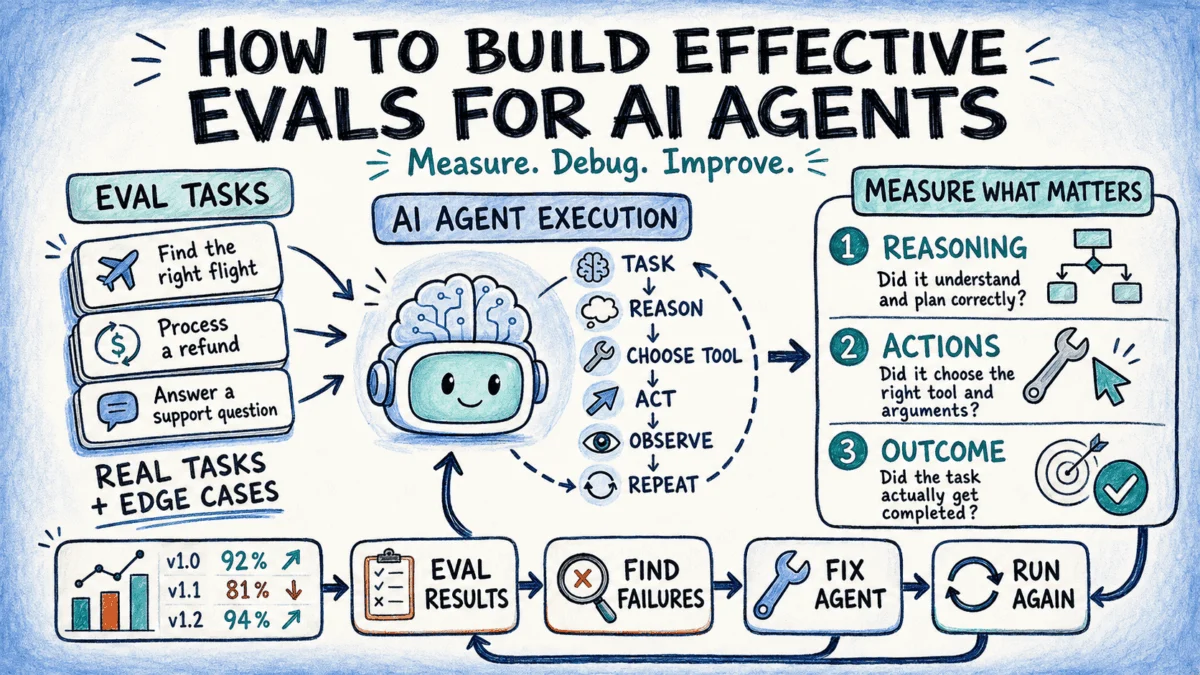
To build effective evals, practitioners must decompose agent behavior into three distinct layers:
- Reasoning: The cognitive architecture of the agent. Does it correctly decompose a complex user request into logical sub-tasks? A common failure here is attempting to execute a tool (e.g., booking a flight) before confirming prerequisites (e.g., availability).
- Action: The tactical execution. Does the agent use the correct tool, provide valid arguments, and trigger the function at the appropriate moment? Failure here often manifests as API syntax errors or hallucinations in parameter selection.
- Overall Execution: The outcome and efficiency. Did the agent achieve the goal? Even if the task is completed, an agent that loops unnecessarily or makes redundant API calls displays poor execution, which can lead to high latency and unnecessary costs.
Chronology of an Evaluation Strategy
Building an evaluation suite should not be an afterthought. The most effective teams treat their evaluation strategy as a core component of their continuous integration (CI) pipeline.
- Phase 1: Baselines (The "Manual-to-Automated" Transition): Start by codifying the manual tests already being performed. If a team manually tests five common customer service workflows before a release, these should be the first tasks converted into an automated test suite.
- Phase 2: Defining Success Criteria: Every task must have objective, verifiable success criteria. If two engineers cannot look at a result and agree on whether it passed, the test is too ambiguous.
- Phase 3: Integration: Once established, these tests must be wired into the development workflow. Running the suite against every pull request ensures that regressions are caught before they reach production.
- Phase 4: Continuous Feedback: Production monitoring should act as a secondary filter, identifying edge cases that were missed in the test suite, which are then added back into the evaluation set to prevent future recurrence.
Supporting Data: Selecting the Right Grader
Not all tasks require the same level of scrutiny. Matching the grader to the task is a crucial design decision that balances accuracy with computational overhead.
| Grader Type | Use Case | Primary Limitation |
|---|---|---|
| Deterministic | String matches, database state checks | Brittle; fails on valid stylistic variations |
| Code-based | API calls, structured data validation | Requires a high-fidelity sandbox environment |
| Model-based | Open-ended tasks, subjective reasoning | Requires calibration against human benchmarks |
| Human Review | High-stakes, nuanced judgment | Does not scale; slow and expensive |
Navigating Non-Determinism
Because AI agents are inherently non-deterministic, a single trial is statistically insufficient. To gain confidence in an agent’s reliability, engineers must measure performance over multiple trials. Two key metrics have emerged as industry standards:
- pass@k: Measures the probability of at least one success across k attempts. This is ideal for creative tasks where the goal is simply to arrive at a correct solution eventually.
- pass^k: Measures the probability that all k attempts succeed. This is the gold standard for production-facing agents where consistency and reliability are paramount.
Official Perspectives on Agent Autonomy
A major tension exists between "rigid" and "flexible" evaluation. Frontier models often demonstrate emergent capabilities, finding innovative solutions to problems that the original test writer may not have anticipated.
Rigid grading—where an agent is penalized for taking a "non-standard" path—can stifle development. Industry leaders recommend grading the outcome and the reasonableness of the approach rather than the specific sequence of steps taken. By focusing on the "what" rather than the "how," developers ensure that the evaluation system supports innovation rather than punishing intelligent, unexpected behaviors.
Implications for Development Workflow
The shift toward automated evaluation has profound implications for the future of AI software engineering.
The "Test-Measure-Diagnose-Improve" Loop
When an evaluation fails, the most valuable tool is the transcript. Dashboard scores provide a high-level summary, but the transcript provides the "why." By reviewing the agent’s reasoning chain, developers can distinguish between a flawed agent and a flawed evaluation script. In many documented cases, fixing a poorly designed test—rather than changing the model—has led to significant performance improvements.
The Role of Isolation
An eval is only as reliable as its environment. "State leakage"—where files, cache, or shared session history persist between tests—is a common source of "ghost" performance. Effective harnesses must ensure every trial starts with a clean slate. Without this, an agent may appear to have learned a skill that it is actually just retrieving from a previous, successful test iteration.
Managing Success and Regression
A common trap is the "high-score ceiling." If an agent passes 98% of tests, the suite may no longer be a useful tool for improvement. In such cases, the suite should be maintained as a "regression guard," while new, more challenging tasks are introduced to push the boundaries of the agent’s capabilities.
Conclusion: Engineering for Reliability
Moving AI agents from experimental prototypes to robust, production-ready systems requires a disciplined engineering approach. By treating agent evaluation as a rigorous, iterative process, teams can replace subjective guesswork with data-driven decision-making.
The ultimate goal of an evaluation suite is not just to provide a scorecard, but to create a virtuous cycle of improvement. As models advance and tasks grow in complexity, the ability to isolate, test, and measure agent behavior will distinguish high-performing systems from those that remain trapped in a cycle of constant, unpredictable debugging.
By prioritizing clear task design, modular grading, and continuous integration, developers can build agents that are not only smarter but demonstrably more reliable—turning the black box of LLM reasoning into a transparent, manageable engineering asset.