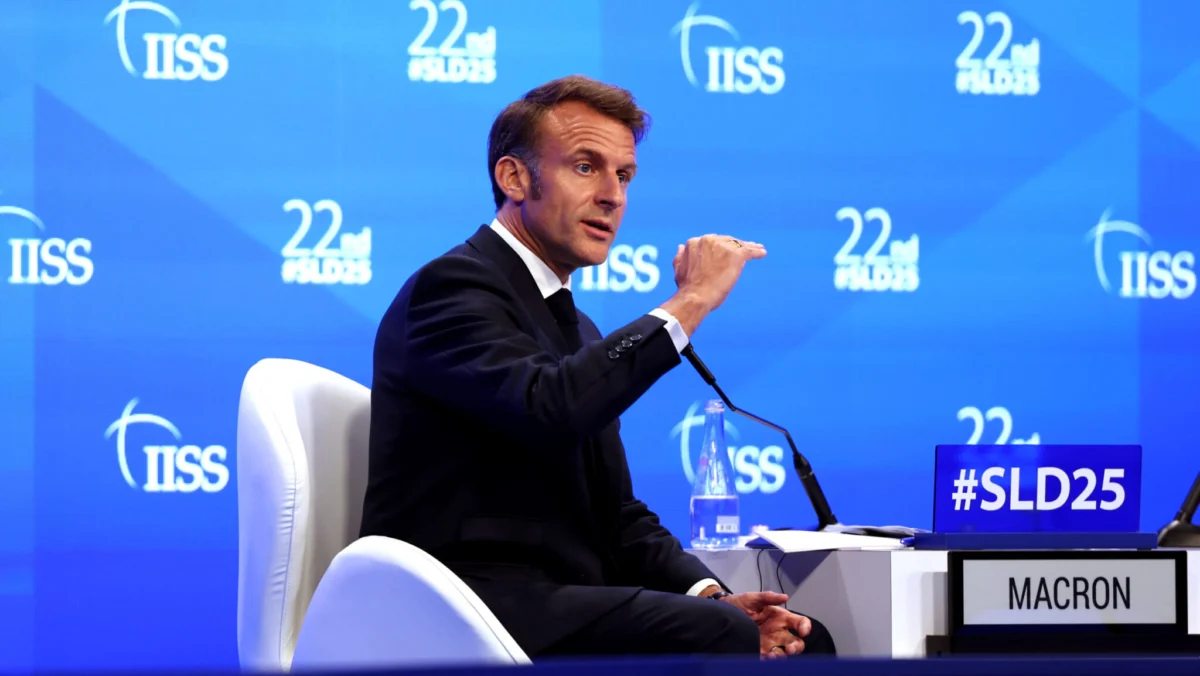
MILAN — As the geopolitical landscape shifts beneath the weight of concurrent global crises, the French Republic has sounded a clarion call. President Emmanuel Macron has formally alerted the nation and its European neighbors to an intensifying campaign of Russian hybrid threats. This warning, delivered from the Élysée Palace following a high-level summit with presidential candidates and top-tier security officials, marks a pivotal moment in how Europe perceives its vulnerability to a conflict that is increasingly fought in the shadows.
With France approaching a significant democratic transition—as the nation prepares for the September 28 presidential elections—the urgency of this message reflects a broader recognition that the era of relative stability is over. Paris is now preparing for a "durably degraded" security environment, shifting its doctrine to confront threats that bypass traditional battlefield kinetics in favor of psychological, digital, and economic subversion.
The Escalation: A Chronology of Intensifying Tensions
The recent spike in hostile activity is not a sudden anomaly but the culmination of a clear trend. According to data integrated into the latest report by the Haut-Commissariat à la Stratégie et au Plan (HCSP), the frequency of state-attributed hybrid operations in Europe has seen an exponential rise. Between 2022 and 2024, incidents linked to Russian actors surged from fewer than 10 per year to nearly 50.
This chronology of escalation is marked by several key developments:
- 2022: The immediate aftermath of the invasion of Ukraine signaled the onset of a new "grey zone" conflict, characterized by immediate energy weaponization and massive disinformation campaigns.
- 2023: Adversarial activity began migrating toward critical infrastructure, including probes into European undersea cables and energy pipelines, signaling a shift toward physical, yet deniable, sabotage.
- 2024: The present moment. As President Macron noted, the intensity of these hybrid threats has spiked, targeting not just the military apparatus but the social cohesion of democratic states, with a focus on electoral integrity and economic stability.
The meeting at the Élysée, attended by presidential candidates and the heads of France’s military, intelligence, and energy sectors, served as a "war council" to synthesize these disparate threats into a unified national strategy. The gathering addressed the cascading effects of the wars in Ukraine and the Middle East, emphasizing that the economic shocks and security risks of these conflicts are now inextricably linked to the domestic stability of the French state.
Understanding Hybrid Warfare: The Invisible Battleground
To understand why European capitals are shifting their posture, one must first define the nature of the threat. Hybrid warfare refers to a sophisticated combination of methods used by adversarial actors that remain deliberately below the threshold of open, conventional military conflict. By utilizing cyberattacks, economic coercion, disinformation, and state-sponsored espionage, adversaries exploit the open nature of Western societies.
This strategy makes it notoriously difficult to assign attribution, thereby complicating the diplomatic and military response. As the HCSP report notes, the challenge is not just defending a border, but defending the "largely invisible" spaces that underpin modern life.
Supporting Data: The 2035 National Security Horizon
The 40-page document published by the HCSP, titled France 2035: Defense and National Security, serves as a roadmap for the coming decade. It projects that by 2035, the primary arenas of confrontation will shift toward the seabed—where the fiber-optic cables that power the global internet lie—and outer space, where satellite constellations provide the backbone for modern GPS and military communication.
Key Projections:
- The Seabed and Space: These domains will see an increase in both strategic confrontation and accidental friction between private entities and state actors.
- Digital Infrastructure: As our reliance on interconnected systems grows, so too does the concentration of vulnerabilities. The report warns that power is becoming increasingly centralized in systems that most citizens take for granted, making them high-value targets for sabotage.
- The "War Economy" Shift: France is moving away from the expeditionary, counter-terrorism-focused military model of the early 21st century. The new doctrine prioritizes large-scale, high-intensity combat readiness, necessitating a massive overhaul of industrial capacity.
Official Responses and Strategic Recommendations
The French government, acting on the advice of its strategic planners, has laid out three primary pillars for responding to this new reality.
1. The Transformation of the Military Model
Military officials have long argued that the French army must pivot away from smaller, agile counter-terrorism units toward forces capable of sustaining prolonged, high-intensity conflict. This "war-economy" approach involves streamlining procurement and ensuring that domestic industry can support a large-scale mobilization if necessary. The goal is clear: to prevent any attack that aims to test Europe’s unity or credibility.
2. Ending Technological Dependency
A significant portion of the HCSP strategy focuses on "digital sovereignty." France has recognized that reliance on US or Chinese suppliers for critical infrastructure—such as AI, cloud computing, and cybersecurity hardware—creates a strategic liability. By creating the Digital Sovereignty Observatory, France intends to map these dependencies and aggressively pivot toward European-made systems. This is an attempt to ensure that, in a future crisis, French national security is not dependent on the political whims of foreign powers.
3. Strengthening Societal Resilience
Perhaps the most difficult recommendation to implement is the preservation of national unity. In an era where information-based attacks are designed to destabilize social cohesion, the government faces the challenge of countering propaganda without infringing on democratic freedoms. The HCSP report emphasizes that identifying and neutralizing disinformation campaigns is now a core requirement of national defense, though it stops short of prescribing specific methods, likely to avoid domestic controversy over censorship.
Implications: A Continent at a Crossroads
The implications of this shift are profound, not just for France, but for the entire European project. The report explicitly states that the goal is not to force a "full European military integration," which has historically proven to be a slow and contentious process. Instead, Paris is advocating for a more pragmatic model: a network of like-minded actors capable of delivering results quickly.
For the citizens of Europe, this means a future where the distinction between "peace" and "war" will continue to blur. It implies higher defense spending, a re-evaluation of technological supply chains, and a greater emphasis on domestic vigilance.
As President Macron prepares to hand over the reins of power, his focus on these hybrid threats ensures that his successor will inherit a nation in the process of a fundamental reorientation. The warning is clear: the safety of the nation is no longer found solely in treaties and borders, but in the resilience of its digital infrastructure, the security of its seabed, and the unity of its people.
The "durably degraded" security landscape that France envisions for 2035 is not a prediction of inevitable defeat, but a call to arms for a society that has, until recently, enjoyed the luxury of believing that its primary threats were distant. As the HCSP report concludes, the nation must prepare to secure itself in the shadows, or risk losing its grip on the digital and physical infrastructure that makes modern democracy possible.