In the corridors of corporate America, the role of the Chief Sustainability Officer (CSO) is undergoing a profound metamorphosis. For years, the sustainability function was siloed, often relegated to the peripheral tasks of corporate social responsibility (CSR), charitable giving, or niche environmental reporting. However, according to the 8th biennial CSO Insights report from the Weinreb Group, a seismic shift has occurred: sustainability is no longer merely a "nice-to-have" peripheral initiative—it has become a central pillar of enterprise risk management.
As public companies navigate an era defined by economic volatility, shifting regulatory landscapes, and the physical realities of a changing climate, CSOs are increasingly positioning themselves as the "futurists" of the C-suite. Their primary mandate has evolved from chasing incremental cost savings to safeguarding the long-term viability of the business.
The Shift from Cost Centers to Risk Managers: Main Findings
The Weinreb Group’s latest research, which surveyed 69 CSOs at publicly traded U.S. companies—representing roughly one-third of the total population of executives holding the title as of July 1—reveals a clear hierarchy of business value.
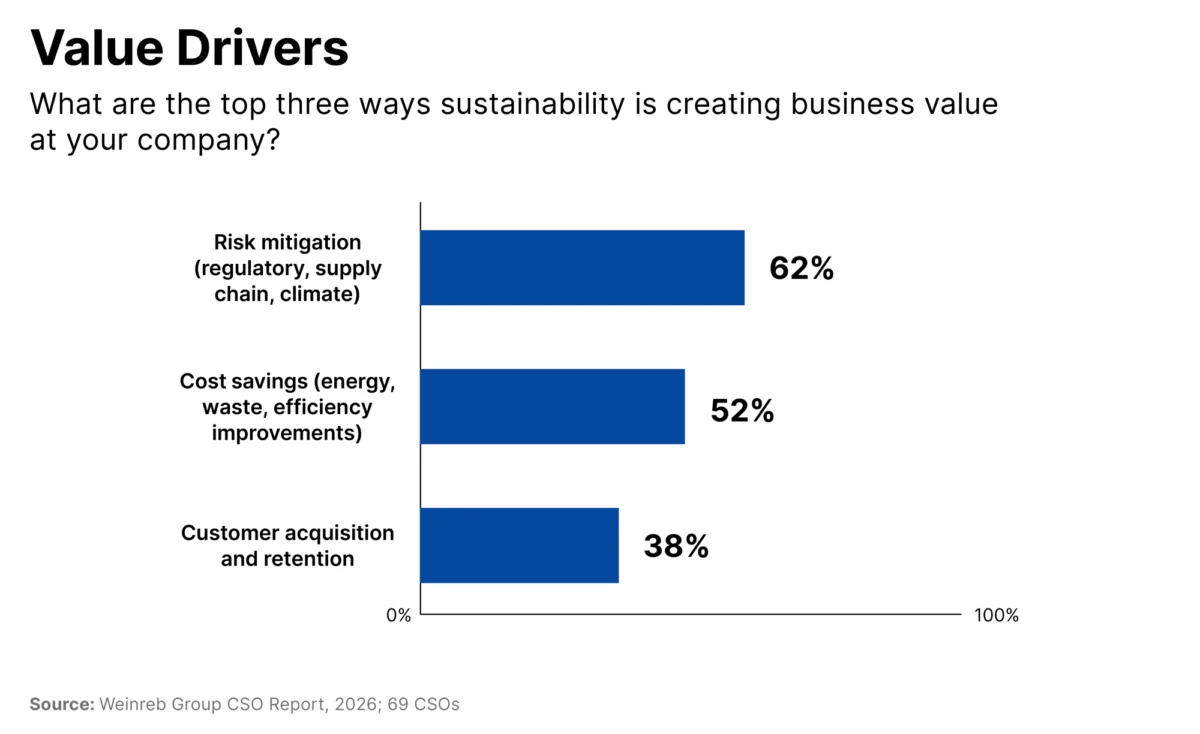
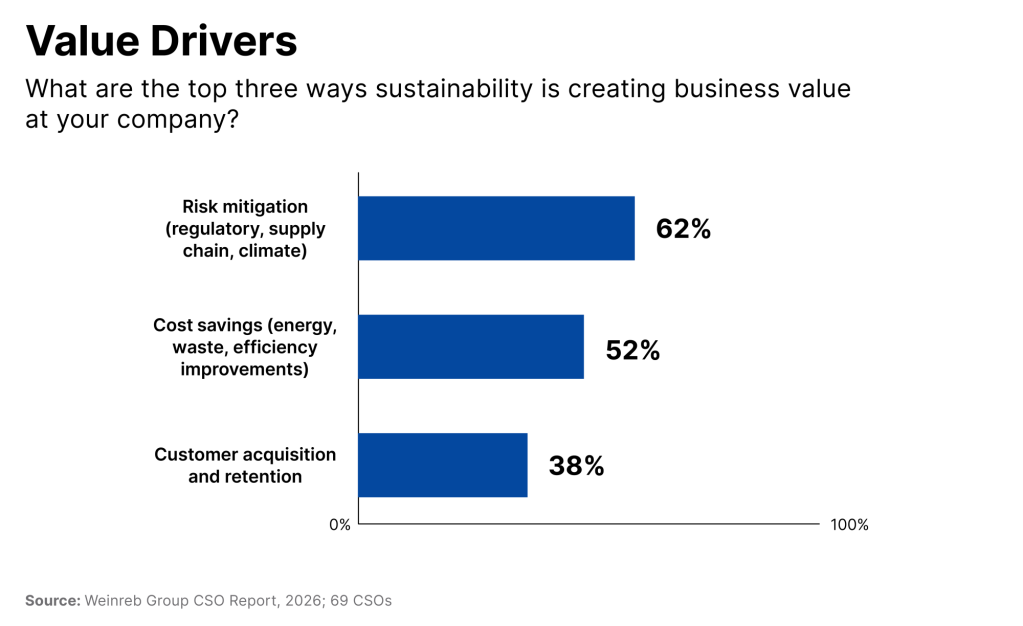
When asked how they best contribute to their organization’s success, more than 62 percent of respondents identified risk mitigation as their top priority. This encompasses the identification and management of supply chain vulnerabilities, navigating complex and evolving regulatory environments, and insulating the business from the physical and transitional risks associated with climate change.
This finding marks a departure from traditional expectations. While cost savings—achieved through energy efficiency, waste reduction, and operational streamlining—remain a significant value driver (cited by 52 percent of respondents), they have been eclipsed by the strategic necessity of risk management. Furthermore, 38 percent of CSOs highlighted initiatives that bolster customer acquisition and retention as a primary lever for generating business value.

A Chronology of the Evolution: From CSR to the C-Suite
The trajectory of the CSO role over the last decade mirrors the maturation of corporate sustainability itself.
- The Early 2010s (The Philanthropic Era): The sustainability function was largely disconnected from core business operations, often residing within communications or human resources departments. The focus was on reputation management and philanthropic output.
- The Mid-to-Late 2010s (The Efficiency Era): Sustainability leaders began to focus on the "low-hanging fruit" of operational efficiency. Reducing energy consumption and waste became the primary mechanism for demonstrating ROI to the CFO.
- The 2020–2024 Period (The ESG Integration Era): The rise of Environmental, Social, and Governance (ESG) frameworks forced sustainability into the realm of investor relations and capital allocation, pushing the CSO closer to the boardroom.
- 2025–2026 (The Risk Management Era): We have now entered a phase where sustainability is synonymous with enterprise resilience. The appointment of Kim Marotta as the CSO and head of risk management at Suntory in early 2025 serves as the definitive archetype of this era. As Marotta noted, the transition from managing "environmental risks" to managing "business risks" is the key to achieving a holistic, high-level view of the enterprise.
Supporting Data: What Drives the Modern CSO?
The data provided by the Weinreb Group highlights the external pressures shaping these internal shifts.
Primary Drivers of Strategy
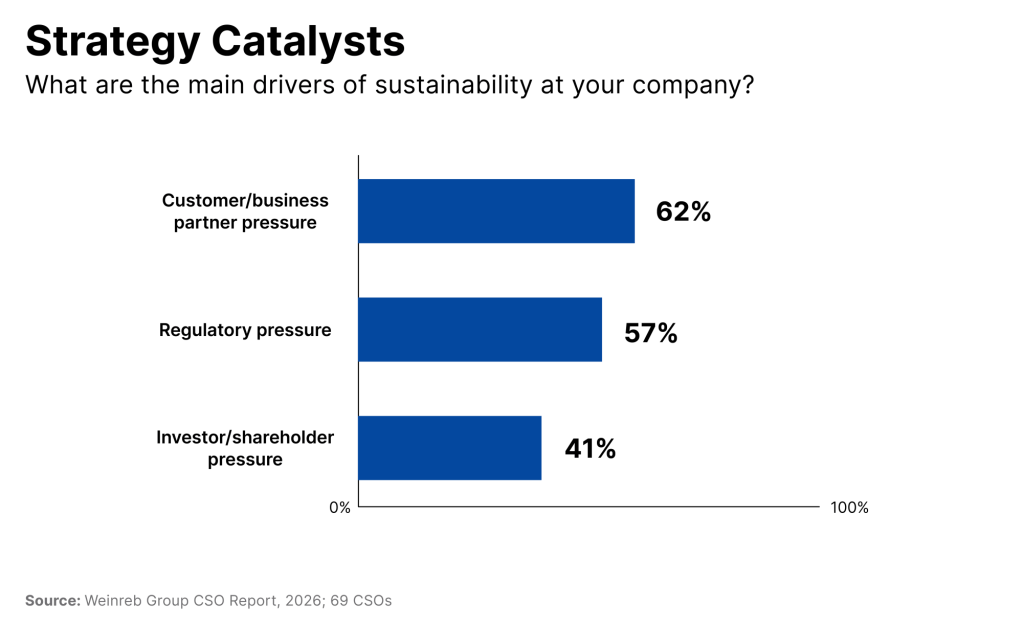
Sustainability strategies are no longer driven by internal idealism alone. The survey found that:
- Customer and Business Partner Pressure (62%): Market demand remains the single largest driver. Companies are being forced to prove the sustainability credentials of their products and services to remain competitive in a supply chain that is increasingly demanding transparency.
- Regulatory Pressure (57%): With the proliferation of disclosure mandates across the globe, regulatory compliance has become a central focus for CSOs.
- Investor/Shareholder Pressure (41%): Despite some political pushback on "ESG" terminology in the U.S., shareholders continue to prioritize the long-term financial stability that strong sustainability governance provides.
The Landscape of Challenges
The obstacles facing these executives are as complex as the drivers. Market and economic uncertainty (62%) and regulatory requirements (57%) top the list. Significantly, these respondents report that these challenges are not unique to the sustainability function; they are shared concerns held by other members of the C-suite, signaling that sustainability has finally become a "language" spoken by the entire leadership team.
Official Responses and Expert Perspectives
The transition of the CSO is not just a statistical trend; it is a shift in mindset among the executives themselves.
"CSOs are the futurists of the corporate context," says Sophie Beckham, CSO at International Paper. "My mandate is to see around corners, build resilience into our business model, and create value that will help my company not just navigate but thrive when facing emerging risks and opportunities."
This sentiment is echoed by Ellen Weinreb, CEO of the Weinreb Group, who has tracked the profession for over a decade. "After tracking the CSO role for so many years, what heartens me the most is the resilience of the people who hold this title," Weinreb notes. "There’s rarely a playbook for what they do, yet they negotiate every new challenge with grace and determination."
The data also reveals a shift in the organizational structure. While the number of individuals holding the title of CSO at U.S. public companies has fluctuated (dropping from 216 in 2025 to 193 in 2026), the role is becoming more deeply embedded. Some 42 percent of respondents reported that their responsibilities had expanded over the past year. Even more telling is the trend of hiring sustainability expertise into functional units—finance, supply chain, and operations—rather than relying solely on a centralized, isolated team.
Implications for the Future of Business
The implications of this shift are profound for both the C-suite and the sustainability profession at large.
1. The Death of the "Sustainability Department"
As sustainability becomes "smart business," the need for a standalone department may diminish in favor of decentralized expertise. The report found that 42 percent of respondents have seen an increase in sustainability headcount outside of central teams. This suggests that the ultimate goal of a CSO is to make their own department redundant by integrating sustainability into the DNA of the company’s core business functions.
2. The Legalization of Sustainability
One of the most striking findings in the report is the shift in reporting lines. Just 14 percent of CSOs now report directly to the CEO, a significant drop from the 33 percent reported 18 months ago. Instead, a growing number of CSOs are reporting to the legal department. This shift is a direct response to the increasing regulatory scrutiny and the need to treat sustainability data with the same level of rigor and audit-readiness as financial reporting. While some might view this as a step back from strategic influence, others argue it is a necessary step toward mainstreaming sustainability as a matter of legal and financial governance.
3. Resilience as a Competitive Advantage
The "tipping point" described by an anonymous respondent—that sustainable business is simply "smart business"—suggests that we are moving toward a period of consolidation. Companies that view climate, social, and regulatory issues through the lens of risk management are better positioned to weather systemic shocks. By "seeing around corners," CSOs are providing a level of foresight that is becoming increasingly rare in an era of rapid, unpredictable change.
Conclusion
The 8th biennial CSO Insights report presents a portrait of a profession that has moved beyond the "green" marketing of the past into a hard-nosed, strategic discipline. The Chief Sustainability Officer is no longer a corporate conscience; they are a corporate architect, designing the systems that will allow companies to thrive in a resource-constrained and volatile future.
While the shrinking number of formal CSO titles at public companies might seem like a contraction, it is more accurately interpreted as a diffusion. Sustainability is being internalized, normalized, and integrated into the broader corporate structure. As the lines between operational efficiency, risk mitigation, and long-term strategy blur, the role of the sustainability leader—whether they hold the title of CSO or not—is destined to become the most critical component of modern enterprise management. The future of the corporation, it seems, depends on its ability to define risk not just by the balance sheet, but by the world in which that balance sheet exists.