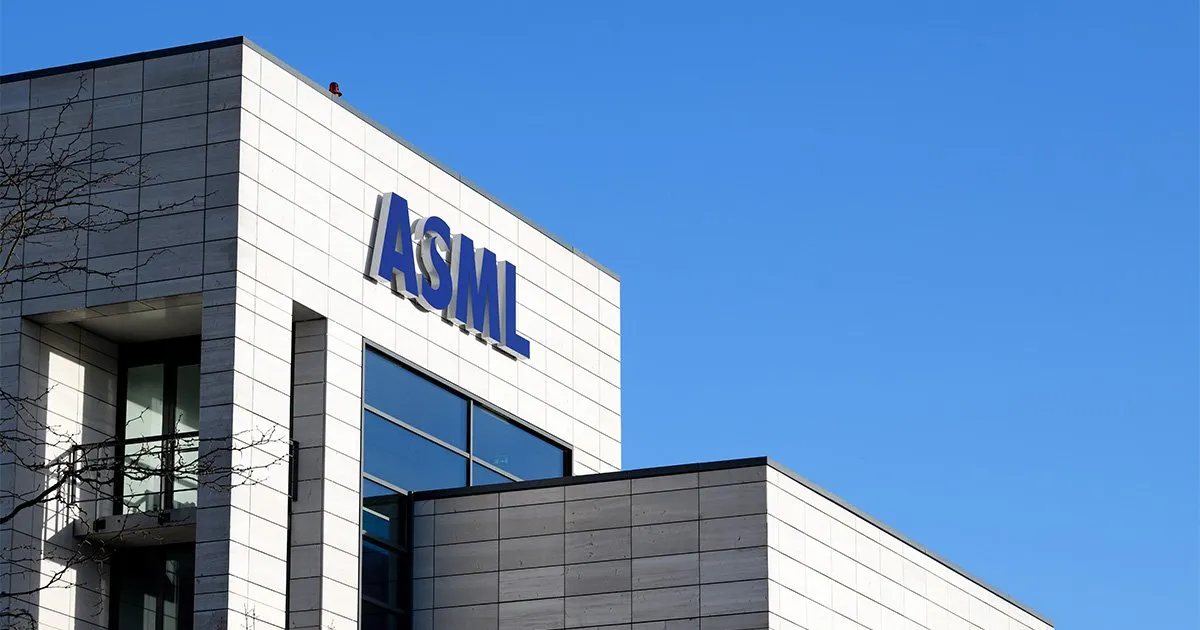
As the global appetite for artificial intelligence continues to reshape the technological landscape, semiconductor lithography giant ASML has emerged as the definitive bellwether for the industry’s health. In its second-quarter 2026 earnings report, the Dutch manufacturer not only surpassed its internal financial guidance but also signaled a robust upward revision to its full-year outlook. This surge in performance reflects a broader industry trend identified by the global association SEMI, which projects total semiconductor manufacturing equipment sales to hit a historic $165.9 billion in 2026—a 23.2% increase year-over-year.
For ASML, the current cycle is defined by a massive shift in capital expenditure as chipmakers race to build the complex infrastructure required to power the next generation of generative AI and high-performance computing (HPC).
Q2 Financial Performance: A Breakdown of Success
For the quarter ending June 28, 2026, ASML reported net sales of €9.3 billion (~$10.7 billion) and a net income of €2.9 billion (~$3.34 billion). The company maintained a formidable gross margin of 54% and an operating margin of 37.1%, showcasing its ability to command premium pricing even as it scales operations.
The revenue stream was remarkably balanced, with net system sales totaling €6.6 billion (~$7.59 billion). This figure was split almost evenly between logic customers (51%) and memory customers (49%), a divergence from historical trends where logic often dominated the mix. Perhaps most notably, the company’s "Installed Base Management" segment—which covers servicing, software upgrades, and hardware enhancements—delivered €2.8 billion (~$3.22 billion) in revenue, exceeding guidance by approximately €300 million.
During the earnings call, CFO Roger Dassen attributed this over-performance to a concentrated push by customers to extract immediate productivity gains from their existing fabs. By leveraging software and hardware upgrades, manufacturers are squeezing higher throughput from current systems, a strategy that underscores the urgency of meeting the relentless demand for AI-ready chips.

The Chronology of an Industry Pivot
The year 2026 marks a pivotal transition point for the semiconductor industry. Following the post-pandemic inventory corrections that plagued 2024 and 2025, the industry entered the current year with a clear objective: massive capacity expansion.
- Early 2026: Industry analysts began noting a significant uptick in capital equipment orders. ASML, as the sole provider of Extreme Ultraviolet (EUV) lithography systems, became the primary bottleneck and the central focus for analysts assessing the supply chain.
- Q1 2026: ASML confirmed that demand for memory-related lithography was rebounding, largely due to the HBM (High-Bandwidth Memory) requirements for AI GPUs.
- Q2 2026: The company hit its stride, beating financial expectations and providing the market with a "green light" signal for the second half of the year. The report confirmed that Intel Foundry is actively utilizing next-generation High-NA EUV technology on its 18A process node, marking a major milestone for advanced semiconductor manufacturing.
- Looking Forward (2027–2028): ASML has begun aligning its supply chain to support a 30% capacity increase by 2027, with the potential for another 30% expansion in 2028, provided the market demand holds its current trajectory.
Supporting Data: The AI-Driven Capital Supercycle
The data provided by SEMI paints a picture of an industry undergoing a structural transformation. According to the association, the total market for semiconductor equipment is expected to maintain its upward trajectory through 2028, potentially reaching an staggering $229.5 billion.
The "Wafer Fab Equipment" segment, which serves as the lifeblood of ASML’s revenue, is projected to grow by 23.1% in 2026 to $143.9 billion. Ajit Manocha, president and CEO of SEMI, has highlighted that the intensity of investment is driven by the race for efficiency. "AI is accelerating demand for more powerful and efficient chips," Manocha stated. "This is driving investment across the board, from logic foundries to memory manufacturers who are currently in a state of high-intensity capacity expansion."
Specifically, the memory sector is seeing a massive influx of capital. DRAM equipment sales are projected to skyrocket by 39% to $38.8 billion in 2026. This is directly tied to the "lithography intensity" of modern memory—the process of manufacturing advanced HBM and DDR chips requires more lithographic layers than traditional memory, forcing manufacturers to purchase more, and more advanced, ASML scanners.
Official Responses and Strategic Management
During the earnings call, management faced rigorous scrutiny regarding the sustainability of these margins and the company’s pricing power.

Pricing Power in a High-Demand Environment
When questioned by UBS analyst François Bouvignies on whether ASML would adjust pricing for its Low-NA systems to better reflect the incremental value provided to customers, CFO Roger Dassen was explicit. "The current environment provides more flexibility for pricing than what you would have had in different days," Dassen noted. However, he cautioned that because the lead times for these machines are so long, any pricing shifts would be a "slow burn," appearing gradually in new orders rather than having an immediate, volatile impact on current revenue.
Capacity and Supply Chain Constraints
The question of whether ASML can handle the anticipated growth was posed by Wells Fargo analyst Joe Quatrochi. He inquired if the target of 85 tools per year was a hard ceiling for the supply chain. Dassen’s response was characteristically pragmatic: "If more is needed, just as we’ve done in the past couple of quarters, we’re going to roll up our sleeves and see if more can be done."
Management also clarified that they are not waiting for signed, ink-on-paper purchase orders before initiating the supply chain expansions required for 2028. Instead, they are relying on "customer demand signals"—the strategic planning of major players like TSMC, Samsung, and Intel—to justify the investment in their own upstream supply chain.
Implications for the Future of Semiconductor Manufacturing
The ripple effects of ASML’s performance are felt throughout the global economy. Several key takeaways define the current state of the industry:
1. The "Lithography Intensity" Shift
The primary driver of the current cycle is not just volume, but complexity. Whether it is the move toward 2-nm and 1.4-nm nodes in the logic sector or the transition to advanced HBM in memory, the "lithography intensity"—the number of times a wafer must pass through a scanner—is increasing. This is a structural benefit to ASML, as it mandates a higher number of systems per wafer produced.

2. Regional Dominance and Geopolitics
The geographic concentration of spending—with China, Taiwan, and Korea remaining the top regions—remains a focal point. While ASML continues to navigate a complex regulatory environment, the sheer necessity of their technology to the global AI roadmap ensures they remain central to the strategic planning of every major manufacturing power.
3. Shareholder Value and Long-term Stability
ASML’s decision to buy back €1.1 billion in shares during Q2 and announce an interim dividend of €1.88 per share signals strong confidence in its cash flow. By focusing on a long-term strategic outlook—with the next major update slated for the June 2027 Capital Markets Day—the company is positioning itself as a stable anchor in an otherwise volatile sector.
4. The Intel 18A Milestone
The confirmation that Intel Foundry is using High-NA EUV for commercial production is a critical validation of ASML’s most expensive and sophisticated product line. As other manufacturers move toward High-NA, this early adoption will provide the baseline data needed to refine the technology, further cementing ASML’s technological moat.
Conclusion
ASML has successfully navigated the transition from post-pandemic recovery to an AI-fueled capital supercycle. By reporting strong Q2 results, raising its 2026 outlook to a range of €43 billion to €45 billion, and maintaining high gross margins, the company has demonstrated that it is both the architect and the primary beneficiary of the modern semiconductor era. As the industry moves toward the 2-nm node and beyond, ASML’s ability to manage its supply chain and maintain its pricing power will remain the most critical factor in the global race for computational dominance.