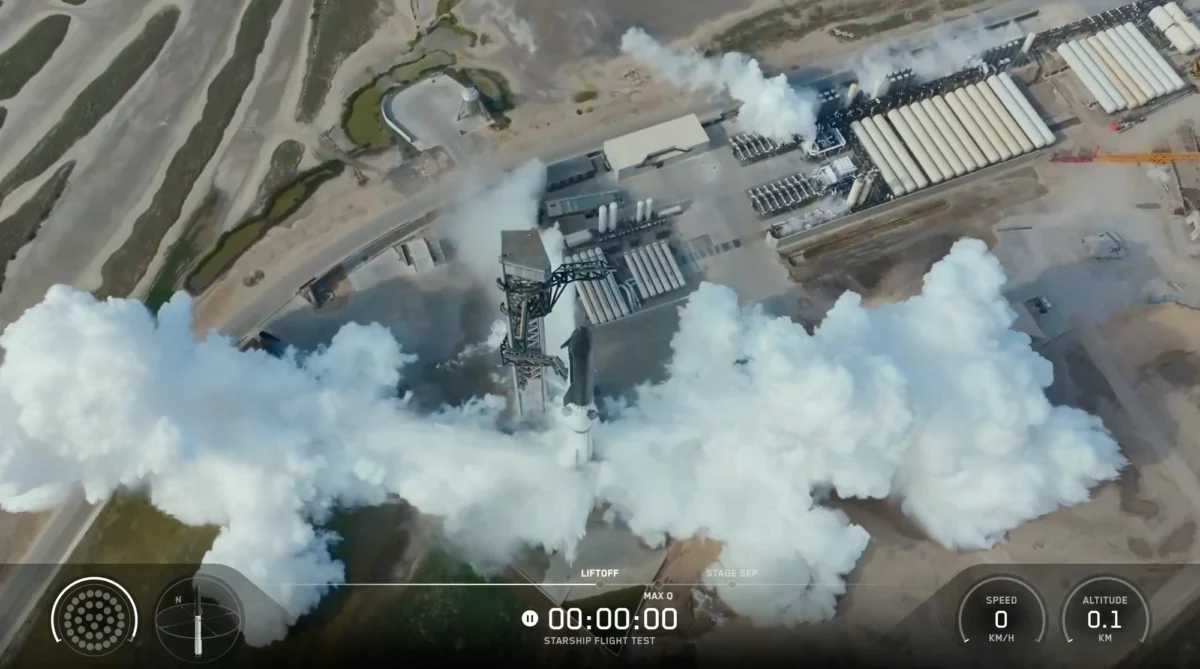
BOCA CHICA, Texas — SpaceX aborted the highly anticipated launch of its thirteenth Starship test flight at the final second on July 16, 2026, after automated ground and flight computers detected a startup anomaly in the Super Heavy booster’s Raptor engines.
The scrub occurred at T-0 during the ignition sequence at SpaceX’s Starbase launch facilities in Boca Chica, Texas. The aborted attempt marks the first major launch-pad disruption for the Starship program since SpaceX transitioned to a public company in June 2026. The incident immediately triggered a volatile reaction in after-hours trading, underscoring the heightened financial scrutiny now facing the aerospace giant.
1. Main Facts of the Flight 13 Abort
The Flight 13 mission was scheduled to lift off during a late-afternoon window at 6:45 p.m. Eastern (5:45 p.m. Local/Central). Propellant loading of subcooled liquid oxygen (LOX) and liquid methane ($CH_4$) had proceeded smoothly throughout the afternoon, with no major issues reported by the launch director.
However, as the countdown reached zero, the Super Heavy booster’s Raptor engines began their staggered ignition sequence. Witnesses and viewers on the live broadcast saw a brief flash of fire and venting at the base of the orbital launch mount, which was immediately followed by a premature shutdown of all engines and a deluge of water from the pad’s sound suppression system.
[ T-10 Seconds ] ---> [ T-3 Seconds: Raptor Ignition ] ---> [ T-0 Seconds: Abort Triggered ]
       |                            |                                    |
       v                            v                                    v
Propellant tanks          Partial engine ignition              Engine failure detected;
fully pressurized         sequence initiated                   automatic shutdown sequence
SpaceX confirmed shortly after the incident that an automatic launch abort had been triggered. Elon Musk, Chief Executive of SpaceX, announced on social media that some of the booster’s Raptor engines had failed to start, prompting the flight computer to halt the liftoff. Musk later clarified that two Raptor engines would need to be removed and replaced on the launch mount before another flight attempt could be made, targeting a launch window in the early part of the following week.
Flight 13 is designed as a suborbital test flight. It represents the second flight of the upgraded Starship V3 platform, following the Flight 12 mission on May 22, 2026. Unlike previous suborbital tests, which carried inert mass simulators, Flight 13 is configured to carry a functional payload of 20 next-generation Starlink V3 satellites to be tested in space before reentry.
2. Detailed Chronology of the Scrub
The countdown to the launch of Flight 13 followed a highly optimized propellant-loading sequence refined over dozens of previous Starship and Falcon 9 campaigns.
The Countdown and Fueling Phase
- T-45 Minutes: The SpaceX Launch Director gave the "go" for propellant loading. Super Heavy booster fueling commenced, pumping thousands of metric tons of liquid oxygen and liquid methane into the booster.
- T-35 Minutes: Propellant loading began on the Starship upper stage.
- T-10 Minutes: The flight computers initiated the chilling of the Raptor engines on both the booster and the upper stage to prevent thermal shock during ignition.
- T-3 Minutes: Propellant tanks on both stages were fully pressurized for flight, and the ground flight control system handed over command to the vehicle’s onboard computers.
- T-19 Seconds: The water-deluge system beneath the orbital launch mount was activated to suppress the immense acoustic energy and heat of the Super Heavy booster’s 33 Raptor engines.
The T-0 Abort and Post-Scrub Safing
- T-3 Seconds: The ignition sequence for the Super Heavy booster commenced. A subset of the 33 Raptor engines began firing in a rapid, staggered pattern to minimize structural loads on the launch mount.
- T-0 Seconds: Onboard diagnostic sensors detected that a critical number of Raptor engines had failed to reach their nominal start parameters. The flight computer instantly commanded an automatic launch abort, shutting down all active engines before the mechanical hold-down clamps could release the vehicle.
- T+2 Minutes: SpaceX launch controllers initiated de-fueling procedures, draining the volatile liquid methane and liquid oxygen back into the Starbase tank farm to safe the vehicle.
- T+10 Minutes: Elon Musk published his first public statement on social media platform X, confirming the engine startup failure and stating that a subsequent launch attempt would be delayed by "a few days."
- T+1 Hour: Musk provided an update, indicating that inspections required the removal and replacement of two Raptor engines, shifting the target launch date to early the following week.
3. Technical Specifications and Supporting Data
The Flight 13 mission serves as a critical bridge between SpaceX’s experimental development phase and its long-term operational goals. The hardware utilized on this flight features significant modifications compared to early-generation Starship vehicles.
The Starship V3 Architecture
Starship V3 is the latest iteration of SpaceX’s fully reusable transportation system, designed to maximize cargo capacity to low Earth orbit (LEO) and facilitate deep-space missions to the Moon and Mars.
| Parameter | Starship V1 / V2 | Starship V3 |
|---|---|---|
| Booster Engines | 33 Raptor 2 | 33 Raptor 3 (optimized thrust) |
| Upper Stage Engines | 6 Raptor (3 sea-level, 3 vacuum) | 9 Raptor (3 sea-level, 6 vacuum) |
| Payload Capacity (LEO) | ~100–150 metric tons | Up to 200 metric tons (fully reusable) |
| Height (Stack) | 120 meters (397 feet) | ~150 meters (492 feet) |
| Propellant Capacity | ~4,500 metric tons | Over 5,000 metric tons |
Flight 13 was designed to implement fixes for engineering issues identified during Flight 12 on May 22, 2026. During that previous test, the Super Heavy booster failed to achieve a fully controlled splashdown in the Gulf of Mexico due to aerodynamic control anomalies, and the Starship upper stage suffered the loss of one of its engines during the ascent phase. Flight 13 featured redesigned engine shielding and updated software guidance algorithms to prevent a recurrence of those failures.
Next-Generation Starlink V3 Payload
A major milestone for Flight 13 is the inclusion of 20 fully functional Starlink V3 satellites. This marks a shift from the mass simulators flown on early V3 tests.

Optimized specifically for Starship’s wide payload bay, the Starlink V3 satellites represent a major leap in telecommunications performance:
- Downlink Capacity: 1 terabit per second (Tbps) per satellite, a tenfold increase over Starlink V2.
- Uplink Capacity: 160 gigabits per second (Gbps) per satellite, a 22-fold improvement over the previous generation.
- Antenna Upgrades: Advanced phased-array systems paired with newly integrated backhaul antennas operating across the Ka-, E-, V-, and W-bands, which collectively improve overall spectral capacity by a factor of eight.
- Power Generation: Upgraded solar arrays that generate twice the electrical power of the V2 design, supporting the high-throughput communication payloads and next-generation argon-fueled Hall-effect thrusters.
Starlink V3 Performance Comparison (vs. V2):
===================================================================
Downlink Capacity: [████████████████████] 10x Improvement (1 Tbps)
Uplink Capacity:   [████████████████████████] 22x Improvement (160 Gbps)
Spectral Capacity: [████████] 8x Improvement (Ka-, E-, V-, W-bands)
Power Generation:  [██] 2x Power Output
===================================================================
Because Flight 13 is a suborbital mission, these 20 satellites will not remain in orbit. Instead, they will be deployed on a high-altitude suborbital trajectory, allowing SpaceX engineers to conduct a 20-minute "speed run" of critical systems. This short testing window will verify solar array deployment, antenna articulation, and cross-link communications with ground stations and orbiting Starlink assets before the satellites reenter the atmosphere over the Pacific Ocean.
4. Official Responses and Corporate Communications
Following the scrub, SpaceX executives and spokespeople emphasized the value of the company’s iterative development philosophy, which prioritizes safety and rapid hardware iteration over adherence to rigid schedules.
On social media, Elon Musk provided immediate updates regarding the technical cause of the abort:
"Some of the engines didn’t start, triggering an automatic launch abort. Next launch attempt hopefully in a few days."
In a follow-up statement issued an hour later, Musk detailed the corrective actions required:
"To be confident of a good flight, 2 Raptors will be removed & replaced. Most probable launch timing is early next week."
During the live launch webcast, SpaceX commentator Tyler Lionquist explained the rationale behind deploying active, expensive Starlink V3 satellites on a suborbital flight path destined for destruction:
"Before we operationalize these satellites, we want to put them in a flight-like environment. This is all part of SpaceX’s iterative process to technology advancement."
Lionquist added that conducting high-fidelity testing in actual flight conditions, even briefly, provides empirical data that ground testing cannot replicate, helping engineers refine the satellite design before mass production begins.
5. Technical, Financial, and Strategic Implications
The Flight 13 abort carries implications that extend beyond the immediate schedule delay at Starbase.

Market Volatility and the Publicly Traded SpaceX
The scrub on July 16 was the first launch abort SpaceX has faced since going public on June 12, 2026. The market’s immediate reaction highlighted the sensitivity of public investors to the risks inherent in experimental aerospace development.
Prior to the launch attempt, SpaceX shares closed regular trading at $131.11, dropping below their initial public offering (IPO) price of $135 for the first time since listing. When the automatic abort occurred at 6:45 p.m. Eastern, after-hours trading saw immediate volatility.
Within five minutes of the scrub, shares plunged nearly 5%, bottoming out near $125 per share. As Musk provided clarifying statements indicating that the vehicle was safe and the delay would be brief, the stock staged a modest recovery, stabilizing around $127 per share.
Share Price Movement (July 16, 2026):
$135.00 |------------------ [IPO Price]
        |
$131.11 |*** [Regular Market Close]
        |   *
$128.00 |    *
        |     *
$125.00 |------*----------- [Immediate Post-Abort Low]
        |       *    ******
$127.00 |--------****------ [After-Hours Stabilization]
This rapid drop demonstrates a shift in investor dynamics for SpaceX. While private investors were accustomed to a "fail fast, learn faster" development style where launch pad explosions and flight failures were treated as valuable data points, public markets often penalize perceived setbacks. This dynamic could place pressure on SpaceX management to adopt a more conservative risk posture during future test flights.
Technical and Operational Logistics
The decision to replace two Raptor engines directly on the launch mount represents a demanding operational task. The orbital launch mount (OLM) at Starbase is equipped to allow technicians to access the booster’s underside, but performing engine swaps outdoors in coastal wind conditions requires specialized mobile gantries and round-the-clock shift work.
If the engine swaps go smoothly, SpaceX could proceed with a static fire test or go straight into another launch attempt by early next week. However, if structural damage is found on the booster’s engine manifold or utility connections, the entire 150-meter stack may need to be destacked and rolled back to the Megabay assembly facility, which would push the launch timeline back by several weeks.
Broader Strategic and Regulatory Outlook
The successful function of the automated abort system is a positive indicator for SpaceX’s safety engineering. The flight computer’s ability to detect startup anomalies and safe the vehicle at T-0 prevented a potential engine failure during liftoff, which could have damaged the orbital launch mount or destroyed the entire vehicle.
This level of safety control is essential for SpaceX’s commitments to key institutional customers, notably NASA. Under the Artemis program, NASA has selected Starship as the Human Landing System (HLS) for the Artemis III and IV lunar landing missions. Ensuring the reliability of the Raptor engines and the Super Heavy booster is a critical milestone toward certifying the vehicle for crewed flights.
Furthermore, the integration of functional Starlink V3 satellites indicates that SpaceX is eager to accelerate its commercial rollout. The V3 constellation is expected to provide high-bandwidth, low-latency connectivity to support enterprise, military, and consumer markets globally. Resolving the engine startup anomalies on the Starship V3 platform remains the key step in unlocking this next-generation satellite network.