
The corporate mandate to decarbonize is arguably the most significant operational shift of the 21st century. However, as organizations race to meet net-zero targets, they are increasingly finding themselves lost in a labyrinth of conflicting terminology, fragmented standards, and a dizzying array of sustainability certifications. When a single term—such as "carbon neutral" or "net-zero"—carries disparate meanings across departments or global markets, the result is more than just confusion. It leads to duplicated labor, misaligned strategies, legal vulnerabilities, and the looming specter of "greenwashing" accusations.
For sustainability leaders, the challenge is not a lack of effort, but a lack of a cohesive map. To build a robust climate strategy, one must distinguish between the foundational building blocks of action, the frameworks that guide them, and the certifications that validate them.
The Four Pillars of Climate Strategy
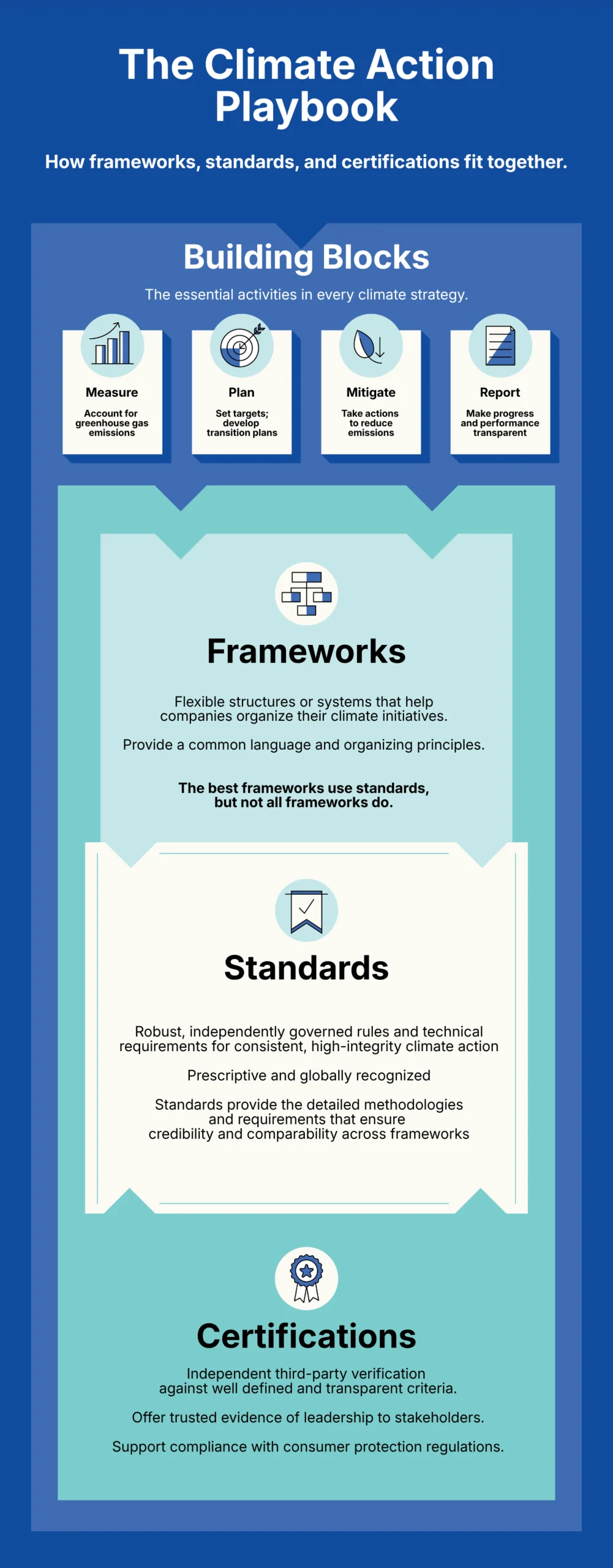
At the core of every high-integrity climate initiative lie four universal building blocks. Understanding these is the first step in moving from performative rhetoric to tangible impact.
- Measurement: The quantification of greenhouse gas (GHG) emissions across the value chain.
- Planning: The development of a roadmap—including climate budgets and risk assessments—to navigate the transition.
- Mitigation: The active reduction of climate impact through supply chain optimization, renewable energy procurement, and carbon removals.
- Reporting: The transparent disclosure of actions, outcomes, and progress to stakeholders.
These blocks are the "atomic units" of climate strategy. Whether a company is analyzing a specific product line or its entire corporate footprint, these four stages are unavoidable. The nuance, however, lies in the execution. Planning may involve sophisticated climate modeling, while mitigation might span everything from transitioning to sustainable aviation fuels to rethinking product end-of-life logistics.
Chronology of Complexity: From Frameworks to Standards
The evolution of climate governance has been rapid. In the early 2010s, "sustainability" was largely defined by voluntary, internal initiatives. Today, we are in an era of mandatory disclosure and standardized rigor.
- Phase 1: The Internal Framework Era (2010–2018): Companies like Adidas and Nike pioneered early strategies. Adidas’s Climate Transition Action Plan and Nike’s Move to Zero established the concept of bespoke frameworks. While these were visionary, they were also highly subjective, making cross-industry comparison difficult.
- Phase 2: The Standardization Wave (2019–2023): As scrutiny increased, the market shifted toward third-party standards. The GHG Protocol became the gold standard for measurement, while initiatives like the Exponential Business Playbook began offering comprehensive, cross-sector guidance.
- Phase 3: The Regulatory & Certification Era (2024–Present): With the introduction of the EU’s Empowering Consumers Directive and various global mandatory reporting requirements (such as the CSRD), the era of "self-reported sustainability" is ending. Companies now rely on third-party certifications to clear legal hurdles and provide the "proof" demanded by regulators and skeptical consumers.
Supporting Data: Why Consistency Matters
The cost of misalignment is significant. Research suggests that sustainability teams often spend over 12 months simply "learning the language" of new carbon accounting requirements. When goalposts move—as they often do with updates to the GHG Protocol or ISO standards—this time is wasted, and resources are diverted from actual mitigation efforts.
A key differentiator in successful firms is the integration of existing standards rather than the creation of new ones. For instance, the Purpose Pledge—a framework championed by Dr. Bronner’s—demonstrates how a high-integrity model can consolidate multiple existing standards (such as Regenerative Organic or TRUE Zero Waste) into a single, cohesive strategy. By leveraging established benchmarks, firms avoid the "reinvention trap," ensuring their data is audit-ready and globally recognized.
Official Perspectives: The Role of Independent Bodies
Independent non-profits and standard-setting bodies now play a critical role in mediating the tension between corporate ambition and verifiable action.

Representatives from organizations like the Environmental Defense Fund (EDF) and the administrators of the AIM Platform argue that standard-setting is not merely a bureaucratic exercise; it is a mechanism for market stabilization. By creating shared norms, these organizations protect the market from "climate noise."
In recent discussions regarding the update of the GHG Protocol and ISO-14064, experts have emphasized that the goal is "interoperability." As one lead auditor noted: "The objective is for a company’s data to be modular. A ton of carbon saved in a supply chain should be counted, verified, and reported in a way that satisfies both a local regulatory filing and a global investor report without requiring three different methodologies."
Implications: Navigating the Future
The current landscape forces a binary choice upon leadership: either invest in rigorous, third-party verified strategies or risk the reputational and legal fallout of vague, unverified claims.
The North Star: Mitigation
While measurement is essential, it is not the goal; it is the diagnostic tool. Mitigation is the only block that directly addresses atmospheric GHG concentrations. Companies that focus exclusively on reporting without evidence of aggressive mitigation will increasingly find themselves vulnerable to litigation and consumer backlash.
The "Avoidance" Strategy
To optimize resources, sustainability teams should adopt a policy of "reuse and recycle" regarding frameworks.
- Adapt, don’t build: Use the flexibility inherent in standards like the Exponential Business Playbook.
- Embrace Imprecision: Do not allow a lack of perfect data to stall action. Use estimates and ranges, clearly document the methodology, and refine as data quality improves.
- Link Outcomes: Map your data to multiple requirements simultaneously. The GHG inventory generated for regulatory compliance should be the same inventory used for brand marketing and sustainability reporting.
Communication and Audience Segmentation
Finally, the "one-size-fits-all" approach to climate communication is dead. Regulatory compliance requires high-fidelity, technical data, while consumer-facing communication requires simple, credible signals—often provided by third-party certifications. Misaligning these—such as using a marketing badge to satisfy a legal auditor—is a recipe for disaster.
Conclusion
The path toward a net-zero future is inherently complex, but it does not have to be chaotic. By grounding strategies in the four building blocks, adopting widely recognized standards, and utilizing certifications as independent verification, corporations can transform their climate strategy from a compliance burden into a competitive advantage.
The most successful companies of the next decade will be those that view decarbonization not as a branding exercise, but as a disciplined, transparent, and iterative process. In this era, the companies that thrive will be those that have stopped chasing moving goalposts and started building the infrastructure to hit them.