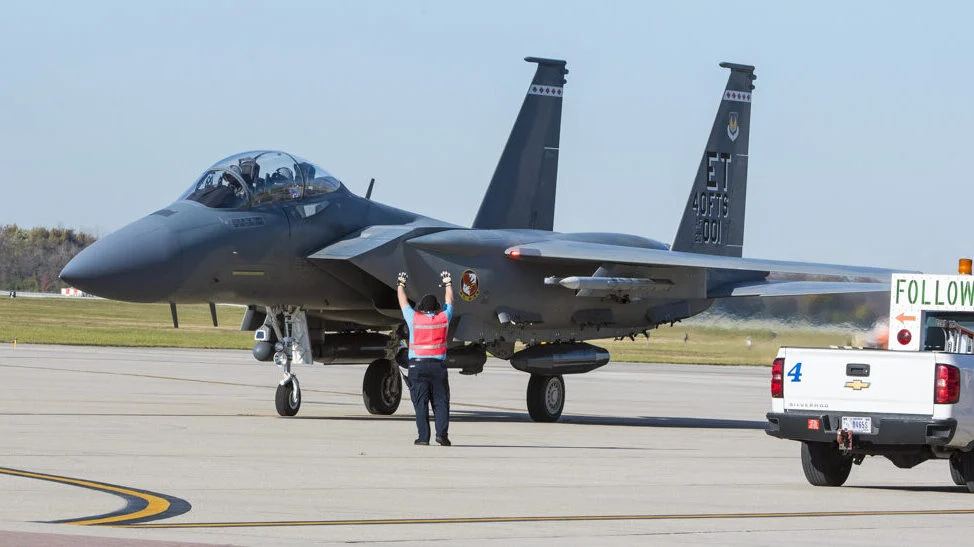
WASHINGTON — In a move that reaffirms the enduring relevance of fourth-generation air superiority, the U.S. Air Force has awarded aerospace giant Boeing a monumental contract vehicle for the F-15 fighter jet program. With a potential ceiling of up to $131.2 billion, the "Eagle Crest" initiative stands as one of the most significant defense procurement commitments in recent history, signaling a long-term strategic reliance on the F-15 platform even as the Pentagon pivots toward next-generation autonomous and stealth technologies.
According to an official notice from the Department of Defense, the Indefinite-Delivery/Indefinite-Quantity (ID/IQ) contract covers an exhaustive range of requirements, including aircraft production, sustainment, critical system upgrades, and logistical support. The agreement is set to span the next decade, with all work slated for completion by August 2037.
The Scope of "Eagle Crest"
The Eagle Crest contract is not a direct purchase of $131.2 billion worth of hardware today; rather, it is a massive "umbrella" vehicle designed to consolidate the administrative and budgetary pathways for all future F-15 requirements. By streamlining the acquisition process under a single, high-ceiling contract, the Air Force aims to reduce the bureaucratic friction that often plagues long-term defense programs.
This vehicle is intended to serve not only the U.S. Air Force but also the growing list of international allies operating the F-15, including Japan, Israel, Saudi Arabia, South Korea, and Singapore. The inclusion of these nations under one contract structure allows for faster Foreign Military Sales (FMS) execution, ensuring that as global threats evolve, the F-15 fleet remains technologically competitive without the need for redundant, time-consuming contract negotiations.
Chronology of a Legacy Platform
The longevity of the F-15—an airframe that first flew in the early 1970s—is a testament to the success of its design and the success of its modern iterations, particularly the F-15EX Eagle II.
- 1970s–2000s: The F-15 establishes itself as the premier air-superiority fighter, boasting an unmatched combat record.
- August 2020: The Air Force issues a $62 billion ID/IQ contract to Lockheed Martin for the F-16. At the time, this was considered a massive investment, but it pales in comparison to the scope of the new Eagle Crest deal.
- November 2025: Boeing faces significant industrial headwinds as a labor strike at its St. Louis production facility causes ripple effects across the F-15 supply chain.
- April 2026: The Air Force announces a strategic pivot to more than double its planned buy of the F-15EX, aiming for a total fleet size of 267 aircraft.
- May 2026: Israel announces major new orders for the F-15, further bolstering demand for the production line.
- August 2026: The U.S. Air Force officially executes the Eagle Crest contract vehicle.
The timeline reflects a period of intense transition. While the service is actively developing the Collaborative Combat Aircraft (CCA) and the next-generation F-47, the decision to commit over $130 billion to the F-15 platform suggests that the "Ex" variant will remain the backbone of the tactical fighter force for decades to come.
Supporting Data and Financial Strategy
To understand the magnitude of this award, one must look at the nature of ID/IQ contracts. As analysts at the Center for Strategic and Budgetary Assessments (CSBA) have noted, the $131.2 billion figure represents a "capacity ceiling." It is an authorization for potential spending rather than an immediate appropriation of funds.
Casey Nicastro, a senior analyst at CSBA, emphasizes that while this is a massive sum, it serves as a hedging strategy. "The size of the new contract seems to indicate that the Air Force believes aircraft like the F-15EX will still play a significant role in the future of air combat," Nicastro noted.
The financial structure also mirrors the "Golden Dome" initiative issued last year, though the Eagle Crest contract is more concentrated. While the Golden Dome program involved over 1,000 separate awards, the Eagle Crest contract is a direct, sole-sourced vehicle to Boeing. This allows for tighter integration between the manufacturer and the Air Force, which is vital given the technical complexity of the F-15EX’s planned upgrades.
Official Responses and Strategic Rationale
In a statement provided to Breaking Defense, an Air Force spokesperson clarified the logic behind the massive contract: "The Eagle Crest contract vehicle is designed to fund actions related to future F-15 agreements and will accelerate delivery of capability to the warfighter by streamlining how the Air Force executes future requirements for both the U.S. Air Force and Foreign Military Sales partners."
The spokesperson highlighted that the primary goal is flexibility. "As an indefinite-delivery, indefinite-quantity contract, it provides flexibility to support future efforts up to the contract ceiling, while each award remains subject to independent decision-making. By consolidating these efforts under a single contract vehicle, Eagle Crest will help the Air Force move faster and reduce administrative burden."
From the perspective of industry experts like John Ferrari, a former two-star Army general and fellow at the American Enterprise Institute, the high ceiling is a prudent move. "My guess is that they are trying to lock this in and there is zero downside to a high ceiling, but a big downside to having too little ceiling and running out," Ferrari observed.
Implications: The Challenges Ahead
Despite the optimism surrounding the contract, the program faces significant headwinds. The most pressing issue is the schedule. A recent Pentagon Selected Acquisition Report (SAR) confirmed that the F-15EX program has officially breached its baseline schedule for reaching Full Operational Capability (FOC). The milestone, originally expected sooner, has been pushed back to February 2028.
Industrial and Technical Hurdles
- Production Delays: The lingering impact of the 2025 labor strike has caused cascading delays. Key installations, including those in the Indo-Pacific theater like Kadena Air Base, have seen their delivery timelines shift, creating concerns about regional readiness.
- The "Technical Refresh" Challenge: The Air Force’s plan to increase the F-15EX buy is not merely a request for more of the same. The SAR notes that the program requires a "major technical refresh" to address the obsolescence of key systems. This includes a complete redesign of the radar, engine components, and the electronic warfare suite.
- Cost Uncertainty: Because these upgrades constitute a significant redesign, the Air Force does not yet have a finalized cost estimate for the expanded fleet. The program is currently undergoing a "re-baselining" process, which essentially resets the expectations for cost and performance.
The Global Market
The contract also highlights the shifting landscape of global defense sales. By including potential work for nations like Indonesia—which previously withdrew its interest in the F-15EX—and Poland, the Air Force is keeping the door open for future international integration. However, the omission of Qatar from the contract, despite the nation’s active operation of the F-15QA (the platform from which the F-15EX was derived), underscores the complex and often delicate nature of geopolitical arms agreements.
Conclusion: A Bridge to the Future
The $131.2 billion Eagle Crest contract is an admission of reality. It acknowledges that the future of air superiority is not built on a single, clean-sheet design, but on the marriage of proven, high-payload platforms like the F-15EX with the advanced, autonomous capabilities of the future.
For Boeing, this contract provides a decade of job security and a clear roadmap for production, provided they can overcome the current technical and supply chain hurdles. For the Air Force, it is a high-stakes bet that the "Eagle" has enough life left in its wings to carry the service through the most volatile decades of the 21st century. Whether the program can successfully navigate its current technical refresh and schedule delays remains the critical variable that will determine if this massive investment truly delivers on its promise to the warfighter.