
In the high-stakes world of corporate governance, the definition of "sustainability" is undergoing a profound transformation. Long dominated by Western-centric frameworks and North American environmental, social, and governance (ESG) standards, the landscape is pivoting. Recent research conducted by GlobeScan and BSR—the leading network of sustainable business experts—reveals that sustainability professionals at the world’s largest corporations are navigating a more constrained, compliance-heavy environment. As resources tighten and the scope of corporate priorities narrows, a critical question arises: Where will the future sustainability agenda be shaped?
The data suggests that the "center of gravity" for global sustainability is moving away from its traditional hubs. While the United States faces a decline in its perceived leadership, the Asia-Pacific region, the European Union, and emerging markets are stepping into the void, promising a more fragmented yet dynamic future for global corporate responsibility.
Main Facts: A Pivot Toward Compliance and Regional Influence
The 2026 survey, which polled 124 sustainability experts from multinational corporations with annual revenues exceeding $1 billion, paints a picture of a sector in transition. The era of broad, aspirational sustainability commitments is giving way to a more pragmatic, compliance-driven reality.
Key takeaways from the research include:
- The Narrowing of Focus: Sustainability professionals are reporting a shift toward "narrower priorities." Instead of tackling systemic societal issues, companies are doubling down on regulatory compliance and risk mitigation.
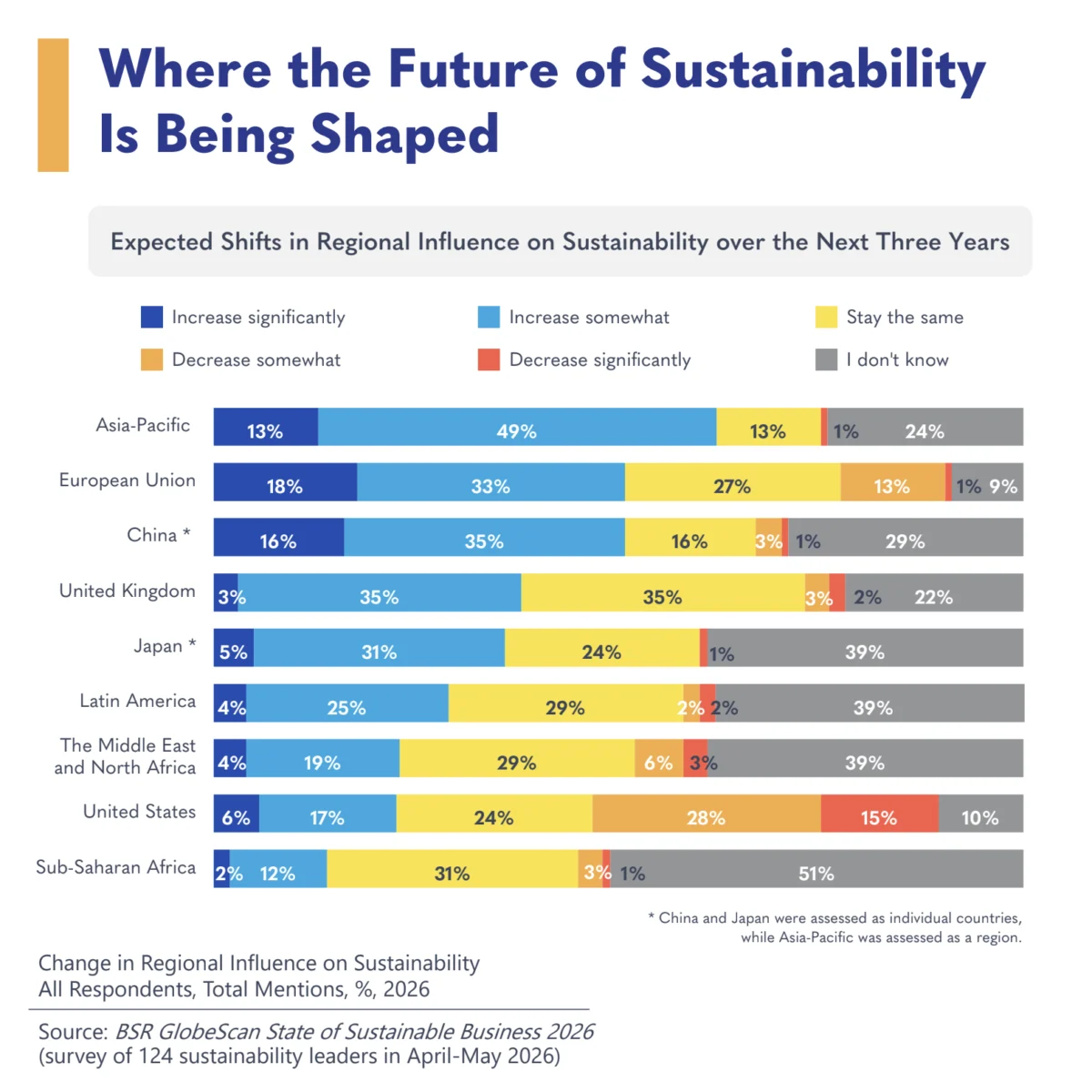
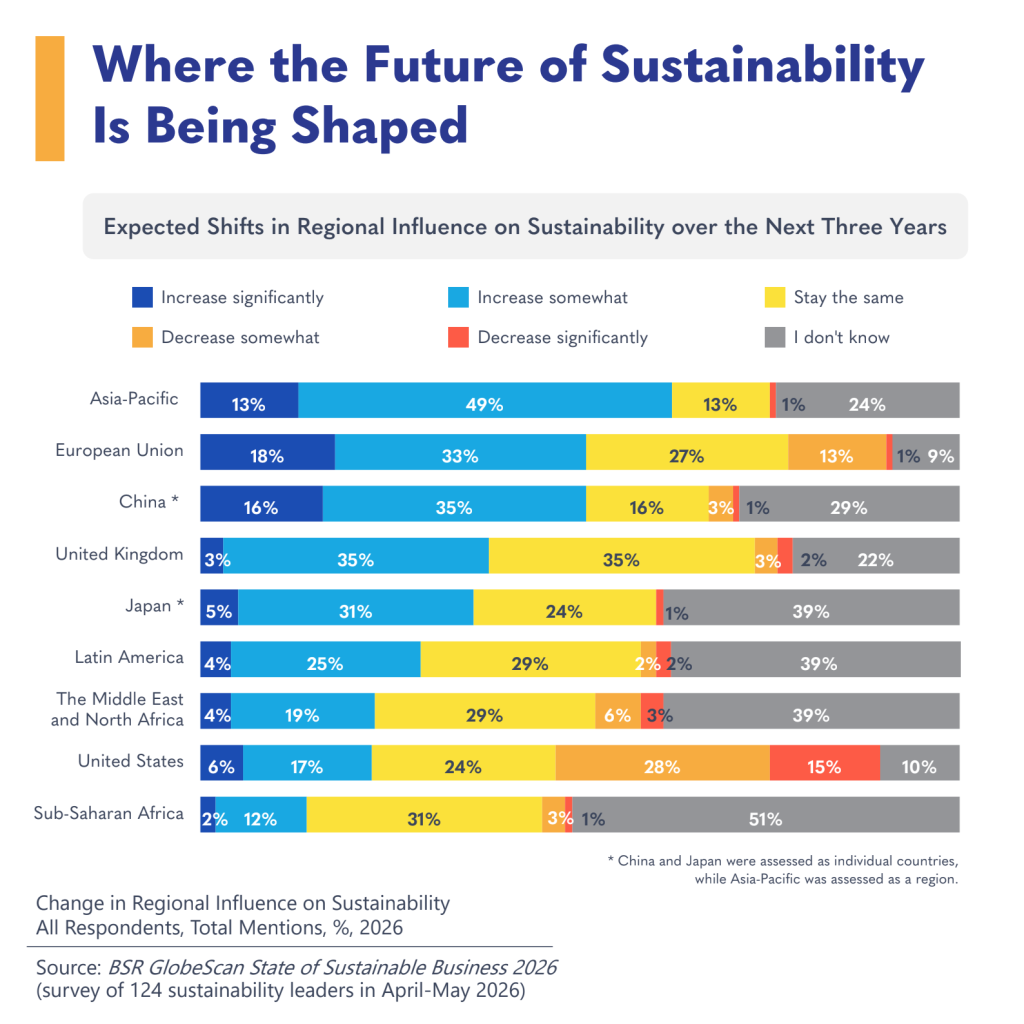
- The Rise of Asia-Pacific: Nearly two-thirds (64%) of respondents identified the Asia-Pacific region as the most significant rising power in shaping future sustainability standards.
- The EU and China as Anchors: Both the European Union and China are viewed as increasingly influential, likely due to the EU’s aggressive legislative agenda (such as the CSRD and CSDDD) and China’s rapid integration of green industrial policies.
- The U.S. Declension: A significant 43% of professionals expect the U.S. influence on sustainability to decrease, with only 23% expecting an increase. This marks a potential decoupling of U.S. corporate strategy from the global sustainability consensus.
Chronology: The Evolution of Global Sustainability Leadership
To understand the current shift, one must look at the timeline of corporate sustainability.
The Era of Voluntarism (2000–2015)
Sustainability was largely voluntary. Multinational corporations, primarily based in North America and Europe, championed Corporate Social Responsibility (CSR) as a brand-building exercise. The UN Global Compact and the early iterations of the Global Reporting Initiative (GRI) set the tone, with Western standards serving as the global default.
The Regulatory Awakening (2016–2022)
Following the 2015 Paris Agreement, the shift toward mandatory disclosure began. This period saw the rise of the Task Force on Climate-related Financial Disclosures (TCFD) and the integration of sustainability into mainstream finance. Europe led the charge, positioning itself as the "regulatory superpower" of the ESG world.

The Fragmentation and Compliance Crunch (2023–2026)
Post-pandemic, the global economy faced geopolitical instability, supply chain shocks, and inflationary pressures. For sustainability professionals, this meant "tighter resources." As noted by GlobeScan’s recent research, 2026 marks a turning point where companies are no longer just asking "how can we do more?" but "how can we comply with the most relevant regional regulations?"
Supporting Data: Mapping the Shifting Influence
The GlobeScan-BSR survey provides a granular look at how experts perceive regional influence. The data reflects a clear divergence in expectations.
Expected Changes in Regional Influence (Next 3 Years)
| Region | Expect Increase | Expect Decrease |
|---|---|---|
| Asia-Pacific | 64% | 12% |
| European Union | 58% | 15% |
| China | 55% | 18% |
| Latin America | 32% | 21% |
| Middle East/North Africa | 28% | 24% |
| United States | 23% | 43% |
This data highlights a "de-Americanization" of the sustainability agenda. For years, the U.S. market—driven by investor pressure from giants like BlackRock—set the pace. However, the current "anti-ESG" political climate in certain U.S. jurisdictions, combined with a lack of federal regulatory alignment, has led to a perceived retreat from global leadership.
Official Responses and Expert Analysis
James Morris, who leads GlobeScan’s San Francisco office, notes that the findings are not merely about geography; they are about the maturation of the market.
"We are witnessing a rebalancing," says Morris. "Sustainability is no longer a monolithic global movement managed from the headquarters of a Fortune 500 firm in New York or London. It is becoming a localized, multifaceted discipline. Success today depends on a company’s ability to decode the regulatory DNA of the markets in which they operate."
The consensus among the surveyed professionals is that the "global standard" is becoming harder to achieve. Instead, companies must adopt a "glocal" strategy—maintaining global corporate values while adhering to the stringent, and sometimes conflicting, demands of the EU’s Green Deal, China’s industrial decarbonization, and the varied requirements of the Asia-Pacific trade blocs.
Implications: Navigating the New Landscape
The implications for multinational corporations are profound. The shift from a centralized model to a fragmented one forces a fundamental rethink of organizational structure.
1. From "Global Standards" to "Regulatory Intelligence"
Companies can no longer rely on a single, global sustainability team to set policy. They must now invest in "regulatory intelligence" at the regional level. The ability to pivot strategy based on the specific demands of the EU’s taxonomy versus the emerging standards in Southeast Asia will become a competitive advantage.
2. The Risk of Policy Divergence
As Asia-Pacific and the EU strengthen their standards, companies risk becoming trapped between conflicting requirements. For example, a company might face one set of carbon accounting rules in its European supply chain and an entirely different set in its Asian manufacturing hubs. The cost of reconciliation will be high, potentially leading to the "narrower set of priorities" noted in the survey—essentially, companies will focus only on what they are legally forced to report.
3. The U.S. as an Outlier
If the United States continues to retreat from global sustainability leadership, American companies face a significant risk of isolation. If the rest of the world aligns on a common set of sustainability reporting standards—largely influenced by the EU—U.S. firms that do not voluntarily adopt these standards may find themselves locked out of key capital markets or supply chains.
4. Resourcing the "Compliance Crunch"
Sustainability budgets are increasingly being cannibalized by legal and compliance departments. While this ensures that reporting is accurate and defensible, there is a danger that the "innovation" side of sustainability—investing in new business models, circular economy initiatives, and social impact—will suffer.
Conclusion: A New Era of Sustainability
The research from GlobeScan and BSR serves as a wake-up call for corporate leadership. The era of comfortable, consensus-driven sustainability is over. We have entered a period of "geopolitical sustainability," where influence is tied to regulatory power, market size, and the capacity for industrial transformation.
As the Asia-Pacific region and the European Union emerge as the new standard-setters, companies must move quickly to adapt. They must move beyond the static, headquarters-led approach and embrace a dynamic, region-specific strategy. The companies that thrive in the coming years will not necessarily be those that have the best marketing or the most ambitious net-zero pledges; they will be those that possess the agility to integrate into the world’s most influential regulatory regimes while maintaining a clear, coherent strategy across their global operations.
In the words of James Morris, the future of sustainability is being shaped in the boardroom, yes—but it is being defined in the halls of regulators from Brussels to Beijing. For the global business community, the mandate is clear: adapt to the shifting geography of influence, or be left behind in the emerging, highly regulated global economy.