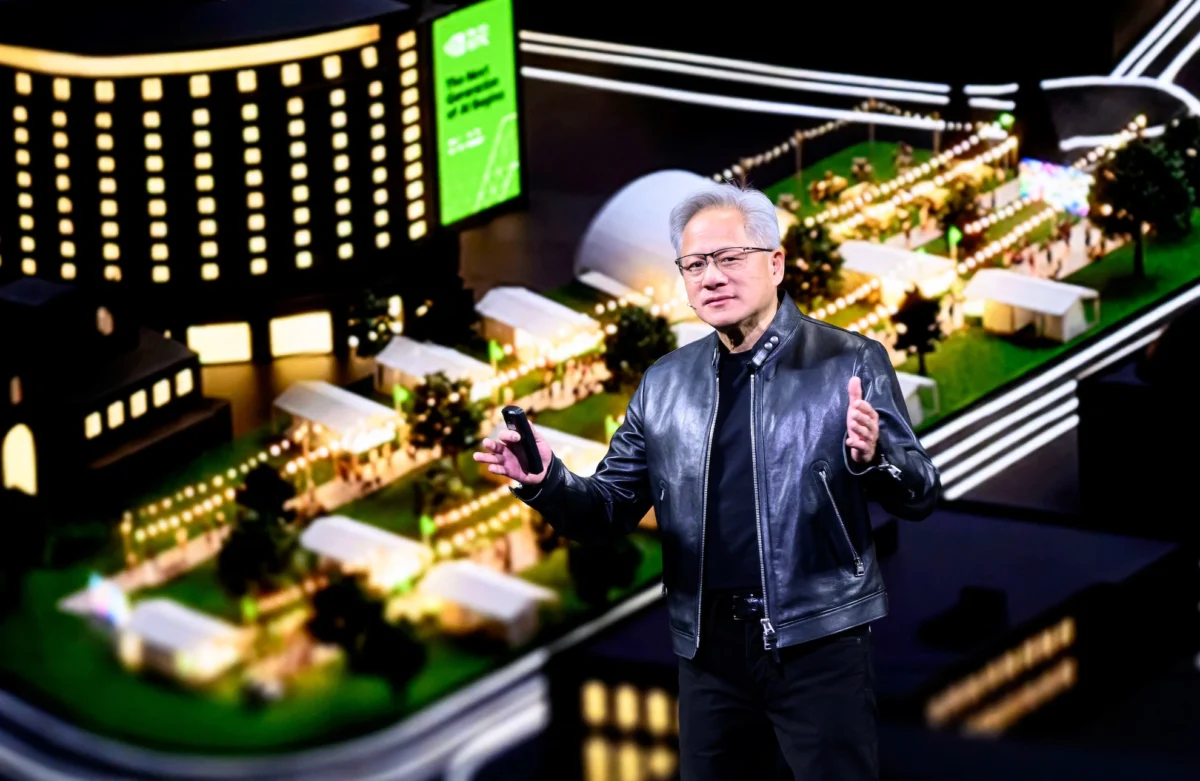
At the Goldman Sachs Communicopia + Technology conference this past Thursday, Nvidia founder and CEO Jensen Huang did more than just present a corporate update; he delivered a masterclass in market conviction. As the tech industry grapples with the sustainability of the artificial intelligence boom, Huang stood firmly against the tide of skepticism, reaffirming his belief that Nvidia’s record-breaking growth trajectory is not merely a momentary peak, but a long-term ascent that will carry well into the end of next year.
For observers worried that the "Nvidia party" might be nearing its conclusion—given the rise of in-house chip development by hyperscalers like Amazon, Microsoft, and Google, and the emergence of specialized competitors like Cerebras and Etched—Huang’s message was clear: Nvidia is no longer a component manufacturer; it is the foundational architecture of the modern digital economy.
The Evolution of the GPU: From PC Gaming to Planetary Infrastructure
To understand Nvidia’s current market position, Huang argued, one must first discard the outdated mental model of the company as a vendor of $399 graphics cards for home PCs. That era is dead.
“Most people think Nvidia builds a chip. I mean, you need airplanes to ship what we build,” Huang told the audience. He painted a picture of a modern Nvidia "GPU"—a term he now uses to describe massive, interconnected computing clusters rather than single silicon dies. “One GPU now is not $399. It’s $8.5 million dollars. That’s one GPU, all connected with NVLink, 2 million parts, right? 250,000 kilowatts. That’s a GPU, and we ship thousands of them.”
This fundamental shift in scale defines the company’s current dominance. Nvidia’s flagship computer systems—specifically the GB200 NVL72, a colossus combining 36 Grace CPUs with 72 Blackwell GPUs—are seeing staggering adoption rates, with Huang confirming a 27% month-over-month sales growth. This isn’t just hardware; it is the infrastructure upon which the entire AI industry is being built.
Chronology: From Silicon Valley Startup to Global AI Bedrock
Nvidia’s trajectory has been a steady climb toward ubiquity, but the last 24 months have represented an unprecedented vertical shift.
- The Catalyst: The release of ChatGPT and the subsequent "Generative AI" explosion forced every major cloud provider to pivot their capital expenditure toward Nvidia’s H100 and Blackwell architectures.
- The Scaling Phase: Throughout 2023 and 2024, Nvidia solidified its "full-stack" strategy, ensuring that its software ecosystem (CUDA) became the primary language for AI developers, effectively creating a "moat" that competitors have struggled to cross.
- The Current Milestone: Last month, Nvidia reported another record-breaking quarter, triggering a guidance update that shocked Wall Street: the company projected revenue growth of 70% for the coming year.
- The Future Outlook: During the Goldman Sachs conference, Huang doubled down on that 70% figure. With analysts estimating the current fiscal year to end at roughly $400 billion in revenue, a 70% growth rate suggests a horizon of nearly $680 billion in annual revenue for the next cycle.
Supporting Data: Why the Bull Case Holds
Huang’s confidence is not rooted in optimism, but in an exhaustive, almost granular level of data collection. Nvidia has positioned itself as the central node in a network of global intelligence. Because Nvidia hardware is the common denominator across Anthropic, OpenAI, Google, and the burgeoning field of open-weight models, the company has unparalleled visibility into the industry’s pulse.
"We’re tracking every single gigawatt of land, power, shell around the world," Huang explained. "Literally everything on the planet." By "shell," Huang refers to the physical data center buildings currently under construction before they are outfitted with compute racks. Because Nvidia works so closely with OEMs, cloud providers, and "neoclouds," the company acts as a central nervous system for the global AI build-out.
If a data center is being built in a remote region or a startup is scaling a new large language model (LLM), Nvidia is usually involved in the procurement phase. This unique vantage point allows Huang to see future demand cycles long before they appear on typical financial analysts’ radar.
Official Responses and the "Circular Deal" Controversy
The sheer scale of Nvidia’s financial success has invited scrutiny, particularly regarding "circular deals"—a criticism suggesting that Nvidia invests in startups, which then use that capital to purchase Nvidia hardware. Critics have compared this to the optics of the late-90s dot-com era, specifically citing the collapse of Lucent Technologies, which famously struggled with similar financing mechanics.
Huang, however, dismissed these concerns with characteristic bluntness and a touch of humor. "Well, it’s not circular because we put a little bit of money in, and a lot of money comes back," he said. "I look at the spreadsheet, we put in $1 and $100 comes back in. Is that circular? If that is, let’s do more of that."
Beyond the quips, Huang provided a rigorous defense of his risk management strategy. He noted that before any investment is finalized, Nvidia performs a rigorous audit to ensure the partner has genuine contracts and actual, verified revenue streams. According to Huang, he has personally reviewed $100 billion worth of these contracts, emphasizing that he is "not taking any risks" and requires a "sure thing" before capital deployment.
Implications: Can the Hegemony Last?
The implications of Huang’s forecast are profound. If Nvidia manages to sustain a 70% growth rate on an already massive revenue base, it would represent one of the greatest periods of value creation in industrial history. However, the tech industry is governed by a recurring, often brutal, law: the cycle of disruption.
The Efficiency Mandate
Huang’s own comments hint at the next phase of the AI industry. Currently, much of the revenue growth is driven by AI-native startups that are flush with venture capital and burning through it to secure compute. As the market matures, the focus will inevitably shift from "growth at all costs" to "operational efficiency." Companies will eventually learn to do more with fewer tokens and more efficient algorithms. If AI becomes more efficient, the insatiable demand for raw hardware could theoretically plateau.
The Competitive Landscape
While Huang remains bullish, the "hyperscalers" are not sitting still. Google’s TPU (Tensor Processing Unit) and internal efforts by Microsoft and Amazon to build custom silicon represent a long-term threat to Nvidia’s margins. Even if these custom chips do not match Nvidia’s performance, they represent a strategic attempt to decouple from a single supplier.
A New Industrial Era
Ultimately, Huang’s thesis rests on the belief that AI is not a trend, but a fundamental shift in how human knowledge is processed. By acting as the "foundational platform" for the AI ecosystem, Nvidia has woven itself into the fabric of the modern economy. Whether or not the company can maintain its current pace, the "Nvidia effect" has already changed the landscape.
As the industry moves forward, the question is no longer just about chip speeds or FLOPS; it is about who controls the infrastructure of the future. For now, Jensen Huang and Nvidia have positioned themselves as the architects of that future, and for the next 18 months at least, they seem convinced that the road ahead is wide open.