FARNBOROUGH, UK — The global landscape of air defense is undergoing a seismic shift. As modern battlefields in Eastern Europe and the Middle East demonstrate the increasing prevalence of high-volume, low-cost threats, defense manufacturers are pivoting away from the era of exclusively premium-priced interceptors. At this year’s Farnborough Airshow, the industry’s two titans, Lockheed Martin and MBDA, signaled this strategic evolution by unveiling new, cost-effective interceptor systems designed to bolster the defensive capacity of Western nations against an influx of cruise missiles, drones, and short-range ballistic threats.
The New Strategic Reality: Managing "The Problem Space"
The central challenge currently facing NATO and its partners is not just the sophistication of adversary hardware, but the sheer quantity of ordnance that can be deployed against air defenses. "An adversary can throw a lot at you—not just drones, but ballistic and cruise missiles in significant quantities," noted Tim Cahill, Lockheed Martin’s president for missiles and fire control. "You have to have the numbers, both from a defensive and offensive perspective."
This recognition has birthed a new requirement for the global defense industrial base: the ability to manufacture high-performance air defense assets at a scale and price point that makes them attrition-resistant. While existing systems like the Patriot Advanced Capability-3 (PAC-3) Missile Segment Enhancement (MSE) remain the "gold standard" for high-end threats, they are expensive and complex to produce. The industry is now attempting to bridge the gap between high-capability luxury and the immediate, mass-market necessity of theater defense.
Lockheed Martin’s PAC-3 ACE: Scaling Efficiency
Lockheed Martin’s announcement of the PAC-3 Adapted Capability Effector (ACE) dominated the opening day of the airshow. The ACE is not intended to cannibalize the existing MSE market; rather, it is a strategic supplement designed to handle threats where the extreme range and performance of the MSE might be considered "overkill."
Design Philosophy and Cost Reduction
The ACE is engineered to hit a price point approximately 50% lower than the current MSE unit cost. According to Lockheed officials, this is achieved through a disciplined "throttling back" of certain technical specifications. By streamlining the solid rocket motor and refining the seeker technology—the "eyes" of the interceptor—Lockheed is applying a "commercial-off-the-shelf" (COTS) mindset to a weapon system.
Beyond simple component downgrades, Lockheed is looking to revolutionize production through:
- AI-Integrated Manufacturing: Utilizing artificial intelligence to optimize assembly lines and quality control.
- Advanced Modular Design: Reducing the number of unique parts to increase manufacturing velocity.
- Globalized Supply Chains: In a move that signals a departure from traditional "US-only" production, Lockheed is exploring the possibility of producing the ACE seeker overseas.
Cahill noted that the company is currently issuing Requests for Information (RFI) to European firms with deep expertise in radio-frequency and seeker technology, explicitly citing Saab and Diehl as examples of the caliber of partners they are seeking.
Implications for Ukraine and Beyond
The timing of this announcement follows President Donald Trump’s recent declaration that Ukraine would be granted a license to produce Patriot systems domestically. While the technical specifics of that endeavor remain under wraps, the ACE system presents a much more viable candidate for local, rapid production. Its architecture, being less reliant on the proprietary, high-end components of the full-scale MSE, makes it a prime candidate for distributed, in-country manufacturing in allied nations.
MBDA’s Counter Mass Interceptor: A Platform-Agnostic Approach
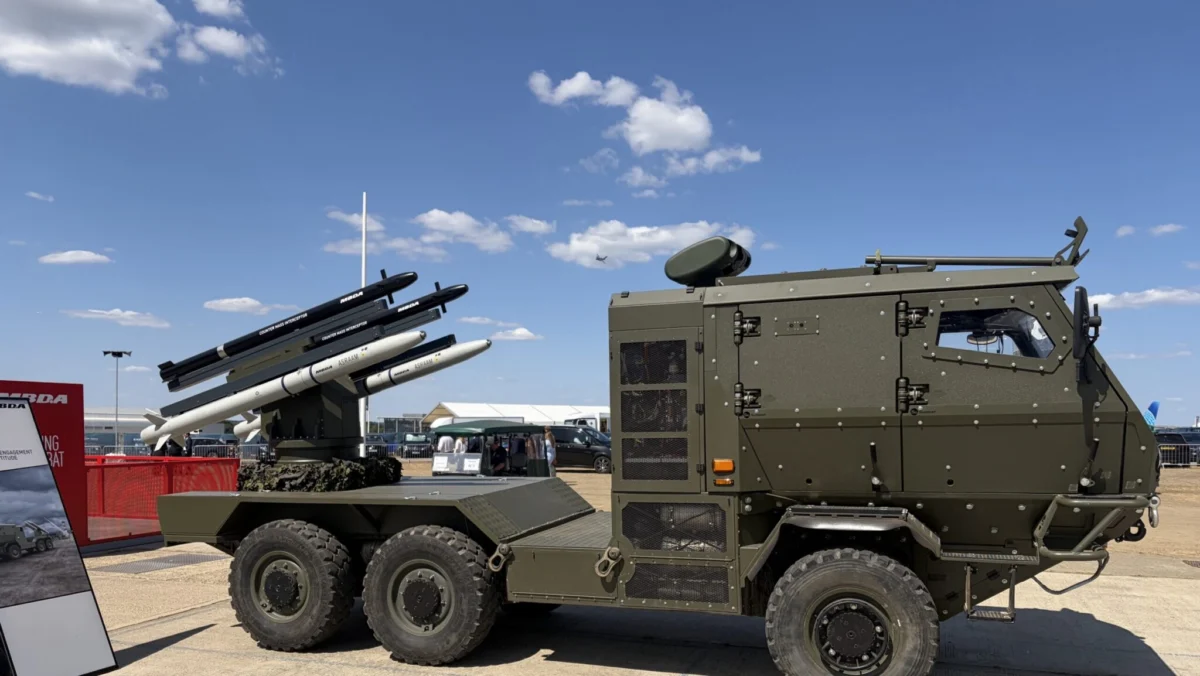
While Lockheed focused on the ballistic and cruise missile tier, European powerhouse MBDA unveiled the "Counter Mass Interceptor." This system targets a different, yet equally urgent, part of the "problem space": drones, helicopters, and low-altitude cruise missiles.
The ASRAAM Evolution
MBDA’s new weapon is a significant upgrade to its proven Advanced Short Range Air-to-Air Missile (ASRAAM). By repurposing this combat-proven technology for ground-based air defense, MBDA aims to solve the problem of engagement altitude.
"Traditional counter-UAS effectors only go up to a two to three-kilometer ceiling," explained Luke Webster, MBDA UK business development manager for ASRAAM. "This will double that." By providing a system that can engage targets at higher altitudes and speeds, MBDA is addressing the "evolving" nature of the drone threat, which is increasingly characterized by higher-speed, higher-altitude flight profiles.
Versatility as a Core Asset
Perhaps the most notable feature of the MBDA system is its "platform-agnostic" design. Recognizing that militaries are currently integrating air defense onto everything from pickup trucks to naval vessels, MBDA has engineered the interceptor to be easily modularized. Whether launched from an unmanned ground vehicle (UGV), a surface vessel, or a traditional truck mount, the system is designed to integrate into existing command-and-control architectures without requiring a complete overhaul of the host vehicle.
Chronology of Development and Future Testing
Both firms are under immense pressure to move from concept to field-ready hardware. The development timelines reflect the urgency of the current geopolitical environment:
- 2024 (Farnborough Airshow): Official unveiling of both the PAC-3 ACE and the Counter Mass Interceptor.
- Early 2025 – Mid 2026: MBDA expects to conduct a live-fire test of the 53-kg (117-pound) Counter Mass Interceptor. This 18-month window will be critical for validating the system’s effectiveness against high-speed drones.
- Early 2028: Lockheed Martin projects the first major flight test of the PAC-3 ACE. The company is leaning heavily on collaborations with European and American industry partners to accelerate this timeline.
Implications for Global Defense Strategy
The introduction of the ACE and the Counter Mass Interceptor signals a fundamental shift in the "defense economics" of the 21st century. For decades, the trend in military technology was toward exquisite, multi-million-dollar interceptors capable of handling any threat. However, the emergence of cheap, abundant threats—what military planners refer to as "massed fires"—has rendered that strategy unsustainable.
1. The End of "Exquisite" Dominance
By moving toward lower-cost interceptors, the defense industry is accepting that in a peer-level conflict, the sheer number of missiles launched by an adversary will eventually deplete any "exquisite" stockpile. The goal is no longer to have the most capable interceptor for every threat, but to have the most cost-effective interceptor for each specific tier of the threat spectrum.
2. Industry Consolidation and Cooperation
Lockheed’s willingness to look for European partners for seeker production and MBDA’s focus on platform-agnosticism represent a new, collaborative era. Western defense firms are realizing that supply chain resilience is as important as the missile itself. The ability to manufacture components across different borders—as highlighted by the potential for a European-made ACE seeker—could mitigate the bottlenecks that have hampered Patriot production for years.
3. The Shift to "Tiered" Defense
These systems suggest that the future of air defense is deeply tiered. A layered defense architecture will likely rely on:
- Top-Tier: PAC-3 MSE for high-altitude, high-value ballistic threats.
- Mid-Tier: PAC-3 ACE for cruise missiles and saturation ballistic threats.
- Lower-Tier: MBDA Counter Mass/ASRAAM-based systems for drones, helicopters, and tactical cruise missiles.
Conclusion
As the Farnborough Airshow concludes, the message from Lockheed Martin and MBDA is clear: the era of the high-cost, high-complexity monopoly is waning. In its place is a pragmatism born of necessity. Whether through Lockheed’s aggressive cost-reduction strategy for the PAC-3 ACE or MBDA’s versatile, platform-agnostic approach with the Counter Mass Interceptor, the defense industry is moving to ensure that NATO and its allies are never outgunned by quantity.
The successful deployment of these systems by 2028 will not just represent a technical achievement; it will be a test of whether Western defense manufacturing can pivot quickly enough to match the realities of modern, high-volume warfare. If they succeed, the battlefield of the future may be far more resilient, and the cost of defense far more sustainable.