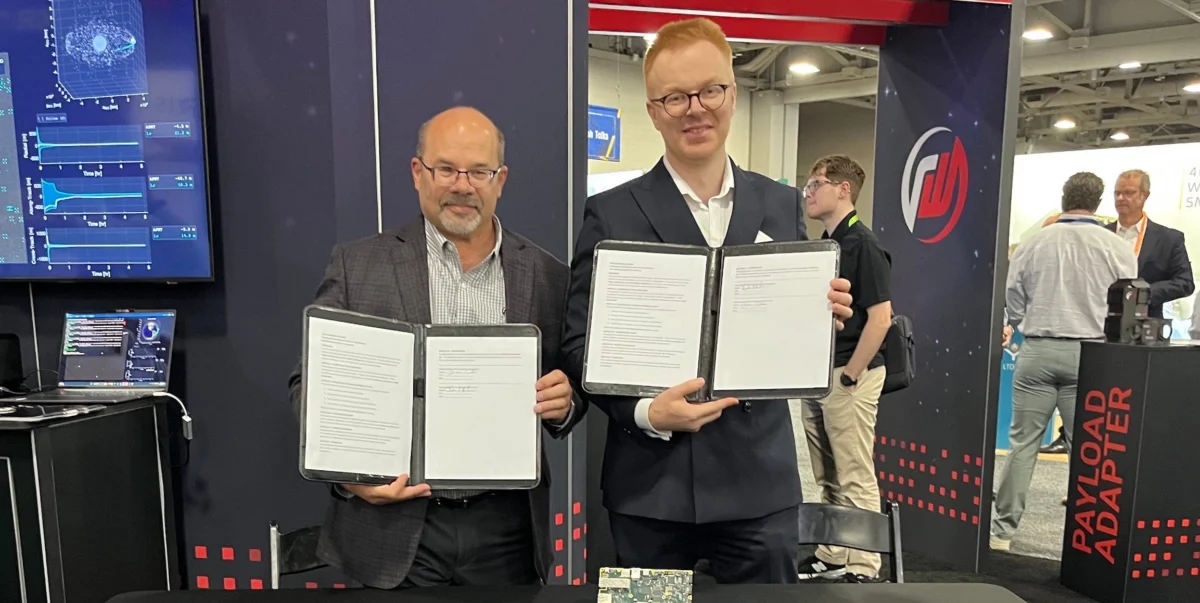
SALT LAKE CITY, UTAH — In a move designed to address the tightening bottleneck of orbital hardware production, Edge Aerospace and Redwire Corporation have announced a landmark licensing agreement that promises to reshape the landscape of space-based data processing. The partnership, formalized during a signing ceremony at the Small Satellite Conference (SmallSat) in Utah, authorizes Redwire to manufacture Edge Aerospace’s proprietary data processing units (DPUs) and network switches within the United States.
This strategic pivot serves as a critical bridge between European innovation and American demand, effectively domesticating the supply chain for a technology that has become the backbone of modern space domain awareness (SDA).
The Core Agreement: A Strategic Synthesis
The agreement marks a significant milestone for Luxembourg-based Edge Aerospace. Despite its European headquarters, the company has found its most aggressive growth trajectory within the U.S. aerospace sector. By leveraging Redwire’s established manufacturing infrastructure—specifically its facility in Marlborough, Massachusetts—Edge Aerospace can bypass the logistical and regulatory hurdles of importing high-end electronics for U.S. government and commercial clients.
For Redwire, the deal is equally transformative. By gaining the rights to manufacture Edge’s high-performance hardware, Redwire not only secures a steady supply of mission-critical components for its own product lines but also becomes a key distributor for the broader U.S. market. The agreement allows for the integration of Edge’s processing technology into Redwire’s existing systems, creating a streamlined, "off-the-shelf" solution for satellite integrators who are currently struggling with long lead times.
Chronology: From Collaboration to Formal Partnership
The relationship between the two entities is not new; it is the culmination of a multi-year effort to refine space-grade computing.
- 2024 (Early Days): Edge Aerospace, then a nascent firm barely out of its infancy, began collaborating with Redwire to test the viability of its processing units. These early stages focused on hardware compatibility and the validation of Edge’s architecture within the U.S. defense ecosystem.
- 2025 (Expansion Phase): As demand for space-based edge computing spiked, it became clear that Edge’s production capacity in Europe could not meet the exponential growth of its U.S. client base. Preliminary discussions regarding a manufacturing license began in earnest.
- August 25, 2026 (SmallSat Signing): At the annual Small Satellite Conference, JJ Jaworski, CEO of Edge Aerospace, and Don Wesson, Senior Vice President of Redwire Defense Tech, officially signed the agreement. This ceremony signaled the start of a new operational chapter for both companies.
- Q1 2027 (Projected Milestone): Redwire expects to initiate its first deliveries of the licensed DPUs and network switches. This target date is critical, as it aligns with the production cycles of major satellite constellation builders who are currently finalizing their 2027 and 2028 deployment manifests.
Supporting Data: The Processing Bottleneck
The necessity for this partnership is rooted in the current state of the global semiconductor market. According to industry analysts, space-grade hardware—particularly processors capable of handling high-volume data onboard—has been subject to lead times ranging from 18 to 24 months.
Don Wesson of Redwire emphasized that this supply chain friction is the primary driver of the deal. "Anyone that tries to buy processing at this point notices that there’s an 18-month to two-year lead time," Wesson noted. By localizing production in Massachusetts, Redwire is effectively insulating its customers from the volatility of international shipping and global component shortages.
The technological shift is being fueled by a change in mission profiles. As the industry transitions from simple data relay satellites to sophisticated, AI-driven platforms, the "on-orbit processing" requirement has surged. Spacecraft are no longer just sending raw data to the ground; they are processing it in real-time, performing signal analysis, and filtering noise—a task that requires robust, reliable, and radiation-hardened DPUs.
Official Responses and Strategic Outlook
JJ Jaworski, CEO of Edge Aerospace
For Jaworski, the deal is a testament to the company’s rapid ascent. "Since Edge Aerospace is two years old, bumping up towards such a large production is a challenge," he admitted during the signing event.
Jaworski highlights that the partnership is a dual-track strategy. While Redwire will handle the U.S. market, Edge Aerospace will continue its manufacturing operations in Europe for its international clients. This dual-track approach ensures that the company remains agile enough to serve global demand without sacrificing its footprint in the lucrative U.S. sector. "The U.S. market is growing surprisingly fast," Jaworski noted. "I have never seen such a demand for the systems we are building right now. This is where Redwire will be essential to help us scale it up."
Don Wesson, SVP of Redwire Defense Tech
Wesson views the agreement as a way to "control the supply chain." For a defense-focused entity like Redwire, the ability to guarantee delivery timelines is a massive competitive advantage. By manufacturing in Marlborough, Redwire is not just acquiring a product; they are acquiring the ability to respond to surge requirements from the U.S. government—a capability that is highly valued in the current geopolitical climate.
Implications for the Aerospace Industry
1. Accelerating Satellite Deployment
The most immediate implication of this agreement is the shortening of the satellite development cycle. By reducing the lead time for one of the most complex components—the processor—satellite integrators can accelerate their "concept-to-orbit" timeline. In an industry where being "first to orbit" can mean the difference between market dominance and irrelevance, this is a significant development.
2. Space Domain Awareness (SDA)
The demand for Edge processors is heavily skewed toward SDA missions. As the orbit becomes more crowded, the need to detect, identify, and track objects in real-time has become a national security imperative. These processors allow satellites to autonomously manage situational awareness data, reducing the burden on ground stations and increasing the speed of decision-making.
3. The Future of U.S.-European Aerospace Cooperation
This partnership serves as a model for future U.S.-European aerospace cooperation. By maintaining regional manufacturing hubs while sharing intellectual property and design architecture, companies can maximize their reach while adhering to national security regulations and domestic sourcing requirements (such as ITAR or similar compliance frameworks).
4. Market Consolidation
The move also highlights a trend of consolidation and strategic alliances among tier-two and tier-three space suppliers. As the "Space 2.0" era matures, companies are moving away from attempting to build everything in-house. Instead, they are forming specialized ecosystems where one partner focuses on cutting-edge design (Edge Aerospace) and the other on industrial-scale production (Redwire).
Conclusion
The licensing agreement between Edge Aerospace and Redwire is a harbinger of the professionalization of the small satellite sector. As the industry moves past the "experimental" phase and into an era of high-volume, mission-critical operations, the importance of robust, domestic supply chains cannot be overstated.
By marrying Edge’s innovative, data-centric hardware with Redwire’s manufacturing prowess, the two companies have created a roadmap for how to survive and thrive in an increasingly demanding space economy. With production slated to begin in early 2027, the industry will be watching closely to see how this collaboration affects the deployment speed and technical capability of the next generation of U.S. satellites. As satellite integrators scramble to meet the needs of a data-hungry world, this partnership ensures that the "brain" of the spacecraft will be ready when the call comes.