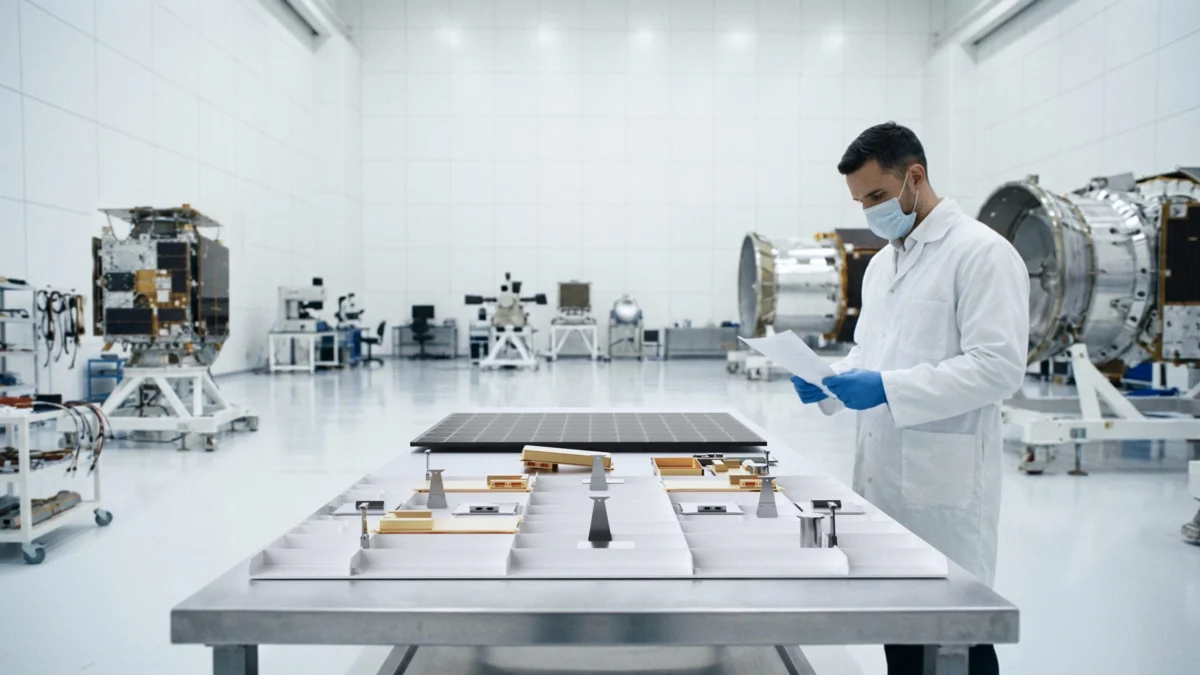
In a landmark development for the burgeoning orbital economy, Sophia Space and the California Institute of Technology (Caltech) have officially secured a patent that promises to redefine the limits of computational infrastructure. Patent No. 12,679,564, titled Space-Based Data Centers, represents a fundamental shift in how humanity manages digital information, transitioning from terrestrial server farms to modular, scalable, and self-sustaining architectures in low Earth orbit and beyond.
The patent, filed in October 2024 and officially issued on July 14, 2026, is the culmination of years of rigorous research into the thermodynamics and structural engineering required to house high-performance computing in the vacuum of space. By formalizing these architectures, Sophia Space—a portfolio company of the Pasadena-based venture studio Mandala Space Ventures—is positioning itself at the vanguard of a new industrial revolution in space.
The Genesis of Orbital Infrastructure: A Chronology
The journey toward Space-Based Data Centers did not happen in a vacuum, but rather through a carefully orchestrated collaboration between academia, government-backed research, and private enterprise.
- June 2023: Dr. Leon Alkalai, a distinguished former Jet Propulsion Laboratory (JPL) Fellow, founded Sophia Space. The company was incubated under the wing of Mandala Space Ventures, with a clear mandate: to bridge the gap between deep-space exploration technology and the commercial demand for robust, off-world data processing.
- October 2024: After intensive R&D, Sophia Space and Caltech formally filed the patent application for their modular data center architecture. This filing codified the proprietary "TILE" technology, a cornerstone of their future operations.
- July 14, 2026: The United States Patent and Trademark Office officially issued Patent No. 12,679,564, validating the technical viability of the team’s proposed architecture.
- July 29, 2026: Sophia Space and Caltech made the official public announcement, signaling a new phase of commercialization and expanded research partnerships.
The patent lists a "who’s who" of aerospace engineering, featuring seven primary inventors whose backgrounds represent a cross-pollination of JPL’s mission-critical expertise and Caltech’s academic rigor. Among the luminaries are Dr. John R. Brophy, Dr. Leon Alkalai, Prof. Sergio Pellegrino, Dr. Jonathan Sauder, Timothy P. McElrath, Dr. Douglas J. Sheldon, and Don J. Hunter.
Technical Foundations: The TILE Architecture
The core of the innovation lies in the realization that space is not merely a high-altitude location for a standard terrestrial data center. On Earth, data centers rely on sophisticated air-conditioning, water-cooling, and proximity to massive power grids. In space, these luxuries do not exist.
The Thermal Paradox of Space
As Dr. Leon Alkalai, Founder and CTO of Sophia Space, noted in a recent statement, the cooling problem is the most significant hurdle to overcome. "You can’t simply take a terrestrial data center and move it into space," Alkalai explained. "Building data centers in space requires a fresh look at the energy life-cycle problem. Cooling in space is not simple. The only way to cool the data center in space is by radiating waste heat into deep space."
The TILE Solution
To address this, the team invented the "TILE" architecture. This is a modular, scalable, and passively cooled unit. Instead of relying on active mechanical pumps or fans, the TILE architecture functions as a "smart surface." These units are designed to be assembled into massive arrays, effectively turning a spacecraft into a computing skin.
Key features of the TILE system include:
- Passive Cooling: Leveraging the extreme temperature differential between the solar-heated surface and the cold sink of deep space to dissipate heat without mechanical complexity.
- Solar-Powered Cycles: The modules are designed to integrate solar collection, ensuring that the computing nodes are constantly powered by the sun.
- Scalable Modularity: Much like building blocks, these TILE units can be launched individually or in clusters, allowing a data center to grow in capacity as the market demands.
Expanding the Research Horizon: The Caltech-Sophia Agreement
The issuance of the patent is only the beginning. Sophia Space has simultaneously announced a new sponsored research agreement with Caltech to push the boundaries of structural materials and thermal management further.
Prof. Sergio Pellegrino, a pioneer in deployable space structures, is at the helm of this ongoing research. The focus of this new phase is the development of ultra-lightweight materials that can be folded during launch and deployed to a massive scale once in orbit. For an orbital data center, surface area is everything; the more surface area that can be exposed to deep space, the more heat can be radiated, and the higher the computing capacity can be.
This collaboration underscores the importance of public-private partnerships in the "New Space" era. By leveraging Caltech’s fundamental research, Sophia Space is able to iterate rapidly on designs that would otherwise remain in the realm of theoretical physics.
The Implications: Why Data Centers in Space?
The transition to space-based data centers is not just a technological vanity project; it is a strategic necessity for the future of the global digital economy. As data demand skyrockets—driven by AI, large-scale simulations, and the growing satellite internet sector—terrestrial constraints are becoming more apparent.
1. Reducing Latency for Orbital Assets
As more infrastructure moves to orbit—including manufacturing, logistics, and surveillance—the need to process that data in-situ becomes critical. Sending petabytes of data back to Earth to be processed, only to send the results back to space, creates unnecessary latency and bandwidth bottlenecks. A space-based data center processes this information at the source.
2. The Sustainability Angle
Terrestrial data centers are among the world’s largest consumers of electricity and water. By shifting the computational load to solar-powered orbital units that utilize passive thermal radiation, Sophia Space is looking to decouple digital growth from terrestrial environmental strain.
3. Resilience and Security
By distributing data storage and processing across a modular, orbital network, organizations can achieve a level of physical security that is impossible on the ground. A space-based network is inherently more resilient to terrestrial natural disasters, geopolitical instability, or localized power grid failures.
Industry Outlook and Future Trajectory
The involvement of Mandala Space Ventures, a firm dedicated to the orbital economy, highlights the financial sector’s growing interest in these high-CAPEX, high-reward ventures. The "Orbital Economy" is no longer a buzzword; it is a sector characterized by real patents, real engineering, and real partnerships.
As the industry moves forward, the success of the Sophia Space-Caltech partnership will likely be measured by the successful deployment of a prototype TILE unit. If the team can demonstrate that a modular surface can maintain a stable temperature while operating at high computational loads, it will unlock a new paradigm of space industrialization.
The implications for the technology sector are profound. We are moving toward a future where "the cloud" is literal. By building the infrastructure to store, process, and transmit data in the vacuum of space, humanity is taking a significant step toward becoming a truly space-faring civilization.
"Our work invented the TILE architecture," Alkalai concluded, "a modular, scalable, passively-cooled, computing and data storage unit that can be assembled into a large-scale computing data center surface in space." As this technology moves from the patent office to the launchpad, the sky is no longer the limit for data storage—it is the platform.