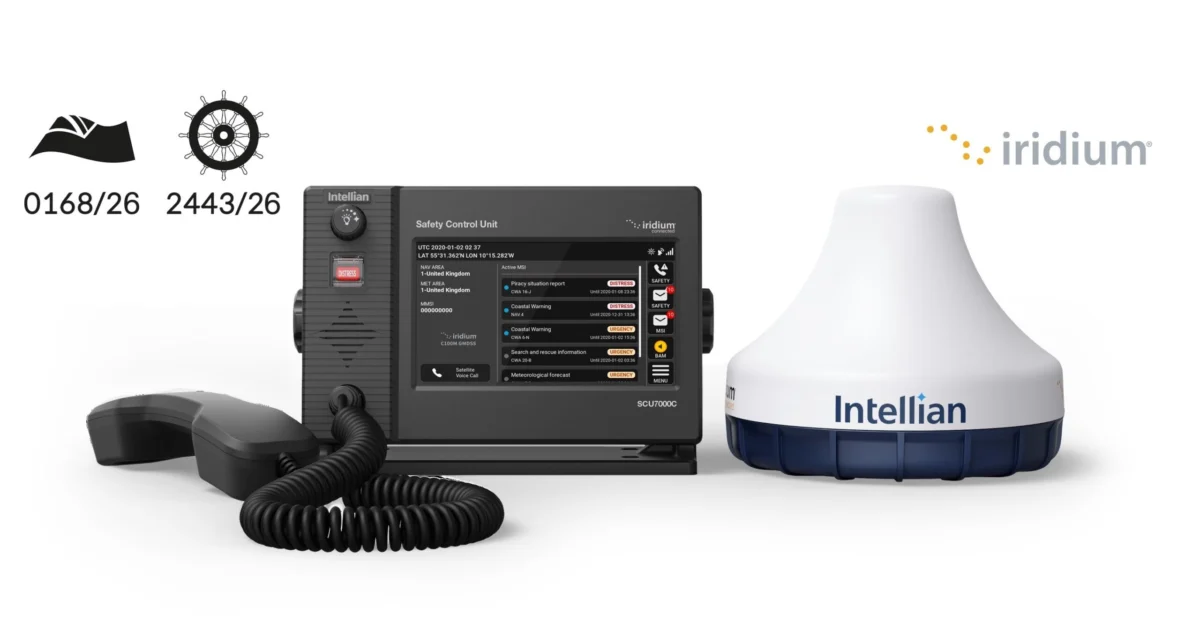
In a significant move to bolster maritime safety infrastructure, Intellian Technologies has officially unveiled the C100M, a specialized terminal engineered for Iridium’s Global Maritime Distress and Safety System (GMDSS). This development marks a pivotal expansion of Intellian’s product portfolio, positioning the company as the sole manufacturer providing dedicated hardware across every service tier of the Iridium Certus network.
The C100M is designed to operate seamlessly with Iridium’s satellite constellation, providing mariners with a lifeline that remains operational even in the most remote corners of the globe. By integrating advanced safety features into a compact, user-friendly unit, Intellian is aiming to streamline how vessels handle emergency communications in an increasingly digital maritime environment.
Main Facts: The C100M at a Glance
The Intellian C100M is more than just a communications terminal; it is a comprehensive safety control unit built to meet the rigorous standards of the International Maritime Organization (IMO). At its core, the system leverages the Iridium Certus 100 service, which is renowned for its low-latency, high-reliability L-band connectivity.
Key Functional Capabilities:
- Full Distress Alerting: The system provides a direct, one-touch mechanism for vessels to signal distress, ensuring that rescue coordination centers are notified immediately during life-threatening situations.
- Safety Voice Connectivity: Unlike traditional, limited systems, the C100M offers robust voice capabilities, allowing captains to communicate directly with search-and-rescue authorities.
- Maritime Safety Information (MSI): The terminal continuously receives critical updates, including navigational warnings, meteorological forecasts, and other essential data.
- Security and Tracking: The unit incorporates a Ship Security Alert System (SSAS) and supports Long-Range Identification and Tracking (LRIT), essential components for modern maritime compliance and fleet management.
- Installation Efficiency: A standout feature of the C100M is its "all-in-one" design, which merges the below-deck unit with the user terminal. Furthermore, the system is designed to be compatible with existing legacy antenna cabling, provided it remains in good operational condition, significantly reducing the cost and complexity of retrofitting older vessels.
Chronology: The Evolution of Iridium GMDSS
To understand the significance of the C100M, one must look back at the trajectory of maritime safety regulation and satellite evolution.
2020: The Breaking of the Monopoly
For decades, maritime satellite safety was dominated by a single provider. This changed in January 2020 when Iridium received formal authorization from the International Maritime Organization to provide GMDSS services. This landmark decision ended a long-standing monopoly, introducing competition and innovation to the GMDSS market.
2020–2024: The Rise of Certus
Following the 2020 authorization, Iridium rapidly scaled its Certus service. The network’s unique architecture—a mesh of 66 cross-linked satellites in Low Earth Orbit (LEO)—offered the first truly global coverage, including the Polar regions, where geostationary satellites often struggle to provide consistent signals.
2026: The Intellian Expansion
By mid-2026, the market demand for more compact and efficient safety terminals grew as regulatory bodies tightened requirements for digital safety systems. Intellian, having already established a strong partnership with Iridium, identified a gap in the "mid-tier" market—vessels requiring high-quality GMDSS but operating under space and budget constraints. The launch of the C100M in July 2026 represents the culmination of this market-driven development cycle.
Supporting Data: Why L-Band Remains King
While the maritime industry is currently captivated by the promise of high-speed Low Earth Orbit (LEO) broadband services, L-band connectivity—the foundation of the Iridium Certus 100 service—remains the gold standard for maritime safety.
Reliability in Harsh Environments
Unlike higher-frequency bands (such as Ku or Ka), L-band signals are largely immune to "rain fade," a phenomenon where heavy precipitation disrupts satellite connectivity. For a GMDSS terminal, the ability to transmit a distress signal through a tropical storm or a blizzard is not merely a feature; it is a requirement for survival.
Global Coverage Statistics
Iridium’s constellation remains the only satellite network to offer 100% global coverage. Data from maritime safety agencies indicates that a significant percentage of distress incidents occur in the "blind spots" of geostationary satellite networks—specifically the high latitudes near the North and South Poles. The C100M’s integration with the Iridium network ensures that a vessel is never out of range, regardless of its coordinates.
The "All-in-One" Economic Impact
Industry reports suggest that the cost of installing traditional GMDSS equipment has historically been prohibitive for smaller commercial fishing vessels and workboats. By allowing for the reuse of existing legacy antenna cabling, Intellian has lowered the "Total Cost of Ownership" (TCO) for shipowners. This creates a compelling business case for operators who were previously hesitant to upgrade their safety infrastructure due to the high costs of structural rewiring.
Official Responses and Industry Outlook
The launch of the C100M has been met with enthusiasm from industry stakeholders, who see it as a validation of the ongoing digital transformation of the maritime sector.
Eric Sung, CEO of Intellian Technologies, emphasized the strategic importance of this launch during the official announcement. "With the launch of the C100M GMDSS System, we now offer the industry’s most extensive portfolio of Iridium GMDSS Systems, with a tailored solution for every vessel size and requirement," Sung stated. He further noted that the terminal acts as a "seamless, modern upgrade path," helping vessels transition from outdated analog safety networks to a fully digital, future-proofed environment.
Market analysts suggest that Intellian’s decision to cover every tier of the Iridium Certus service puts them in a dominant position for the remainder of the decade. By providing a "one-stop-shop" for shipowners, Intellian can ensure that as a vessel grows or its needs change, the technology stack remains within the same ecosystem, simplifying maintenance, training, and support.
Implications: The Future of Maritime Safety
The introduction of the C100M has profound implications for the maritime industry, particularly in terms of regulatory compliance and operational safety.
1. Accelerating the Digital Transition
As the International Maritime Organization continues to push for the digitalization of shipping, hardware that simplifies this transition will become the standard. The C100M reduces the barrier to entry for smaller vessels, which are often the last to adopt new safety technology due to cost sensitivities.
2. Enhanced Search and Rescue (SAR) Efficiency
The technical capabilities of the C100M allow for more granular data transmission between the vessel and shore-based rescue centers. With better voice quality and reliable data tracking, Search and Rescue teams can coordinate more effectively, potentially reducing response times during critical incidents.
3. The End of "Legacy" Reliance
Many vessels currently operating at sea rely on equipment installed over a decade ago. These legacy systems are increasingly difficult to maintain as spare parts become scarce and service providers sunset older networks. The C100M provides a definitive roadmap for these operators, offering a solution that is not only state-of-the-art but also designed to integrate with the ship’s existing physical architecture.
4. A Standardized Safety Ecosystem
As Intellian solidifies its role as the primary hardware provider for Iridium GMDSS, the industry may move toward a more standardized experience. For mariners, this means that moving from one vessel to another will likely involve familiar interfaces and predictable operational protocols, reducing the risk of "human error" during emergency scenarios—a factor that has historically contributed to maritime tragedies.
Conclusion
The release of the Intellian C100M GMDSS terminal is a clear indicator that the maritime industry is prioritizing reliability, ease of integration, and global connectivity. By bridging the gap between legacy safety systems and modern L-band satellite technology, Intellian is not only expanding its market footprint but is also actively contributing to a safer global maritime environment. As the shipping industry continues to navigate the complexities of the 21st century, tools like the C100M will remain the vital, often unseen, backbone of human safety at sea.