In the current technological climate, the conversation is dominated by the meteoric rise of Large Language Models (LLMs) and generative AI. From ChatGPT to sophisticated image synthesis engines, the industry has become enamored with the "bigger is better" philosophy. However, for the pragmatic data scientist, the pursuit of the most complex model often obscures a fundamental truth: the simplest solution is frequently the most effective.
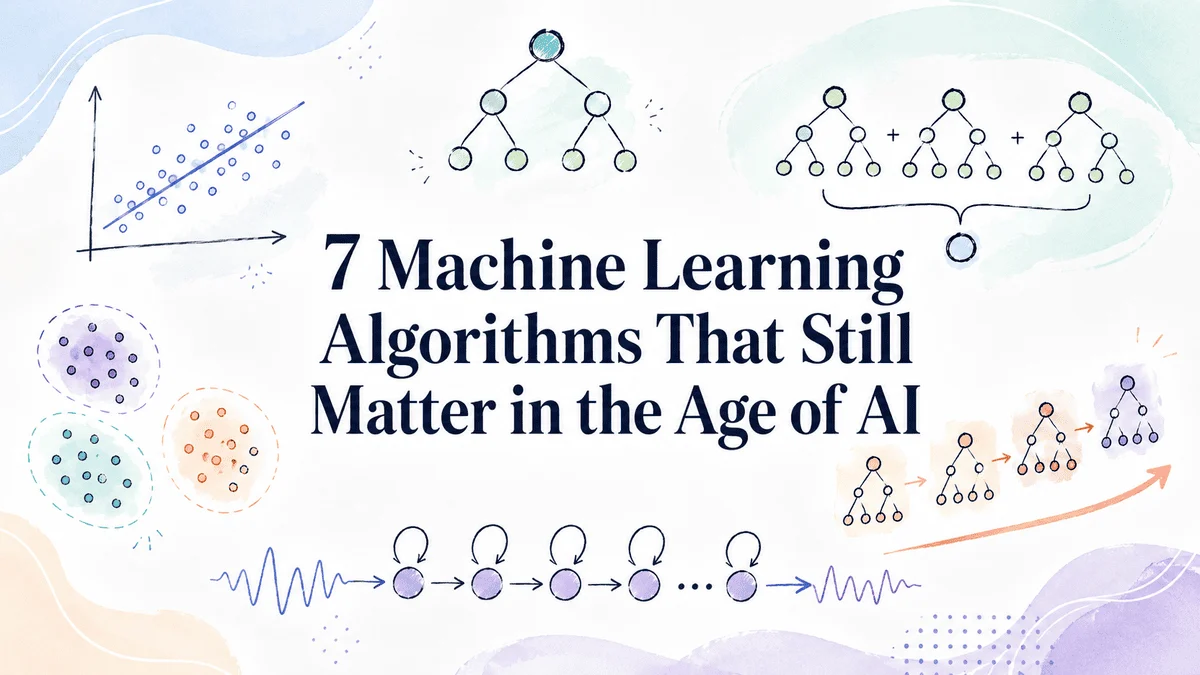
While generative AI captures headlines, the backbone of modern enterprise data science remains built upon time-tested machine learning algorithms. These foundational models offer efficiency, interpretability, and cost-effectiveness that massive transformer architectures simply cannot replicate for specific, structured tasks. This article explores the seven essential algorithms that remain indispensable in the age of AI, providing the technical context necessary for navigating modern data science challenges.
1. Linear Regression: The Bedrock of Predictive Analytics
Main Facts and Functionality
Linear regression remains the most widely deployed algorithm for predicting continuous numerical values. Its elegance lies in its mathematical simplicity: it models the linear relationship between independent input features and a dependent target variable by fitting a straight line that minimizes the sum of squared residuals.
Implications for Modern Data
Despite the advent of deep learning, linear regression is the "gold standard" for baseline performance. When tasked with predicting house prices, monthly revenue, or energy consumption, practitioners should always start here. If a linear model achieves high accuracy, the need for a complex neural network is nullified, saving significant computational resources.
from sklearn.linear_model import LinearRegression

# Initializing and training the model
model = LinearRegression()
model.fit(X_train, y_train)

# Predicting on test data
y_pred = model.predict(X_test)
By using fit(), the model calculates the coefficients that quantify the impact of each feature. This interpretability is crucial in regulated industries like finance and healthcare, where "black box" models are often rejected by stakeholders.
2. Logistic Regression: Classification with Precision
The Logic of Probability
Contrary to its name, logistic regression is a classification algorithm. It maps the output of a linear equation to a probability between 0 and 1 using the sigmoid function. This makes it ideal for binary classification tasks, such as determining if an email is spam or if a transaction is fraudulent.
Supporting Data and Usage
Logistic regression is computationally inexpensive and highly scalable. In many production environments, it serves as the primary engine for real-time decision-making where latency must be kept to a minimum. Because Scikit-learn implements regularization (L1/L2) by default, it effectively manages model complexity, preventing the overfitting that often plagues more complex models on small datasets.
3. LightGBM: Efficiency for Tabular Data
Technical Evolution
LightGBM (Light Gradient Boosting Machine) represents a shift in how we handle structured data. Unlike traditional boosting methods that grow trees level-wise, LightGBM grows them leaf-wise. This approach prioritizes the leaves that reduce loss the most, leading to significantly faster training times and higher accuracy.
Why It Matters
For data scientists working with massive tabular datasets, LightGBM is often the first choice. Its use of histogram-based learning—which buckets continuous features into discrete bins—dramatically reduces memory consumption. It is a powerful tool for high-dimensional data where training speed is a priority, supporting parallel and GPU-accelerated learning.
from lightgbm import LGBMClassifier

model = LGBMClassifier()
model.fit(X_train, y_train)
y_pred = model.predict(X_test)
4. XGBoost: The Industry Standard for Gradient Boosting
Chronology and Dominance
XGBoost (eXtreme Gradient Boosting) fundamentally changed the landscape of machine learning competitions. It popularized the use of gradient boosting for structured data, refining the process of building sequential trees where each tree attempts to correct the residuals of the previous ones.
Official Performance Standards
XGBoost remains the most reliable algorithm for ranking and regression tasks. By utilizing tree_method="hist", developers can achieve efficiency comparable to LightGBM while maintaining the robustness and hyper-parameter flexibility that XGBoost is known for. It is the definitive choice for enterprise-grade tabular modeling.
5. Random Forest: Ensemble Strength
Core Mechanism
Random Forest operates on the principle of "wisdom of the crowd." By creating an ensemble of decision trees trained on random subsets of the data (bagging) and random subsets of features (feature bagging), it drastically reduces the variance of the model.
Practical Implications
One of the greatest strengths of the Random Forest algorithm is its built-in capability for feature importance. It allows data scientists to quantify exactly which variables are driving the model’s predictions, providing the transparency required for business intelligence. Because it is highly resistant to overfitting, it is a robust "set it and forget it" solution for many classification and regression problems.
6. Long Short-Term Memory (LSTM) Networks
The Sequence Challenge
While tree-based models excel at tabular data, they struggle with temporal dependencies. LSTMs are a specialized type of Recurrent Neural Network (RNN) designed to overcome the "vanishing gradient" problem, allowing the model to retain information across long sequences.
Industry Application
LSTMs are the standard for time-series forecasting, speech recognition, and natural language processing tasks that require long-term context. They use a system of "gates"—forget, input, and output—to manage the flow of information. While they require more data and compute power than the other algorithms on this list, they are unmatched when the order and history of data points are the primary drivers of the outcome.
7. K-Means Clustering: Uncovering Hidden Patterns
Unsupervised Learning Principles
K-Means is the quintessential unsupervised learning algorithm. It seeks to partition observations into k distinct clusters by iteratively assigning points to the nearest centroid and then recalculating that centroid’s position.
Strategic Use Cases
K-Means is invaluable for market segmentation, anomaly detection, and data exploration. It requires no labels, making it the perfect starting point for understanding raw data before deploying supervised models. The primary challenge remains selecting the optimal value of k, usually addressed through the "Elbow Method" or silhouette analysis.
Implications for the Future of Data Science
The current obsession with Generative AI has created a "complexity trap." Organizations often spend millions in compute costs to implement massive LLMs for tasks that could be handled by a simple, well-tuned gradient boosting model.
The Path Forward
The future of data science is not exclusively generative. Instead, it is becoming a hybrid discipline. The most successful practitioners are those who recognize the hierarchy of complexity:
- Start with the Baseline: Always begin with simple models like Linear or Logistic Regression to establish a performance benchmark.
- Optimize for Structure: Use XGBoost or LightGBM for tabular data where performance and speed are paramount.
- Deploy Complexity When Necessary: Reserve LSTMs and large transformers for sequential or unstructured tasks that defy traditional statistical methods.
The skill that truly defines an expert data scientist is not the ability to fine-tune the latest model from Hugging Face; it is the wisdom to know when a 50-line script using a classical algorithm will outperform a massive, opaque AI system. By returning to these seven core algorithms, data scientists can build faster, cheaper, and more reliable systems that deliver tangible business value in an era otherwise blinded by the hype of the "next big thing."
As we look toward the future, the integration of these fundamental models into automated pipelines will continue to be the cornerstone of effective machine learning engineering. Simplicity, when applied correctly, remains the ultimate sophistication.