In the rapidly evolving landscape of artificial intelligence, the focus is often directed toward the parameter count of massive foundation models. However, for practitioners building narrow, high-frequency automation—such as support ticket classification—the true challenge lies not in model capacity, but in inference efficiency.
This article concludes our three-part series on optimizing Small Language Models (SLMs). Having previously explored the benefits of constraining output space and the strategic reuse of key-value (KV) caches, we now turn our attention to the most significant bottleneck in production pipelines: the inefficiency of item-by-item processing. By transitioning to a strategy of batching by length, developers can significantly accelerate throughput without sacrificing the accuracy of their models.
The Core Problem: The Latency Tax of Sequential Processing
When deploying a model like the Qwen2.5-0.5B-Instruct on consumer-grade hardware—such as an M2 MacBook Air—processing one ticket per forward pass represents a massive waste of computational potential. At a batch size of 1, small models are rarely compute-bound; they are memory-bandwidth bound.
In this "item-by-item" regime, the hardware is forced to stream every model weight from memory to the processor to serve a single sequence. Once that sequence is complete, the process repeats. The arithmetic units, which are designed for massive parallelism, spend the vast majority of their time idling, waiting for memory controllers to fetch the next set of weights.
While batching is the standard solution to this problem, naive implementations introduce their own inefficiencies. Because deep learning frameworks require all sequences within a batch to be of identical length, they rely on padding—adding filler tokens to shorter sequences to match the longest item in the batch. In real-world datasets, which typically follow a "long-tail" distribution (where many items are short, but a few are quite long), padding every batch to the global maximum leads to a scenario where the model spends most of its cycles processing meaningless filler rather than useful data.
Chronology of the Optimization Strategy
To solve the conflict between memory-bound sequential processing and the padding-heavy waste of standard batching, we must implement a more intelligent scheduling strategy.
Phase 1: The Baseline (The "One-at-a-Time" Approach)
Our baseline tests were conducted on an M2 MacBook Air with 24GB of RAM using the Qwen2.5-0.5B-Instruct model in float16 precision. We simulated a realistic support ticket distribution: a few long, complex queries mixed with a large volume of short, punchy requests.
Running these 600 tickets individually yielded a throughput of approximately 4.2 items per second. The total execution time was 144.35 seconds. The diagnostic metrics were clear: because the maximum prompt length was 449 tokens while the median was only 94, the system was wasting significant cycles on padding overhead.
Phase 2: Implementing Length-Bucketed Batching
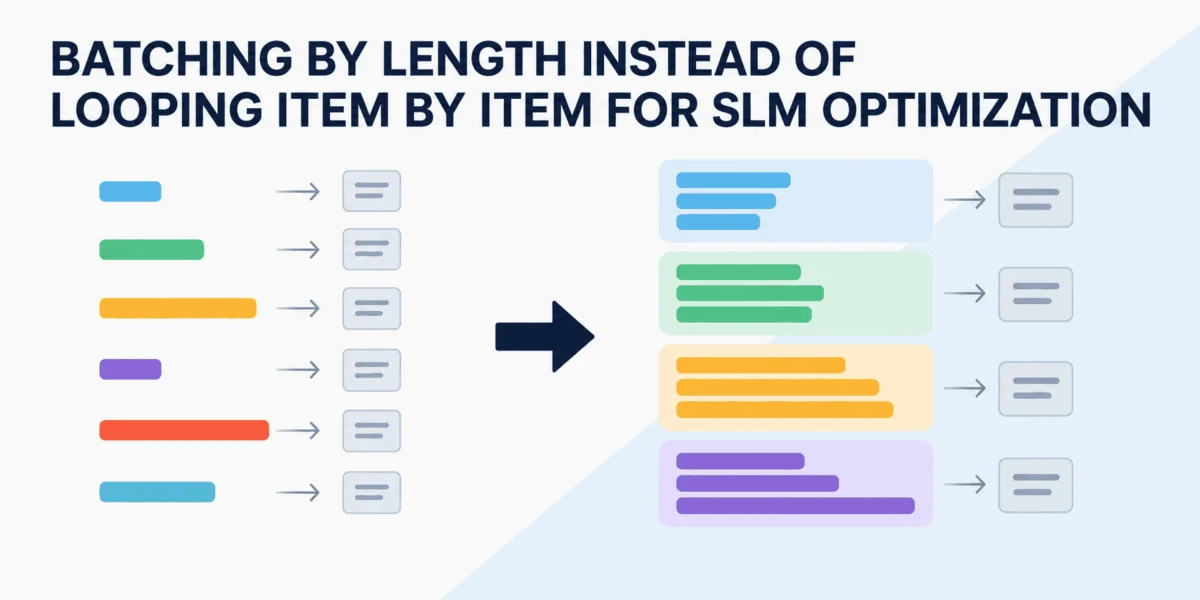
The objective was to minimize padding by grouping similar sequences together. By sorting the dataset by token length before partitioning it into batches, each batch can be padded to its own "local" maximum.
The algorithm follows a simple logical flow:
- Tokenize and Measure: Convert all raw inputs into token IDs and record their lengths.
- Sort: Reorder the indices of the dataset based on these lengths.
- Chunking: Slice the sorted list into batches of a fixed size (e.g., 32).
- Local Padding: Process each batch through the model. Because the batch contains sequences of similar lengths, the padding added to reach the maximum within that batch is negligible compared to the global maximum.
Phase 3: Validation and Benchmarking
We ran the batched version against the original dataset. The results were stark: the throughput jumped to 7.5 items per second, reducing the total processing time to 79.6 seconds—a near 45% reduction in latency. Most importantly, the padding overhead—the percentage of total processed tokens that were effectively "wasted"—dropped to a mere 7.6%.
Supporting Data: Why Sorting Matters
The gap between a "randomly batched" approach and a "length-sorted" approach provides a direct, empirical measurement of the optimization’s value.
| Metric | Item-by-Item | Length-Sorted Batching |
|---|---|---|
| Total Time | 144.35s | 79.60s |
| Throughput | 4.2 items/s | 7.5 items/s |
| Padding Overhead | High (Global Max) | 7.6% (Local Max) |
| Accuracy | Baseline | 100% Agreement with Baseline |
The "agreement" check is critical. As noted in the methodology, we performed a probe test comparing the output of the batched model against the unbatched model. The result was a 10/10 match. If an optimization increases speed but alters the model’s classification, it is not an optimization—it is a regression.
Technical Considerations and Official Best Practices
While batching by length offers a clear performance path, there are specific architectural nuances that developers must respect.
Combining Prefix Caching and Batching
A recurring theme in this series has been the use of KV caches to speed up repeated prompt prefixes (e.g., system instructions). However, combining prefix caching with batching is not a "free" operation. Since the cache was likely built with a batch size of 1, applying it to a batch of 32 requires expanding the key and value tensors to match the new batch dimension.
Developers should:
- Verify Shape Compatibility: Ensure the expanded cache tensors are correctly mapped to each item in the batch.
- Crop Carefully: After processing, the cache must be managed to ensure that specific padding tokens do not pollute the key-value state for future generations.
- Test for Drift: Always validate the output against an unbatched, non-cached run during the implementation phase.
The Hardware-Memory Interface
It is vital to recognize that these optimizations rely on the interplay between the Neural Engine and the system memory. By batching, we are shifting the model from being limited by the time it takes to move data from RAM to the processor (memory-bandwidth bound) to being limited by the arithmetic capability of the chip (compute-bound). For developers working with SLMs, this is the "sweet spot" of performance.
Implications for Industry and Future Development
The implications of this series are significant for the broader data science community. As we push for smaller, more efficient models to run at the "edge"—on laptops, mobile devices, and local servers—the need for algorithmic efficiency becomes as important as model training.
- Democratization of AI: By reducing the compute requirements for inference, these techniques allow smaller organizations to deploy sophisticated NLP pipelines on modest hardware, bypassing the need for expensive cloud-based GPU clusters.
- Sustainability: Efficient inference is green inference. By cutting the time required to process a dataset by nearly half, we effectively halve the energy consumption required for that specific task.
- Shift in Focus: The data science community is beginning to move away from "brute force" AI. The future of the field lies in the architectural optimization of existing, well-understood models.
Final Summary of the Series
To recap our journey through SLM optimization:
- Constraint of Output Space: By limiting the model’s vocabulary at the output layer, we remove the need for full-sequence decoding, saving cycles on every pass.
- Key-Value Cache Re-use: By caching the static portions of a prompt, we eliminate redundant computations that occur in every request.
- Length-Bucketed Batching: By aligning our data to the hardware’s strengths, we maximize throughput and minimize the waste inherent in traditional padding.
None of these techniques make the model "smarter" in terms of reasoning, but they make the model infinitely more practical for real-world application. As we continue to refine how we interact with Small Language Models, the focus must remain on these fundamentals: verify your outputs, measure your bottlenecks, and optimize for the hardware you have.