In the rapidly evolving ecosystem of artificial intelligence, the deployment of Small Language Models (SLMs) has emerged as a cornerstone for efficient, narrow-scope automation. While much of the industry’s discourse remains fixated on the gargantuan parameter counts of frontier models, a quiet revolution is taking place in the realm of operational efficiency. For developers and engineers, the challenge is no longer just about model accuracy, but about extracting maximum utility from limited hardware.
This article, the final installment in a technical series focused on SLM optimization, explores the critical role of length-bucketed batching. By moving away from inefficient, item-by-item processing and implementing smart, sorted batching, developers can achieve significant throughput gains without compromising the integrity of the model’s output.
Main Facts: The Bottleneck of Sequential Processing
At the heart of the current optimization challenge is a fundamental hardware reality: processing one ticket per forward pass is the single largest source of waste in the typical inference pipeline. When a model operates at a batch size of 1, it is almost exclusively memory-bandwidth bound rather than compute-bound.
In this scenario, the hardware is forced to stream every weight out of memory to serve a single sequence. Once that sequence is complete, the process repeats. The result is that the arithmetic units—the very heart of the GPU or CPU—sit idle for the vast majority of the time, waiting for the next set of weights to load.
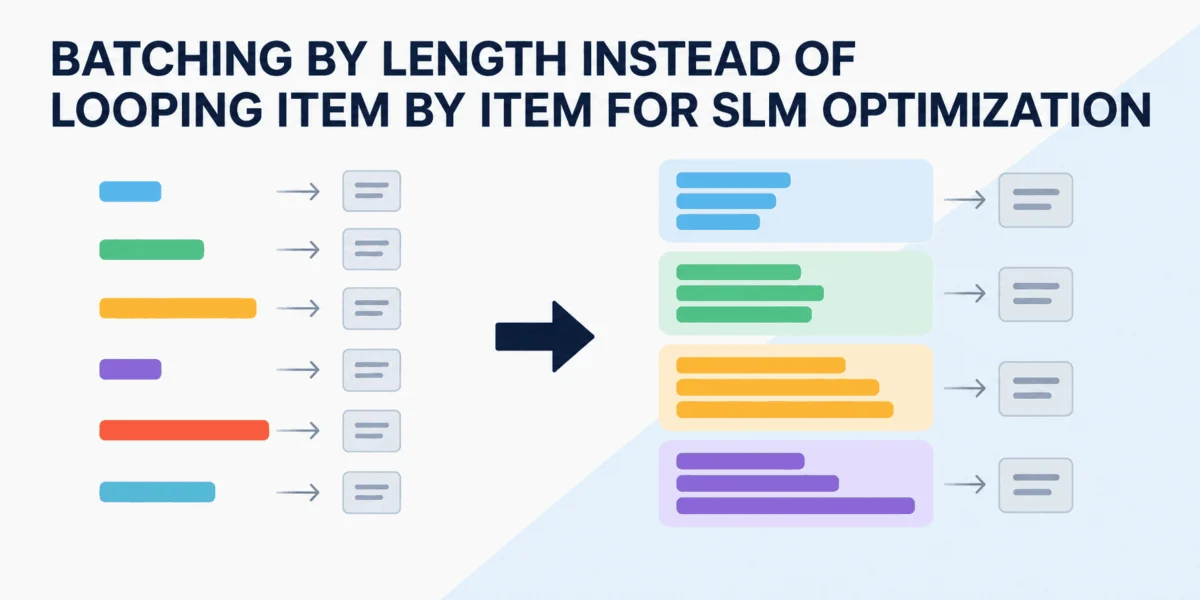
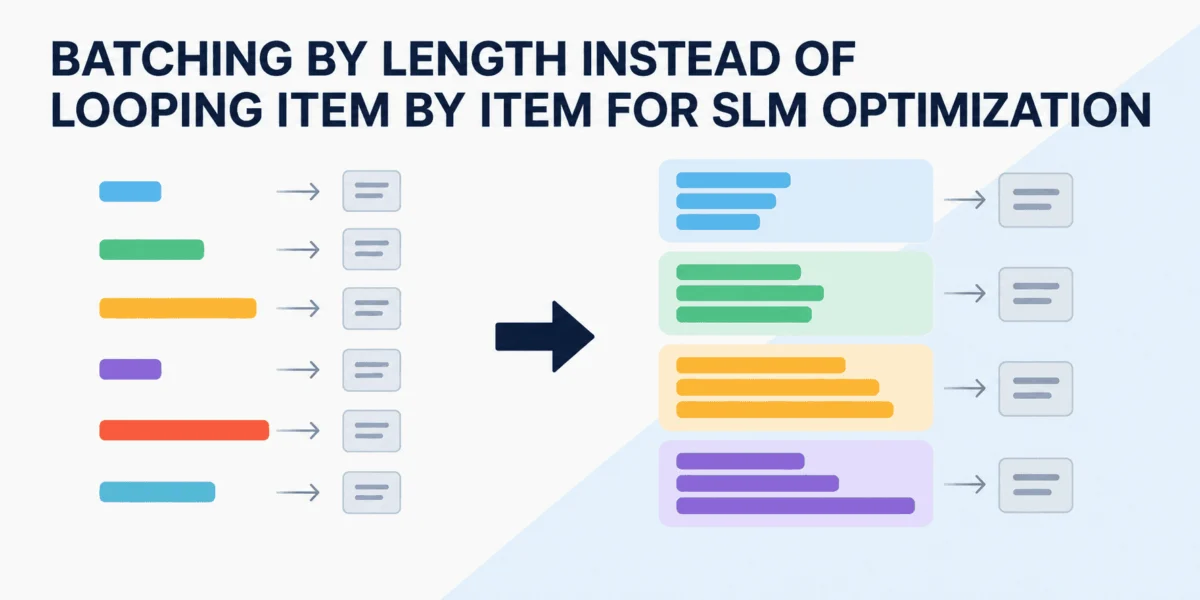
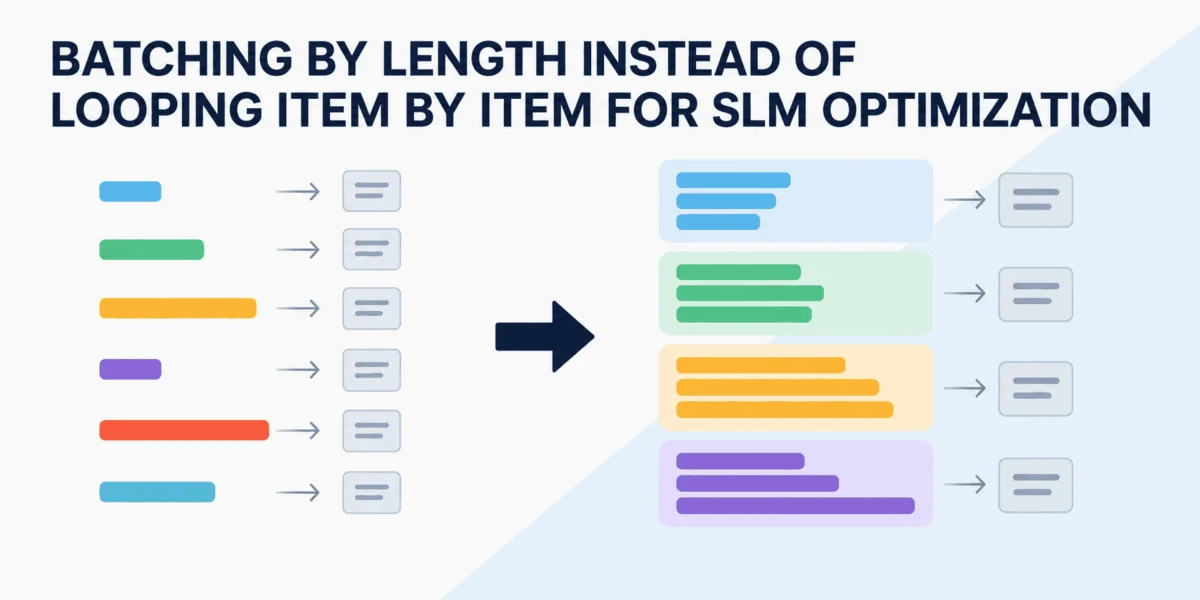
The traditional solution is batching. By grouping multiple sequences together, the model can amortize the cost of reading weights across dozens of items. However, a "naive" implementation of batching introduces a new form of inefficiency: padding. Because tensors in a batch must be uniform in shape, every item in a batch is typically padded to match the length of the longest sequence. If your dataset follows a "long-tail" distribution—where a few very long sequences coexist with many short ones—you end up computing vast amounts of useless "padding" tokens.
The solution is elegant in its simplicity: sort your data by token length before forming batches. This ensures that each batch contains items of similar length, effectively minimizing the amount of padding required for each individual set.
Chronology: A Three-Part Optimization Journey
This technique serves as the culmination of a broader investigation into optimizing SLMs. To understand how we arrived at this final milestone, it is useful to review the preceding steps:
- Constraining the Output Space: In the first phase of this series, we explored how limiting the model’s output tokens (e.g., forcing a classifier to choose between specific labels) dramatically reduces the computational load. By narrowing the search space, we allow the model to focus its resources on relevant probability distributions.
- Reusing Prompt Prefixes: In the second phase, we implemented a key-value (KV) cache. By caching the KV pairs for a shared system prompt, we avoided the redundant computation of the same instructions for every single input. This saved significant cycles when running repetitive automation tasks.
- Length-Bucketed Batching: This third phase focuses on the structural organization of the input data. By sorting and grouping, we tackle the "memory-bandwidth" bottleneck, ensuring that the hardware is utilized at its highest possible efficiency.
Together, these three strategies form a robust toolkit for developers looking to deploy models like the Qwen2.5-0.5B-Instruct on commodity hardware, such as an M2 Macbook Air, without sacrificing performance.
Supporting Data: Benchmarking Efficiency
To prove the efficacy of this approach, we conducted a series of experiments using a simulated dataset of 600 support tickets with a realistic, long-tailed length distribution. The goal was to classify these tickets into three categories: "billing," "technical," and "account."
The Baseline: The "One-at-a-Time" Approach
When processing tickets individually, the model requires approximately 144 seconds to complete the full set of 600 tickets. This results in a throughput of roughly 4.2 items per second. The waste here is clear: the hardware is constantly reloading weights, and the CPU is struggling to maintain peak utilization.
The Improvement: Length-Bucketed Batching
By implementing a batch size of 32 and sorting the tickets by their token length, we achieved a dramatic shift in performance. The same 600 tickets were processed in approximately 79 seconds, effectively increasing our throughput to 7.5 items per second—a near doubling of performance on the exact same hardware.
The data reveals that the "padding overhead"—the percentage of processed tokens that were merely padding—was kept to a minimal 7.6%. This confirms that sorting by length successfully mitigates the inefficiency of naive batching.
Crucially, we verified that the model’s predictions remained identical to the unbatched baseline. This validation step is non-negotiable: an optimization is only valid if it maintains the "truthfulness" of the model’s original performance.
Implications: Building for Production
What does this mean for the future of AI automation? The implications are three-fold:
- Accessibility of SLMs: The ability to run models efficiently on consumer-grade hardware (like a MacBook) removes the barrier to entry for small businesses and independent developers. You do not need a cluster of H100s to build a responsive, automated ticket-routing system.
- Sustainable AI Engineering: By optimizing the "compute per token," we reduce the energy consumption of our applications. Efficient code is, by definition, more sustainable. Reducing the padding waste means fewer total floating-point operations (FLOPs) are required to reach the same conclusion.
- The Priority of Logic over Scale: There is a growing consensus that "smarter" AI isn’t always about "larger" AI. By focusing on how we schedule and process data, we can achieve high-performance results using smaller, more interpretable, and more manageable models.
Official Responses and Expert Perspective
In discussions regarding these optimization techniques, the technical community emphasizes the importance of systemic verification. When asked about the potential pitfalls of combining these optimizations, experts caution that techniques like prefix caching and batching require careful orchestration.
"Reusing a cache across a batch means expanding every key and value tensor along that dimension to match, and then carefully cropping it back," notes the technical documentation for these methods. "It is worth doing when your prefix is long, but you must do it deliberately."
The consensus is clear: while these techniques provide a significant boost, they must be implemented with a "test-first" mindset. The primary danger in performance engineering is the introduction of subtle, hard-to-debug logic errors—such as padding-related misalignments or position-index bugs—that can silently degrade the quality of the model’s reasoning.
Conclusion: Final Thoughts on Narrow Automation
The series has demonstrated that through a combination of output constraints, clever caching, and intelligent batching, the "Small Language Model" is far more capable than its parameter count suggests.
By treating the optimization process as a rigorous engineering challenge, developers can turn a standard laptop into a production-ready inference engine. We have moved from a baseline of 4.2 items per second to 7.5 items per second, all while maintaining 100% agreement with the model’s original, slower performance.
As the AI field moves toward a more diverse array of model sizes, the skills practiced here—understanding memory bandwidth, managing padding, and optimizing the inference loop—will remain essential. Optimization is not just about speed; it is about ensuring that the tools we build are as efficient, reliable, and accessible as possible. For the developer, the lesson is clear: before you seek a larger model, optimize the one you already have.