Executive Summary
In a landmark development for the small satellite industry, Spanish startup Kreios Space has announced a strategic partnership with Kongsberg NanoAvionics to demonstrate a groundbreaking Air-Breathing Electric Propulsion (ABEP) system. The mission, designed to operate in the challenging environment of Very Low Earth Orbit (VLEO), seeks to overcome the traditional limitations of atmospheric drag that have historically relegated satellites to higher, less efficient altitudes. By utilizing residual atmospheric gases as propellant, Kreios Space aims to unlock a new paradigm for Earth observation and satellite communications.
The VLEO Challenge: A New Frontier
For decades, the majority of Earth-observation satellites have operated in Low Earth Orbit (LEO), typically at altitudes between 500 km and 2,000 km. While these orbits provide a stable environment, they necessitate a trade-off: higher altitude results in lower resolution imagery and increased latency in signal transmission.
VLEO, defined as the region between 150 km and 300 km, offers a tantalizing alternative. At these altitudes, optical sensors can capture sub-meter resolution images with significantly smaller apertures, and communication links benefit from drastically reduced signal path loss. However, the "VLEO barrier" has long been defined by extreme aerodynamic drag. At these altitudes, the density of residual atomic oxygen and nitrogen creates enough friction to de-orbit a conventional satellite within days or weeks. To stay aloft, satellites must expend massive amounts of onboard propellant—a finite resource that dictates the lifespan of the mission.
Kreios Space’s mission is to dissolve this barrier. By harvesting the very atmosphere that causes drag and converting it into propellant, the company aims to enable indefinite operational lifespans at altitudes previously considered "the graveyard of satellites."
Technical Architecture: The NanoAvionics Partnership
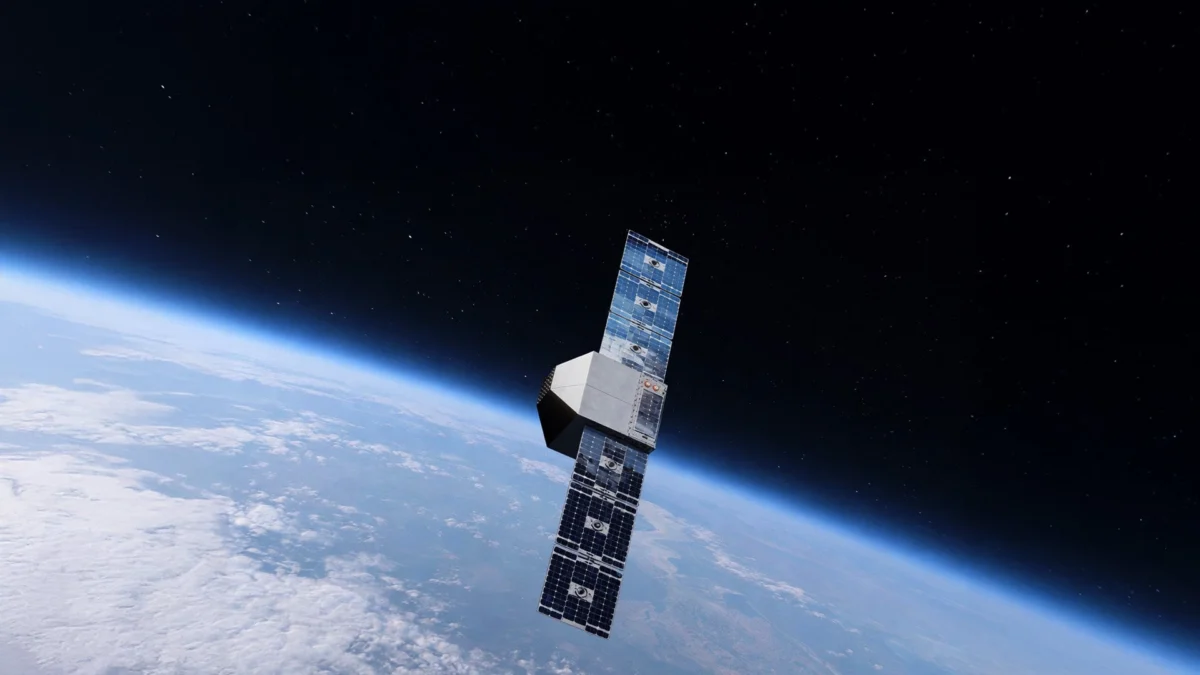
To validate this technology, Kreios Space has selected the flight-proven MP42 microsatellite bus provided by Kongsberg NanoAvionics. The MP42, a 200 kg class platform, is widely regarded as a workhorse of the small satellite sector, offering the modularity and power required for advanced experimental payloads.
The Role of the MP42 Bus
The NanoAvionics MP42 serves as the backbone of the mission. Its integration goes beyond simple structural support; NanoAvionics will oversee:
- System Integration: Housing the ABEP thruster alongside an undisclosed high-resolution optical payload.
- Environmental Testing: Ensuring the sensitive ABEP intake systems can survive the extreme thermal and mechanical stresses of launch and VLEO deployment.
- Commissioning: Managing the critical "Early Orbit Phase," where the satellite must deploy its solar arrays and initialize the thruster intake mechanisms while contending with high-drag conditions.
The ABEP Propulsion System
At the heart of the experiment is the Kreios Space ABEP thruster. Unlike traditional electric propulsion, which relies on onboard xenon or krypton tanks, the ABEP system features an intake manifold designed to capture rarefied atmospheric particles. These particles are ionized and accelerated through an electromagnetic field, generating thrust. Because the "fuel" is gathered from the surrounding environment, the satellite is theoretically limited only by the longevity of its electrical components and solar power generation, rather than the mass of its propellant tanks.
Chronology of the Mission
While the partners have not released a fixed launch date, the roadmap for this technology demonstration follows a structured, multi-phase trajectory:
- Design and Integration Phase: Currently underway, this involves the calibration of the ABEP intake system with the structural requirements of the MP42 bus.
- Payload Integration: The inclusion of an optical payload—capable of capturing imagery in the visible and near-infrared (VNIR) spectrum—marks this as a dual-purpose mission.
- Launch and Deployment: The satellite will be placed into a standard LEO injection, from which it will perform a controlled descent into the VLEO target zone (300 km to 150 km).
- In-Orbit Validation: The primary mission phase, during which the thruster will switch from traditional gas to air-breathing mode to demonstrate orbit maintenance.
- Operational Testing: Long-term assessment of atmospheric harvesting efficiency and the quality of sub-meter imagery captured at ultra-low altitudes.
Supporting Data: Why 150 km Matters
The shift to VLEO represents an order-of-magnitude improvement in mission efficiency. Data from industry studies suggests that operating at 200 km rather than 500 km provides:
- Optical Clarity: A reduction in atmospheric interference and a 2.5x increase in ground sampling distance (GSD) resolution for the same sensor size.
- Signal Latency: Lower transmission times for time-sensitive data, critical for military and disaster-response applications.
- Propellant Independence: By eliminating the need to launch with hundreds of kilograms of heavy chemical propellants, satellites can either be made smaller and cheaper or carry larger, more sophisticated instrumentation.
Official Responses and Strategic Vision
Adrián Senar, CEO of Kreios Space, framed the mission as a pivotal moment for orbital sustainability. "Kreios is building the satellites that make sustained operations in Very Low Earth Orbit possible," Senar stated. "By enabling satellites to fly lower, longer, and more efficiently, we are enabling higher-resolution Earth observation, much better satellite communications, more responsive and accurate missions, and a more sustainable orbital infrastructure."
The collaboration with NanoAvionics is seen as a strategic "de-risking" move. By utilizing a proven bus manufacturer, Kreios Space can focus its R&D efforts exclusively on the proprietary ABEP thruster, ensuring that the primary experimental objective—propulsion—is supported by a reliable, battle-tested satellite platform.
Implications for the Space Economy
The success of the Kreios Space mission could trigger a fundamental shift in the space industry, impacting several key sectors:
1. Earth Observation (EO)
The EO market is currently defined by a "race to resolution." VLEO allows companies to achieve high-resolution imagery without the astronomical costs associated with massive, high-aperture telescopes. This democratization of high-resolution data could open new markets in urban planning, precision agriculture, and environmental monitoring.
2. Space Sustainability
One of the most profound benefits of ABEP technology is the mitigation of orbital debris. Because ABEP-enabled satellites can maneuver with greater agility and perform controlled de-orbits using atmospheric drag as a tool rather than an enemy, they pose a significantly lower risk of becoming "zombie satellites."
3. National Security and Defense
The ability to maintain satellites at very low altitudes provides a strategic advantage in reconnaissance. Lower orbits make satellites harder to track and easier to replace with constellations of smaller, more affordable assets. The capability to sustain these orbits indefinitely changes the calculus for space-based persistent surveillance.
Challenges Ahead
Despite the optimism, the mission faces significant technical hurdles. The VLEO environment is chemically harsh; atomic oxygen is highly corrosive and can degrade satellite surfaces and optical coatings rapidly. Furthermore, the intake of atmospheric gases must be carefully managed to avoid clogging or contamination of the thruster’s ionization chamber.
The mission must also demonstrate that the power generated by the satellite’s solar arrays is sufficient to sustain the thruster’s energy-intensive ionization process while simultaneously powering the communication and optical payloads.
Conclusion
The partnership between Kreios Space and NanoAvionics is a bold step into the "forgotten" altitude of space. By mastering the ability to "breathe" while orbiting the Earth, these companies are not just launching a new satellite; they are validating a new technology that could redefine the physical constraints of spaceflight. As the mission progresses, the global space community will be watching closely to see if the dream of sustainable, long-term VLEO operations can finally be realized. If successful, the era of the "air-breathing" satellite may soon become the new standard for the next generation of orbital infrastructure.