Main Facts: NRO Expands Commercial SAR Integration
In a major move to bolster its space-based intelligence-gathering capabilities, the National Reconnaissance Office (NRO) has awarded operational contracts to three prominent commercial synthetic aperture radar (SAR) providers: Capella Space, Iceye U.S., and Umbra. Announced on August 5, 2026, these contracts represent a transition from experimental evaluation to operational integration. They establish a direct, formalized pathway for defense and intelligence users to acquire commercial SAR data.
Managed under the NRO’s Commercial Radar Capabilities (CRC) program, these agreements allow the U.S. government to directly order SAR collections, access historical image archives, buy derived analytical products, and collaborate on new sensor capabilities. This operational framework is designed to augment the United States’ highly classified, "exquisite" national reconnaissance satellites with the rapid innovation, high revisit rates, and resilience of the commercial space sector.
       ┌────────────────────────────────────────────────────────┐
       │         National Reconnaissance Office (NRO)           │
       │         Commercial Systems Program Office (CSPO)       │
       └───────────────────────────┬────────────────────────────┘
                                   │
                    Defines Requirements & Funding
                                   │
                                   ▼
       ┌────────────────────────────────────────────────────────┐
       │          Commercial Radar Capabilities (CRC)           │
       └─────┬─────────────────────┬──────────────────────┬─────┘
             │                     │                      │
             ▼                     ▼                      ▼
      ┌──────────────┐      ┌──────────────┐      ┌──────────────┐
      │Capella Space │      │  Iceye U.S.  │      │    Umbra     │
      └──────────────┘      └──────────────┘      └──────────────┘
Operational Scope and Capabilities
The newly awarded contracts are managed by the NRO’s Commercial Systems Program Office (CSPO). This office is tasked with identifying, assessing, and integrating commercial remote sensing capabilities to support national security. Under the CRC program, the selected vendors will provide day-and-night, all-weather imaging. This imagery is critical for monitoring high-interest targets, assessing battle damage, supporting humanitarian operations, and tracking environmental disasters.
Unlike traditional electro-optical (optical imaging) satellites, which require daylight and clear skies, SAR systems emit their own radar signals and measure the return echo. This allows them to "see" through thick cloud cover, smoke, dust, and complete darkness. By incorporating commercial SAR into its broader intelligence, surveillance, and reconnaissance (ISR) enterprise, the NRO gains a more resilient, flexible, and persistent global monitoring capability.
Chronology: From Experimental Studies to Operational Integration
The August 2026 operational contracts are the result of a multi-year, phased effort by the NRO to evaluate commercial radar capabilities, assess vendor reliability, and build the software architecture needed to ingest commercial data.
  2022                          Late 2024                     May 2026                      August 2026
  ┌──────────────────────────┐  ┌──────────────────────────┐  ┌──────────────────────────┐  ┌──────────────────────────┐
  │ Study Contracts          │  │ RF & SAR Integration     │  │ Multi-Phenomenology      │  │ Operational CRC          │
  │ • Airbus U.S., Capella,  │  │ • Umbra tapped for       │  │ • EarthDaily, Iceye,     │  │ • Capella, Iceye U.S.,   │
  │   Iceye, PredaSAR, Umbra │  │   Stage III integration  │  │   Pixxel contracts for   │  │   Umbra receive direct   │
  │ • Modeling & simulation  │  │ • RF validation studies  │  │   EO, hyperspectral, RF  │  │   tasking pathways       │
  └──────────────────────────┘  └──────────────────────────┘  └──────────────────────────┘  └──────────────────────────┘
2022: The Initial Commercial Radar Studies
The foundation for this program was laid in January 2022, when the NRO signed historical study contracts with five commercial SAR operators: Airbus U.S., Capella Space, Iceye U.S., PredaSAR (later absorbed into Terran Orbital’s broader strategy), and Umbra.
These early contracts allowed the CSPO to perform extensive modeling, simulation, and on-orbit demonstration exercises. The goal was to understand how commercial radar imagery could complement the NRO’s classified constellation, assess the latency of commercial tasking systems, and determine the data security of commercial ground stations.
Late 2024: Expanding Multi-Phenomenology and RF Validation
Building on the 2022 studies, the NRO expanded its commercial partnerships in late 2024 through its Strategic Commercial Enhancements (SCE) framework.
- Stage III SAR Integration: The NRO selected Umbra for a Stage III SCE contract designed to integrate the company’s high-resolution SAR data directly into the U.S. government’s broader ISR architecture.
- Radio Frequency (RF) Validation: Umbra was also selected to provide commercial RF products. This allowed the government to validate on-orbit performance and evaluate how commercial RF data could support signal intelligence and maritime domain awareness missions.
May 2026: Multi-Sensor Diversity via SCE
In May 2026, the NRO utilized its Strategic Commercial Enhancements Commercial Solutions Opening (CSO) to award contracts to EarthDaily, Iceye, and Pixxel.
These awards expanded the NRO’s reach beyond radar into a broader "multi-phenomenology" approach. This included electro-optical (EO) imaging, hyperspectral imaging, and radio frequency monitoring, ensuring that U.S. intelligence analysts have access to a diverse mix of data types to verify findings.
August 2026: Operationalization under the CRC Program
The announcement on August 5, 2026, represents the operational phase of this pipeline. By transitioning Capella Space, Iceye U.S., and Umbra to the Commercial Radar Capabilities (CRC) program, the NRO has moved past the study and pilot phases.

These companies are now active operational partners, with established interfaces that allow tactical military units and intelligence analysts to order and receive SAR imagery in real time.
Supporting Data: The Mechanics of Commercial SAR and Vendor Profiles
Why Synthetic Aperture Radar Matters
Synthetic Aperture Radar is a highly valued sensing technology for national security because of its unique physical properties. While optical sensors capture reflected sunlight—rendering them ineffective at night or when obscured by clouds—SAR sensors emit microwave pulses and record the backscattered signals to construct high-resolution 2D or 3D images.
| Feature / Metric | Optical Imagery (Electro-Optical) | Synthetic Aperture Radar (SAR) |
|---|---|---|
| Primary Source | Reflected ambient sunlight | Active microwave radar pulses |
| Day/Night Usability | Daytime only (except for specialized low-light sensors) | 24/7 continuous operation |
| Weather Dependency | Highly degraded by clouds, fog, rain, and smoke | Unaffected by atmospheric conditions |
| Data Characteristics | Intuitive, photographic representation of the ground | Structural, material, and surface roughness data |
| Key Military Value | High-fidelity identification and human-readable analysis | Persistent monitoring, change detection, and soil penetration |
Profiles of the Selected Providers
The three companies selected for the CRC program represent the leading edge of the U.S. and allied commercial SAR industrial base. Each offers distinct orbital configurations, frequency bands, and resolution capabilities:
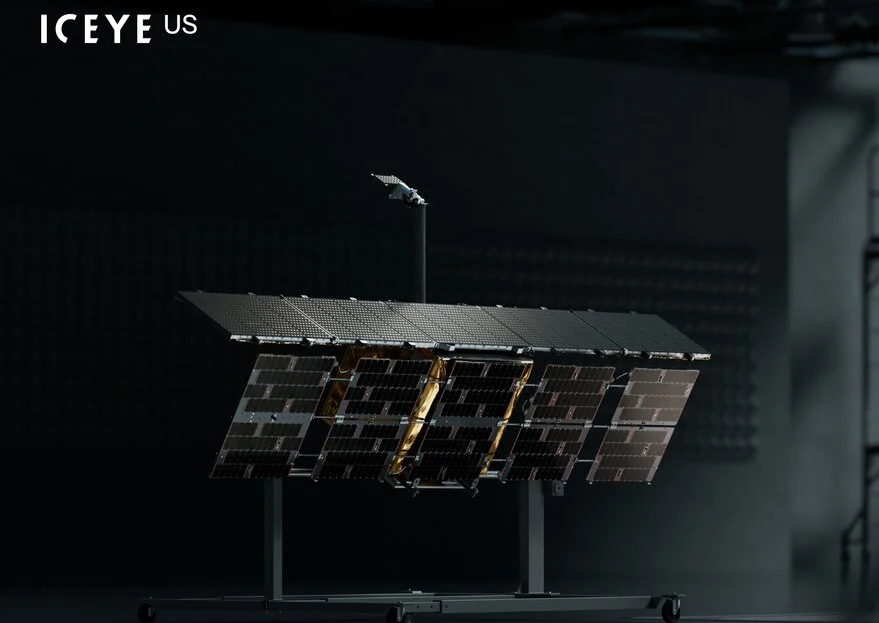
- Iceye U.S.: Based in Irvine, California, Iceye U.S. operates as a subsidiary of the Finnish parent company Iceye, satisfying strict U.S. government foreign ownership, control, or influence (FOCI) mitigation requirements. Iceye operates the world’s largest constellation of commercial SAR satellites, offering high-revisit imaging and rapid-response tasking. Their Gen4 satellites provide high-resolution spotlight imaging alongside wide-area search modes.
- Umbra: Headquartered in Santa Barbara, California, Umbra is known for producing some of the highest-resolution commercial SAR data available. Umbra’s satellites carry a large, deployable parabolic antenna that operates in the X-band. This allows the company to generate radar images with sub-meter resolutions. Umbra has actively supported the NRO’s commercial integration studies, validating its capabilities across multiple phases of the SCE program.
- Capella Space: Headquartered in San Francisco, California, Capella Space was the first American commercial SAR company to launch an operational satellite. Capella operates an advanced constellation of X-band SAR satellites, utilizing an automated tasking platform that allows customers to request imagery and receive products within hours. Capella’s focus on low-latency delivery and high-contrast imaging makes it a key asset for tactical military decision-making.
Official Responses: Industry and Government Perspectives
The Intelligence Community’s Vision
In its official release, the NRO emphasized that integrating commercial SAR with national systems is an efficient way to expand the agency’s intelligence, surveillance, and reconnaissance capacity. By relying on commercial operators for routine monitoring and broad-area surveillance, the NRO can free up its highly specialized national assets to focus on the nation’s most sensitive, high-priority intelligence targets.
The NRO noted that its strategy is informed by lessons learned from other commercial initiatives, such as the Electro-Optical Commercial Layer (EOCL) program. These programs established the software, security, and licensing frameworks necessary to integrate commercial data into government networks.
Executive Insights from Iceye U.S. and Umbra
Industry executives welcomed the contract awards, describing them as validation of the commercial sector’s readiness to support national security missions.
Ann Stevens, CEO of Iceye U.S., highlighted the growing trust between the intelligence community and commercial providers:
"Commercial remote sensing is increasingly part of how the Intelligence Community augments some of its hardest collection challenges. Earning a place on the RCA [Radar Capabilities] program reflects the trust the NRO places in our technology and our team. We focused on delivering the reliability and responsiveness this mission requires, and on continuing to advance what commercial radar can contribute to national security."
Stevens also emphasized the operational benefits of commercial SAR data’s unclassified nature:
"Because Iceye U.S. SAR data is unclassified, collections can be shared across the defense, intelligence, civil, and allied and coalition partner community under existing sharing agreements, maximizing collaboration when it is needed most."
David Langan, CEO of Umbra, spoke to the long-term partnership and shared commitment to innovation:

"We’re honored by the trust the NRO has placed in Umbra to support U.S. intelligence missions. Today’s announcement is an important new chapter in a partnership built on years of consistent delivery for the missions that CSPO supports. Our team is focused on solving the hardest remote sensing challenges in space, and we move at speed to turn new ideas and U.S. technology into better capabilities for national security."
Geopolitical and Strategic Implications
Hybrid Architectures and Mission Resilience
The NRO’s transition to operational commercial SAR contracts reflects a broader shift within the U.S. Department of Defense and the Intelligence Community toward "hybrid space architectures."
Historically, the U.S. government relied entirely on a small number of large, highly classified, and incredibly expensive national security satellites. While these systems offer unmatched capabilities, they are difficult to replace if damaged, compromised, or targeted by adversary anti-satellite (ASAT) systems.
       TRADITIONAL ARCHITECTURE                  PROLIFERATED HYBRID ARCHITECTURE

          ┌────────────────┐                           ┌───┐   ┌───┐   ┌───┐
          │                │                           │   │   │   │   │   │
          │   Exquisite    │                           └───┘   └───┘   └───┘
          │   National     │                               Commercial SAR
          │   Satellite    │                               Constellation
          │                │                           ┌───┐   ┌───┐   ┌───┐
          └────────────────┘                           │   │   │   │   │   │
                                                       └───┘   └───┘   └───┘
       High cost, low resilience                     Low cost, high resilience,
       but unmatched capability                      rapid global revisit rates
By integrating commercial SAR constellations, the NRO creates a proliferated, distributed architecture. If a national asset is unavailable, or if its orbit does not align with an urgent tasking request, the NRO can quickly route the request to a commercial partner. This multi-layered approach makes the entire national space architecture far more resilient to physical or cyber disruption.
The Unclassified Advantage in Coalition Warfare
One of the most significant advantages of commercial SAR is its unclassified nature. National reconnaissance satellites collect highly classified data that cannot easily be shared with international allies, non-governmental organizations, or the public without undergoing a lengthy declassification process.
Commercial imagery, however, is purchased under flexible licensing agreements. This allows the U.S. government to share high-resolution radar imagery with international partners, coalition forces, and humanitarian agencies in near-real-time.
This capability has proven vital in modern conflict zones, such as the war in Ukraine, where commercial satellite imagery has been used to document troop movements, verify damage to civilian infrastructure, and counter disinformation campaigns. Under the CRC program, the U.S. and its allies can maintain a shared, verified, and timely operational picture.
Cultivating the Commercial Space Industrial Base
These contracts also serve a broader strategic purpose: fostering a robust domestic commercial space industrial base. By acting as an anchor tenant and establishing reliable, long-term procurement pathways, the NRO provides the financial stability that commercial space companies need to secure private investment, fund research and development, and scale their constellations.
This ongoing investment ensures that the United States and its allies maintain a technological lead in commercial remote sensing. It also encourages a continuous cycle of innovation, driving down costs and accelerating the deployment of advanced capabilities like real-time change detection, radio frequency analysis, and automated, AI-driven target recognition.