In the modern enterprise landscape, the chatbot has evolved from a simple scripted interface into a critical component of customer experience and operational efficiency. However, as businesses rush to integrate Large Language Models (LLMs) into their support workflows, they are encountering a harsh reality: off-the-shelf solutions often fail to meet the rigorous demands of corporate environments.
For a recent client project, the mandate was clear: develop a support AI that is safe, accurate, and capable of near real-time interaction. The client needed a system that could handle complex support queries without drifting from the company’s brand voice or exposing sensitive proprietary data. This is no longer a niche requirement; it is a business imperative. According to IBM’s 2025 report, the average global cost of a data breach has soared to $4.44 million, underscoring that AI systems that prioritize speed over security and accuracy quickly become financial liabilities rather than assets.
The Architectural Impasse: Why Standard LLMs Falter
The current industry standard—passing massive amounts of documentation to a general-purpose LLM—is proving to be a flawed strategy. While models like GPT-4 or Claude are powerful, they are constrained by token limits, context utilization issues, and a propensity for "hallucinations."
When an organization asks, "How do we build an AI that knows what to answer based on real data and how to answer like an expert?" the answer is rarely found in a single, monolithic model. Instead, it requires a sophisticated architectural pivot: separating the model’s "behavior" from its "knowledge."
The Core Challenges of Modern AI Deployment
Design teams frequently encounter four fundamental roadblocks when moving AI from a prototype to a production-ready enterprise tool.
1. The Myth of Infinite Context
Modern LLMs boast massive context windows—16K, 32K, or even 128K tokens. However, research into "primacy-recency bias" confirms that model attention often degrades in the middle of long prompts. Providing more context does not equate to better reasoning; in fact, it often leads to information being ignored or misinterpreted. For enterprises with millions of pages of technical documentation, "dumping" data into a prompt is a recipe for failure.
2. The "Lost in the Middle" Phenomenon
As noted in seminal research on long-context inputs, LLMs frequently struggle to synthesize information buried in the middle of a prompt. When an AI is tasked with navigating complex, domain-heavy support data, this leads to incomplete reasoning. If the model cannot reliably find the "needle in the haystack," the entire support interaction is compromised.
3. The Retrieval Paradox: Precision vs. Performance
Retrieval-Augmented Generation (RAG) is the industry standard for grounding models. However, there is a delicate trade-off: retrieve too little, and you increase the risk of hallucinations; retrieve too much, and you trigger latency issues and dilute the model’s focus. The real goal is "precision retrieval"—providing the minimum sufficient context required to reach a correct answer.
4. The Hallucination Problem
Perhaps the most dangerous trait of modern LLMs is their reluctance to say "I don’t know." In a support environment, a confident but incorrect answer is often worse than no answer at all. This lack of guardrails poses significant risks to trust, compliance, and brand reputation.
A New Paradigm: The Hybrid AI Architecture
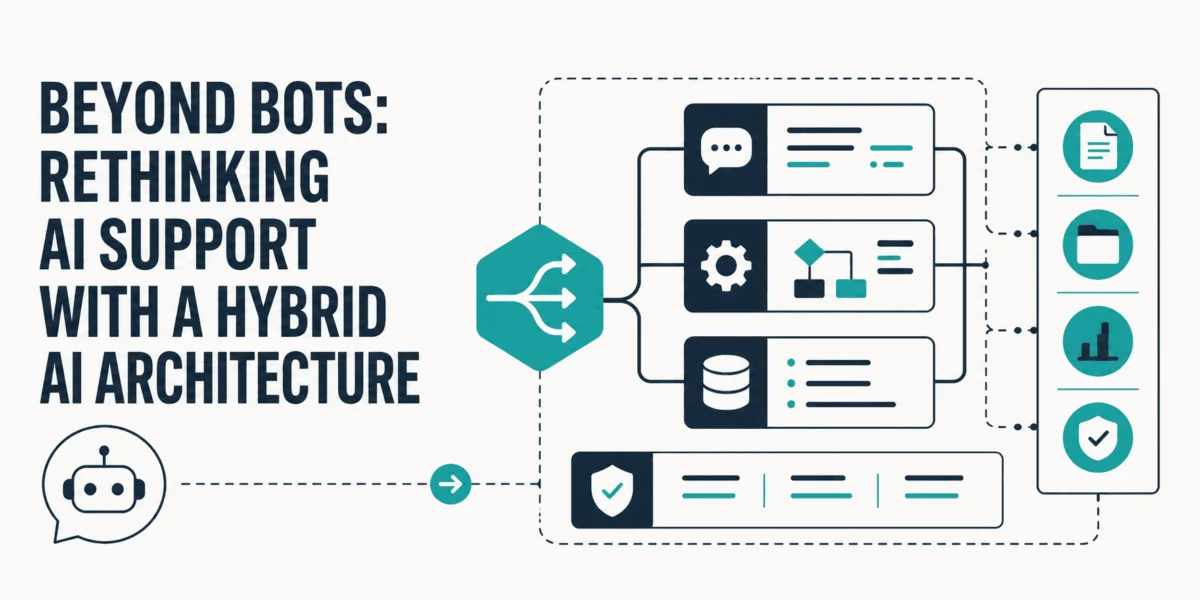
The solution lies in a hybrid approach: the marriage of Retrieval-Augmented Generation (RAG) and domain-specific fine-tuning. By decoupling what the model knows (RAG) from how it communicates (fine-tuning), developers can create a system that is both grounded in truth and consistent in tone.
The Chronology of Implementation
The development process for this hybrid architecture followed a deliberate, iterative path:
- Phase One: Curated Knowledge Curation. Instead of feeding raw data into the model, the team built a structured, searchable knowledge base. This repository contained vetted Q&A pairs, technical manuals, and policy documentation.
- Phase Two: RAG Integration. The system was programmed to retrieve only the most relevant chunks of data during inference. This kept the context window small, reduced latency, and significantly lowered hallucination rates.
- Phase Three: Fine-Tuning for Voice. With the "what" (knowledge) secured by RAG, the team turned to the "how" (tone). They fine-tuned the Qwen model using approximately 1,000 expert-verified Q&A pairs.
- Phase Four: Performance Optimization. To avoid "catastrophic forgetting"—where a model loses its general knowledge during training—the team utilized Low-Rank Adaptation (LoRA) adapters. This allowed for targeted training without the heavy compute costs of a full model retrain.
Supporting Data: The Impact of Hybridization
The results of this architectural shift were quantified through rigorous testing. Relying on RAG alone provided high factual accuracy but failed to maintain the professional, conversational tone required for client interactions. In one study, while the model had access to 100% of the correct context, its output correctness hovered at 70% due to an inability to manage tone and structure.
Conversely, fine-tuning the model alone achieved a 90% alignment in tone but saw factual accuracy drop to 50% because the model was relying on its own "memory" rather than the provided documentation.
When the two methods were integrated, the results were transformative:
- Tone Accuracy: Improved to 75% (significantly more stable than RAG alone).
- Factual Correctness: Reached 73% (outperforming both RAG and fine-tuning in isolation).
The synergy between the two techniques allowed the fine-tuned model to better understand the nuances of the retrieved information, resulting in a system that could reason through complex, procedural support queries while adhering to strict company formatting guidelines.
Implications for the Enterprise
This hybrid architecture represents a fundamental shift in how organizations should view AI development. The "one model to rule them all" approach is being replaced by modular, specialized systems that treat knowledge and communication as separate, distinct functions.
For businesses looking to deploy AI, the implications are clear:
- Invest in Data Hygiene: The success of RAG is entirely dependent on the quality of the underlying knowledge base. If your documentation is disorganized, your AI will be, too.
- Prioritize Behavioral Training: Fine-tuning is not for facts; it is for style, process, and edge-case management. Use it to ensure your AI represents your brand accurately.
- Embrace Modularity: As models evolve, having an architecture that allows for swapping out components—such as updating a LoRA adapter or upgrading a retrieval database—ensures the system remains future-proof.
Conclusion: The Path Forward
The quest for a "perfect" chatbot is not a race to find a larger, more expensive model. It is a challenge of engineering precision. By combining the factual grounding of RAG with the behavioral consistency of fine-tuned language models, organizations can finally bridge the gap between "experimental chatbot" and "enterprise-grade support solution."
As we move further into 2025, the competitive advantage will go to those who stop trying to build "smarter" models and start building better architectures—systems that are as reliable as they are intelligent.
About the Author
Alakh Sharma is a Data Scientist at Talentica Software, a global product development company helping startups build and scale their AI infrastructure. An alumnus of the Indian Institute of Science, Bangalore, Alakh specializes in reinforcement learning and NLP. For more insights on building AI "moats" and scalable enterprise solutions, follow him on LinkedIn.