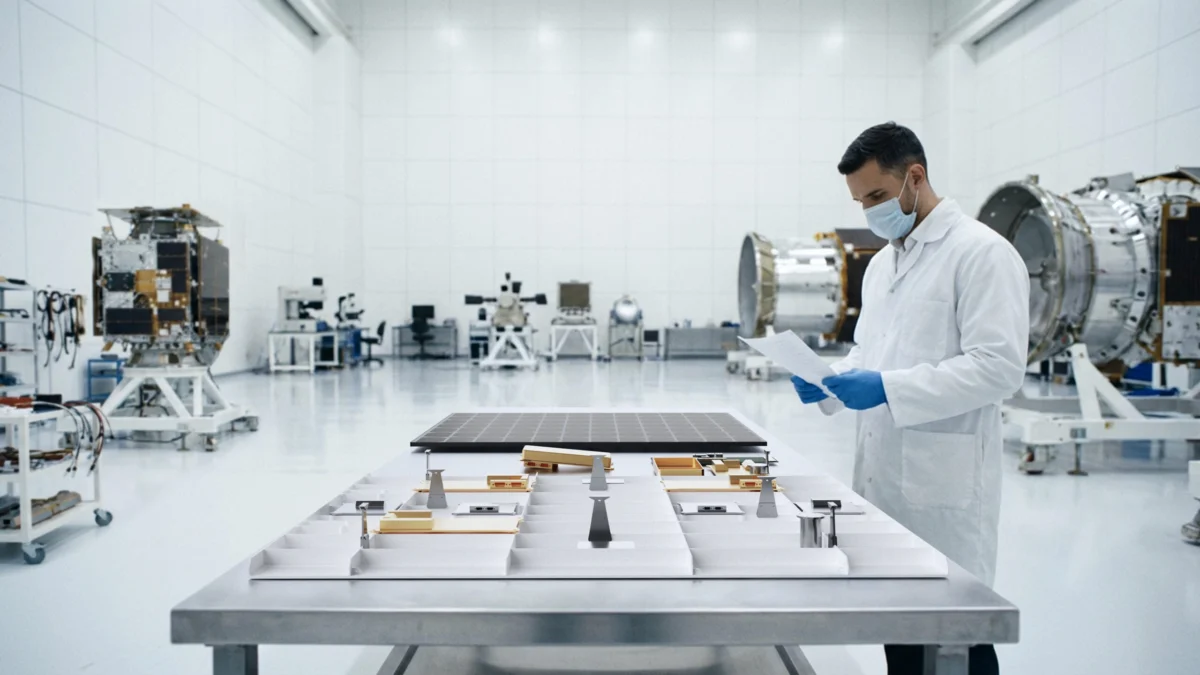
In a development that marks a significant pivot in the evolution of the space economy, Sophia Space and the California Institute of Technology (Caltech) have officially secured a landmark patent for the architecture of space-based data centers. Patent No. 12,679,564, titled Space-Based Data Centers, represents a fundamental shift in how humanity envisions computing infrastructure beyond the confines of Earth.
The patent, issued on July 14, 2026, following a filing in October 2024, outlines the blueprint for large-scale, modular data centers designed specifically for the vacuum of space. By bridging the gap between terrestrial cloud infrastructure and orbital logistics, the collaboration aims to solve one of the most pressing challenges of the modern era: the exponential growth of data processing needs in an environment where traditional cooling and power constraints do not apply.
The Genesis of Orbital Infrastructure: A Chronology
The journey toward this patent began long before the formal filing in 2024. The project is the culmination of years of research into space-based hardware, fueled by the expertise of veterans from the Jet Propulsion Laboratory (JPL) and the academic rigor of Caltech.
- June 2023: Dr. Leon Alkalai, a long-time JPL Fellow, founds Sophia Space. The company is established as a portfolio venture of Mandala Space Ventures, a Pasadena-based venture studio specializing in the orbital economy. The goal is clear: commercialize cutting-edge space hardware.
- October 2024: The core team, comprising seven distinguished inventors from JPL, Caltech, and Sophia Space, formally files the patent for Space-Based Data Centers.
- July 14, 2026: The U.S. Patent and Trademark Office formally issues Patent No. 12,679,564, validating the technical feasibility of the proposed orbital architectures.
- July 29, 2026: Sophia Space and Caltech issue a joint public statement announcing the patent and detailing the next phase of their collaborative research agreement.
The team behind this breakthrough includes Dr. John R. Brophy (JPL), Dr. Leon Alkalai (Sophia Space), Prof. Sergio Pellegrino (Caltech), Dr. Jonathan Sauder (JPL), Timothy P. McElrath (JPL), Dr. Douglas J. Sheldon (JPL), and Don J. Hunter. Their collective experience spans decades of deep-space exploration, mission architecture, and thermal dynamics.
Technical Foundations: The "TILE" Architecture
The primary obstacle to moving data centers into orbit has never been the computation itself, but rather the physics of the environment. On Earth, data centers rely on complex HVAC systems, liquid cooling, and reliable, high-density power grids. In space, these systems fail due to the lack of convection and the constant bombardment of radiation.
Dr. Leon Alkalai, Founder and CTO of Sophia Space, emphasized that the patent is not merely an iteration of existing hardware, but a complete reimagining of the computing life cycle. "You can’t simply take a terrestrial data center and move it into space," Alkalai noted. "Building data centers in space requires a fresh look at the energy life-cycle problem."
The Passive Cooling Paradigm
The core innovation, as detailed in the patent, is the "TILE" architecture. This system is defined by:
- Passive Cooling: Unlike Earth-bound centers that use fans and liquids, the TILE architecture utilizes the vacuum of space. The only way to discard heat in orbit is through radiation. The TILE design turns the data center into a giant, efficient radiator.
- Modularity: The architecture is designed to be scalable. Individual units can be assembled in orbit to form a massive, contiguous surface of computing power.
- Solar Integration: The system is engineered to be powered continuously by solar energy, ensuring that the data center remains operational as long as it is exposed to sunlight.
Research and Development: The Caltech Partnership
The issuance of the patent is only the starting point. Sophia Space has simultaneously entered into an expanded sponsored research agreement with Caltech to push the boundaries of structural and thermal engineering.
Under the guidance of Professor Sergio Pellegrino—a pioneer in deployable space structures—the team is focusing on how to transport and unfold these data centers. Since rocket fairings have limited volume, the data center cannot be launched as a monolithic block. It must be a "deployable" structure—a compact package during launch that unfurls into a sprawling, multi-acre computing array once in orbit.
Thermal Management and Materials Science
Caltech’s role in this partnership is critical. The university is tasked with developing lightweight materials that can withstand the harsh thermal cycling of orbit, where temperatures can swing from hundreds of degrees in the sun to sub-zero in the shade. The research focuses on:
- Advanced Thermal Radiators: Improving the emissivity of the TILE surfaces to ensure maximum heat dissipation.
- Deployable Structures: Utilizing carbon fiber and advanced polymers to create rigid yet foldable arrays that maintain structural integrity without adding unnecessary mass.
- Radiation Hardening: Protecting delicate computing components from the high-energy particles found in the Van Allen belts and beyond.
Implications for the Global Data Economy
The implications of successful orbital data centers are profound, touching upon sectors ranging from artificial intelligence to global telecommunications and Earth observation.
1. Solving the Latency and Proximity Equation
As the number of satellites in Low Earth Orbit (LEO) grows, the volume of data being generated by Earth observation sensors is exploding. Currently, this data must be downlinked to terrestrial ground stations, processed, and then redistributed. An orbital data center would allow for "edge computing" in space. Raw data could be processed directly in orbit, and only the actionable insights—the "answer" rather than the "noise"—would be sent back to Earth, significantly reducing bandwidth requirements.
2. The Sustainability Argument
Terrestrial data centers are massive consumers of water and electricity. By moving computing infrastructure to space, Sophia Space suggests a future where high-energy processing is decoupled from Earth’s limited resources. While the carbon footprint of launching these assets is a factor, the long-term operational efficiency of a solar-powered, passively cooled facility could offer a sustainable alternative for high-performance computing (HPC) tasks.
3. A New Economic Frontier
As a portfolio company of Mandala Space Ventures, Sophia Space is positioned at the vanguard of the emerging orbital economy. The ability to host data in space changes the competitive landscape for cloud providers, space agencies, and private corporations. If the TILE architecture proves scalable, we could see the emergence of "Data Heavens"—orbital nodes that offer computing power to the highest bidder, independent of terrestrial geopolitical constraints.
Expert Commentary and Future Outlook
The industry response to the patent has been one of cautious optimism. While the engineering hurdles are immense—specifically regarding the cost of launch and the long-term maintenance of these structures in a debris-rich environment—the legitimacy provided by the JPL/Caltech pedigree cannot be overstated.
"This patent reflects a different way of thinking about computer infrastructure," says Dr. Alkalai. "We are moving from a world where we bring data to the compute, to a world where the compute follows the data."
As the partnership between Sophia Space and Caltech deepens, the next two years will likely see the development of small-scale prototypes. These tests will be crucial in proving that the passive cooling mechanisms can handle the heat loads of modern AI-driven server clusters.
For now, the vision of a shimmering, solar-powered data array orbiting silently above the planet has moved from the realm of science fiction into the category of intellectual property. The era of the space-based data center has officially begun. Whether this technology will become the backbone of the future internet or remain a niche tool for space-faring nations remains to be seen, but one thing is certain: the sky is no longer the limit for the digital revolution.