Tokyo, Japan – August 15, 2026 – Japanese telecommunications giant KDDI has kicked off Fiscal Year 2027 with a commanding performance, demonstrating significant momentum across its core mobile operations and accelerating its strategic expansion into high-growth digital sectors. The company reported a strong first quarter, characterized by rising mobile revenue, enhanced Average Revenue Per User (ARPU), steady subscriber acquisition, and a notable decrease in churn. This success is further bolstered by aggressive advancements in Artificial Intelligence (AI) integration, cybersecurity, cloud services, and data center development, positioning KDDI as a diversified digital infrastructure leader.
A Resounding Start to the Fiscal Year
For the period spanning April to June 2026, KDDI announced a robust increase in operating revenue, reaching ¥1.4873 trillion, a 5.1 percent jump from the ¥1.4157 trillion recorded in the same quarter of the previous fiscal year. This impressive growth trajectory is a testament to the company’s multifaceted strategy, which leverages the strength of its mobile services while strategically venturing into new frontiers of digital innovation. Financial services, device sales, AI integration, cybersecurity solutions, and data center expansion all played pivotal roles in contributing to this impressive financial uplift, underscoring KDDI’s successful transition from a traditional connectivity provider to a comprehensive digital infrastructure and enterprise technology powerhouse.
Telecom Core: The Bedrock of Growth
The "Telecom Core" segment, encompassing KDDI’s extensive mobile offerings and broadband services, remains the company’s largest operational pillar. This segment’s operating revenue climbed by a healthy 3.4 percent, reaching ¥1.0837 trillion, up from ¥1.0479 trillion in the prior year’s quarter. Within this crucial segment, mobile communication revenue experienced a significant surge of 4.6 percent, totaling ¥491.5 billion, an increase from ¥469.8 billion.
The operational efficiency and profitability of the Telecom Core were equally impressive. Operating income within this segment saw a substantial increase of 19.5 percent, equating to an additional ¥34.4 billion, bringing the total to ¥210.7 billion. A significant portion of this profit growth, ¥18.0 billion, is directly attributable to the elevated mobile communication revenue. KDDI’s strategic approach within the Telecom Core is clear: it encompasses its flagship au brand, the value-oriented UQ mobile, and the flexible povo offerings, alongside robust smartphone sales and high-speed Fiber-to-the-Home (FTTH)/CATV broadband services. The overarching strategy is to maximize customer Lifetime Value (LTV) while simultaneously employing AI to refine network quality and enhance operational efficiency.
Mobile Metrics: A Story of Value and Loyalty
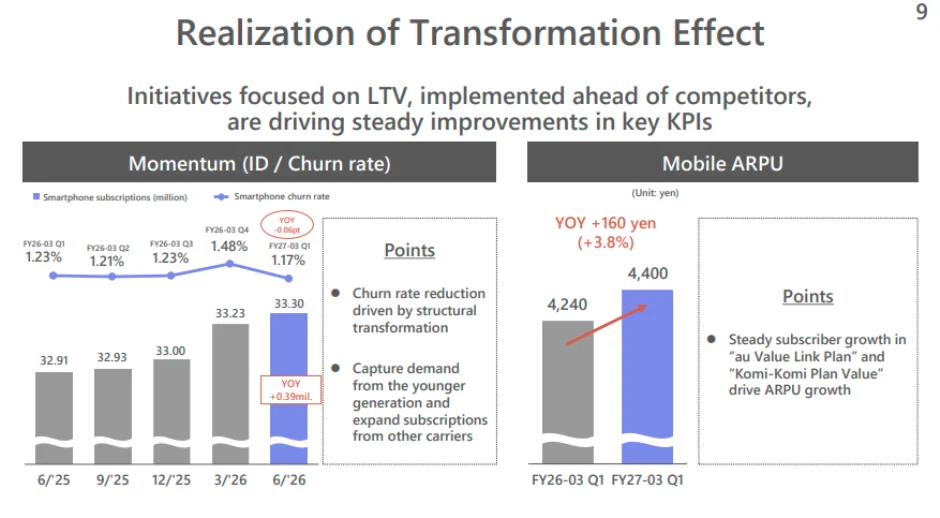
KDDI’s mobile Key Performance Indicators (KPIs) painted a compelling picture of improving customer economics and increasing loyalty. The company’s mobile ARPU rose by ¥160, a significant 3.8 percent year-on-year increase, to reach ¥4,400. This marks a notable improvement from the ¥4,240 ARPU recorded in the first quarter of FY2026. This upward trend in ARPU is directly linked to the sustained subscriber growth for KDDI’s popular plans, including the au Value Link Plan and the Komi-Komi Plan Value. These offerings are central to KDDI’s competitive strategy, which prioritizes delivering exceptional service value and cultivating deeper customer relationships to drive LTV.
The subscriber base for KDDI’s smartphone services also demonstrated healthy expansion. As of June 2026, the company boasted 33.30 million smartphone subscriptions, representing a year-on-year increase of 390,000 from the 32.91 million recorded in June 2025. This growth has been consistent, with the subscriber base steadily climbing from 32.91 million in June 2025 through 32.93 million in September 2025, 33.00 million in December 2025, 33.23 million in March 2026, and culminating in the 33.30 million figure in June 2026.
Equally encouraging is the significant improvement in customer churn. Smartphone churn decreased by 0.06 percentage points year-on-year, falling to a low of 1.17 percent from 1.23 percent. This downward trend in churn was observed throughout the fiscal year, with figures of 1.21 percent in Q2 FY2026, 1.23 percent in Q3, and 1.48 percent in Q4, before reaching the current impressive 1.17 percent in Q1 FY2027. KDDI attributes this enhanced customer retention to its ongoing mobile structural transformation initiatives. Furthermore, the company’s targeted strategies to attract younger demographics and win subscribers from rival operators have clearly gained traction, contributing to this positive momentum.
A key element of KDDI’s internal migration strategy has also yielded positive results. The differential between UQ mobile-to-au migrations and au-to-UQ mobile migrations has improved by an impressive 70 percent. This indicates KDDI’s success in guiding customers towards its premium au brand, thereby extending contract durations and maximizing customer value.
Network Innovation and Diversified Offerings
KDDI is actively differentiating its network capabilities as a core component of its ARPU and customer retention strategy. The company’s 5G Standalone (SA) population coverage has now surpassed an impressive 90 percent as of the end of March 2026. Moreover, the cumulative number of users benefiting from au 5G Fast Lane, a premium high-speed service, has exceeded 3.1 million as of July 14, 2026.
Expanding its global reach, KDDI has introduced international roaming for its au Starlink Direct service in the United States and Canada. The company plans to extend this service to four additional countries within 2026. The au Starlink Direct SOS service, launched on May 28, 2026, provides crucial 24/7 relaying of SOS information from areas with no cellular coverage, enhancing safety and connectivity for its users.
The value proposition of UQ mobile continues to gain traction. The UQ Komi-Komi Otoku Discount, offering a substantial 35GB of data per month, has been a significant driver of customer engagement. Following the introduction of this initiative, selections for the Komi-Komi Plan Value increased by approximately 2.1 times, and the adoption rate of the au PAY Gold Card saw an impressive rise of approximately 1.6 times.
Povo, KDDI’s flexible and customizable mobile offering, has also experienced a surge in customer activity. Following the launch of new "toppings" (add-on data or service packages), new Mobile Number Portability (MNP) subscriptions from other carriers increased by approximately 4.4 times. Similarly, sales of Giga Charge cards, which allow for flexible data top-ups, more than quadrupled, rising approximately 4.3 times compared to the first quarter of FY2026.
AI and Cybersecurity: A Catalyst for Business Growth
KDDI’s strategic push into AI-related products and services is yielding significant returns. By synergistically combining its telecom capabilities with offerings in devices, its Lawson convenience store chain, and a suite of digital services, KDDI is effectively enhancing customer LTV across its ecosystem.
The "Business Growth" segment of KDDI’s operations has emerged as the fastest-growing area, with revenue surging by 11.7 percent to reach ¥165.2 billion, up from ¥147.8 billion in the previous year. All five key areas within Business Growth reported increases in both revenue and income. Notably, the AI Integration/Cybersecurity division experienced a substantial revenue jump of 19.2 percent, reaching ¥47.2 billion from ¥39.6 billion. The Connected Solutions segment also demonstrated strong performance, with revenue climbing 14.6 percent to ¥24.3 billion, from ¥21.2 billion.
KDDI is strategically investing in expanding its cloud infrastructure to support AI integration and is actively building overseas data center capacity. This proactive approach is designed to capitalize on the burgeoning demand for AI inference infrastructure, a critical component of the AI revolution.
AI-Powered Efficiency and Innovation
KDDI is not only selling AI services to enterprises but also deploying AI internally to drive operational efficiency and enhance customer support. The company’s "au Sales Support AI" was rolled out to approximately 2,000 au stores in July 2026. This advanced AI system is designed to handle a significant volume of internal inquiries, generating around 200,000 per month. The impact has been profound: inquiries directed to human support staff have been halved, and response times have been dramatically reduced. AI-powered responses are now delivered in approximately 30 seconds, a stark contrast to the 128 seconds for human chat support and 259 seconds for phone inquiries.
Beyond customer-facing applications, KDDI is also leveraging AI in its governance functions. The company has introduced an AI system for credit screening and an anomaly detection tool that analyzes financial data to identify potential risks and irregularities. These applications underscore KDDI’s commitment to utilizing AI for robust risk management and enhanced decision-making.
Strategic Infrastructure Investments
KDDI’s financial statements reveal a sustained commitment to infrastructure development. During the April-June 2026 quarter, the company invested ¥82.997 billion in property, plant, and equipment, a slight decrease from the ¥88.255 billion invested in the same period of the previous year. However, investments in intangible assets saw a notable increase, reaching ¥72.913 billion, up from ¥66.291 billion.
Cumulatively, these investment categories amounted to approximately ¥155.910 billion, a slight increase from the ¥154.546 billion invested in the prior-year period. While KDDI does not formally label this combined figure as Capital Expenditure (Capex) in its quarterly disclosures, it provides a clear indication of the company’s ongoing commitment to bolstering its infrastructure. These investments are strategically directed towards enhancing mobile networks, expanding broadband services, fortifying cloud capabilities, developing AI infrastructure, and scaling its data center footprint.
A key initiative in this regard is KDDI’s "All-Photonic Network," which aims to achieve approximately 60 percent lower power consumption compared to conventional network designs. This advanced network also prioritizes low-latency connectivity between data centers, crucial for supporting data-intensive AI applications.
Outlook and Future Trajectory
Despite the robust performance in the first quarter, KDDI has maintained its financial outlook for the fiscal year ending March 31, 2027. The company continues to project operating revenue of ¥6.410 trillion, representing a projected year-on-year increase of 5.6 percent. This forward-looking stance, coupled with the strong Q1 performance, signals KDDI’s confidence in its strategic direction and its ability to sustain growth in an increasingly dynamic digital landscape.
The company’s strategic diversification, coupled with a revitalized focus on its core mobile business and a deep integration of AI and advanced technologies, positions KDDI for continued success. As it navigates the evolving demands of the digital economy, KDDI’s commitment to innovation, customer value, and robust infrastructure development suggests a bright and dynamic future.