San Jose, CA – September 28, 2026 – The future of personal computing is no longer defined by the apps we open, but by the intelligent agents that anticipate our needs and act on our behalf. This paradigm shift was the undeniable centerpiece of Snapdragon Summit 2026, where Qualcomm unveiled a sweeping vision for "agentic AI," promising to weave intelligent, personalized AI experiences across a vast ecosystem of consumer devices. From next-generation smartphone processors to expanded PC platforms, and from the subtle integration of AI into wearables to a future where cars and even home appliances become intelligent partners, Qualcomm is aggressively positioning itself as the silicon backbone of this emerging agent-centric world.
The summit, a crucial annual event for the chip giant, saw CEO Cristiano Amon articulate a compelling narrative: the evolution from a device-centric, app-driven model to an agent-centric one where software possesses intent, maintains context, and operates autonomously for the user. While the smartphone remains a critical anchor in this strategy, the implications of Qualcomm’s announcements extend far beyond the pocket. The company’s aggressive push into PCs with Snapdragon X2, the miniaturization of AI into glasses and earbuds, and a long-term roadmap for AI integration across virtually every consumer touchpoint, signal a fundamental recalibration of Qualcomm’s market ambition.
However, amidst the technological exuberance, industry analysts are quick to point out a significant chasm between Qualcomm’s ambitious future and the current consumer reality. As Tom Mainelli of IDC noted, "The hardware required for personal agents is arriving faster than the applications and user behavior needed to make autonomous AI mainstream." This gap between potential and adoption will be a critical determinant in the success of Qualcomm’s agentic AI strategy.
The Agentic AI Imperative: A New Era of Computing
Qualcomm’s CEO, Cristiano Amon, set the stage for the summit with a powerful keynote, asserting that the computing landscape is undergoing a profound transformation. "We are moving from an app-centric world, where users are the initiators of every task, to an agent-centric world," Amon declared. "This new paradigm is defined by software that understands your intent, maintains your context, and acts on your behalf, seamlessly across your digital life."
This vision hinges on the idea that personal AI agents will require deep access to user context, preferences, and permissions, all while operating with low latency and a high degree of privacy. These demands, Amon argued, make on-device processing not just an advantage, but a necessity. The traditional model of relying solely on cloud-based AI, while impressive in its current scale—with Google’s Gemini reaching a staggering 1 billion monthly users and sevenfold year-over-year token usage increases—is insufficient for the nuanced and continuous operation required by personal agents.
Qualcomm’s proposed solution is a hybrid approach, skillfully blending the immense power of cloud AI for complex reasoning and massive model execution with the localized capabilities of edge devices for privacy, low latency, and immediate contextual understanding. This interconnected architecture, where the smartphone serves as a central hub for personal data and AI coordination, is seen by IDC as a more compelling proposition than simply touting Neural Processing Unit (NPU) performance. The opportunity for Qualcomm, therefore, lies in its ability to bridge these two worlds, creating a unified and intelligent personal computing experience.
Hardware Innovations: Powering the Agentic Revolution
The Snapdragon Summit 2026 was not just about a vision; it was about the silicon that will bring that vision to life. Several key hardware announcements underscored Qualcomm’s commitment to agentic AI:
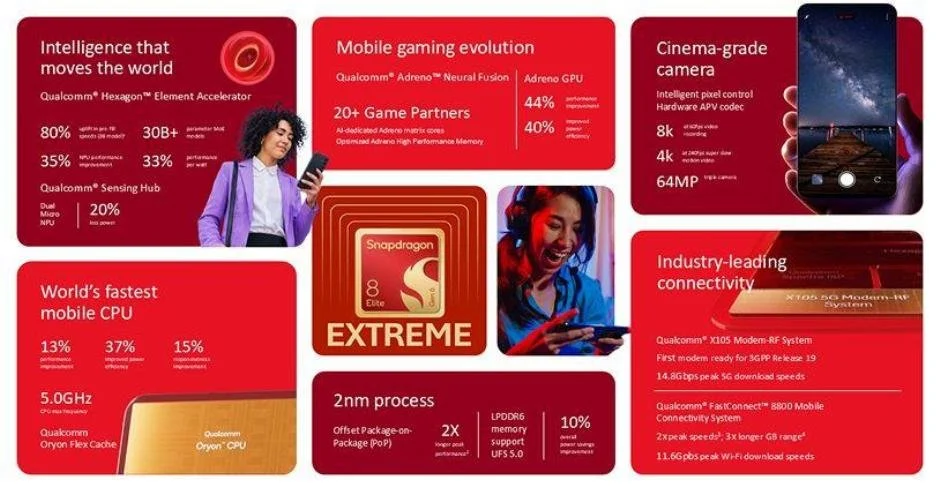
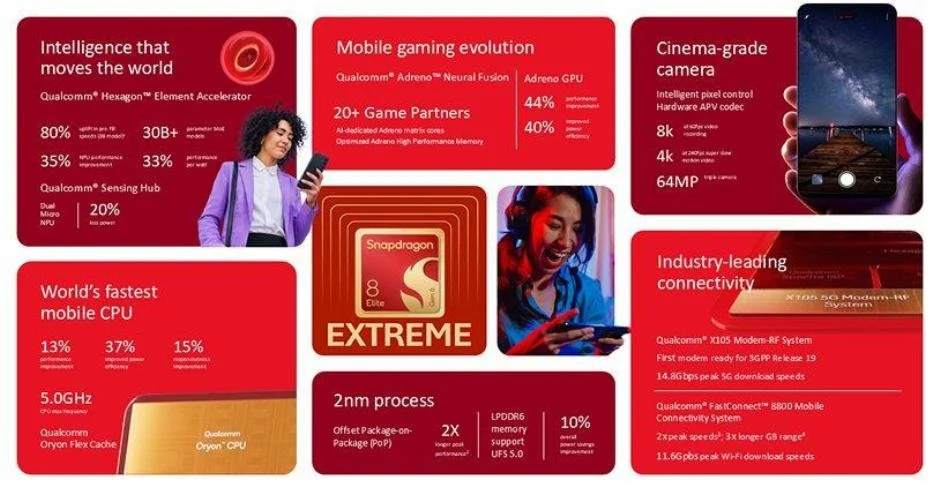
Snapdragon 8 Elite Extreme Gen 6: The New Flagship for AI Smartphones
The undisputed hardware star of the summit was the introduction of a bifurcated flagship mobile processor family: the Snapdragon 8 Elite Extreme Gen 6 and the Snapdragon 8 Elite Gen 6. Both processors are built on a cutting-edge 2nm process and integrate Qualcomm’s potent Oryon CPU, Adreno GPU, and Hexagon NPU. The "Extreme" variant represents Qualcomm’s most aggressive technological leap, designed for the pinnacle of performance. Meanwhile, the standard Snapdragon 8 Elite Gen 6 offers manufacturers greater flexibility to tailor premium devices to diverse performance, efficiency, and cost profiles.
This strategic segmentation reflects the evolving nature of the premium smartphone market. With distinct categories emerging—conventional flagships, ultra-premium devices, foldables, gaming-centric phones, and camera-focused models—each with unique thermal, power, and pricing considerations, Qualcomm’s dual-pronged approach provides essential differentiation. Device manufacturers including HONOR, iQOO, Motorola, OnePlus, OPPO, REDMI, RedMagic, vivo, and Xiaomi are slated to bring devices powered by these new chips to market. These platforms are pivotal to Qualcomm’s broader agentic AI smartphone strategy, aiming to transform phones from mere command executors into intelligent orchestrators of user tasks and contextual understanding.
Snapdragon X2 Expansion into Linux: Broadening the Developer Horizon
While the flagship smartphone chips garnered significant attention, a strategically crucial announcement centered on the Snapdragon X2 Series for PCs. Qualcomm is now extending official Linux support to this platform, a move that significantly broadens its appeal to developers and technical users. With Debian support anticipated by the end of 2026 and Ubuntu certification targeted for the first half of 2027, Qualcomm is actively courting the developer community that often relies on Linux for advanced AI and machine learning development.
By upstreaming core Snapdragon X2 drivers, including those for the Hexagon NPU and Adreno GPU, Qualcomm is making its architecture more accessible. This is a critical step in the long-term battle for AI computing dominance, where developer ecosystems play a vital role. The expansion of Snapdragon X2 into the Linux realm provides Qualcomm with an alternative pathway into AI development environments traditionally dominated by x86 processors and NVIDIA GPUs, signaling a clear intent to challenge existing market leaders.
High Bandwidth Compute (HBC): A Glimpse into Future Memory Architectures
Qualcomm also offered a tantalizing preview of High Bandwidth Compute (HBC), a technology designed to bring memory and AI processing capabilities into much closer proximity. Expected to debut more broadly around Mobile World Congress 2027, HBC has the potential to revolutionize memory-intensive AI workloads across smartphones, laptops, smart glasses, and automotive platforms. If Qualcomm can achieve significant gains in the efficiency of memory-bound AI processing, HBC could become a foundational component of its future edge AI architecture, offering substantial performance and power advantages.
Snapdragon Sound Elite Gen 2: Earbuds as Intelligent AI Endpoints
The evolution of personal AI extends to audio devices, with the introduction of Snapdragon Sound Elite Gen 2. This marks Qualcomm’s first premium audio platform specifically engineered with Personal AI in mind. Combining on-device AI processing with cloud connectivity and integrated micro-power Wi-Fi 6E, this platform opens up new possibilities. Notably, future earbuds equipped with this technology could potentially connect directly to AI services, bypassing the need for a smartphone as an intermediary.
This "Personal AI Hearables" strategy signifies a fundamental shift in consumer interaction with AI. As AI agents become more persistent and less reliant on deliberate user initiation, earbuds could transcend their role as mere audio accessories to become crucial AI endpoints, offering a natural and always-available voice interface for interacting with intelligent systems. Snapdragon Sound Elite Gen 2 also promises support for a new generation of intelligent and multimodal audio wearables, further solidifying the trend towards pervasive AI integration.
The Smartphone’s Evolving Role: The Personal AI Hub
Contrary to speculation that emerging devices like smart glasses might supplant smartphones, Qualcomm envisions the smartphone becoming even more central to the agentic AI experience. Amon emphasized that the smartphone, being a constant companion, already holds a wealth of personal data – communications, photos, location, applications, identity credentials, and increasingly, behavioral context. This rich repository makes it the ideal "personal knowledge layer" for AI agents.
Qualcomm’s redesigned sensing and AI architecture aims to empower future devices, including smartphones, to understand user routines and context locally. IDC views this focus on personal context as a significant competitive advantage for edge AI, moving beyond the mere ability to run increasingly large AI models. This deep personalization, coupled with the capabilities of HBC, positions the smartphone as the linchpin of a distributed AI network.
Expanding the Reach: Agentic AI Beyond the Smartphone
The second day of Snapdragon Summit 2026 underscored Qualcomm’s expansive ambitions, demonstrating how agentic AI is being integrated across a diverse range of devices. The company’s vision is not simply to embed AI into every gadget, but to enable a unified personal intelligence layer that seamlessly transitions between these devices.
Consider the synergistic potential: a smartphone managing communications and location, smart glasses offering visual context, earbuds providing an always-on voice interface, a smartwatch tracking health and activity, and a PC offering enhanced processing and a larger display. The strategic opportunity lies in orchestrating these capabilities into a cohesive AI experience. The success of Qualcomm’s vision hinges on whether users perceive a single, intelligent assistant that operates across their entire device ecosystem, rather than a collection of disparate AI functionalities.
The Economic Imperative: Shifting Inference to the Edge
Kedar Kondap, head of Qualcomm’s compute business, framed a critical question: "Where should inference run?" While cloud infrastructure offers unparalleled model scale and reasoning depth, edge devices provide privacy, low latency, and access to personal data. Furthermore, the economic implications are becoming increasingly significant. Transmitting every prompt, image, audio stream, and token generated by potentially billions of devices to data centers incurs substantial infrastructure and inference costs.
As AI evolves from intermittent chatbot interactions to continuous, always-on agents, these economics become paramount. By migrating appropriate workloads to edge devices like smartphones and PCs, Qualcomm aims to reduce cloud processing demands, improve user responsiveness, and create a more cost-effective AI ecosystem. IDC believes this economic argument, rather than headline-grabbing NPU performance metrics, may ultimately prove more persuasive in driving adoption.
Hits and Misses: Navigating the Agentic AI Landscape
Snapdragon Summit 2026 showcased both the immense potential and the significant hurdles facing the widespread adoption of agentic AI.
Hits:
- Coherent On-Device AI Story: Qualcomm has finally articulated a compelling case for why AI should run on personal devices, leveraging a hybrid cloud-edge approach.
- Snapdragon 8 Elite Extreme Gen 6: The introduction of a bifurcated flagship processor family caters to the diverse needs of the premium smartphone market.
- Smartphone as Personal AI Hub: The strategy to position the smartphone as the central orchestrator of personal AI experiences is a strong play.
- Agentic AI Beyond Smartphones: The clear ambition to extend agentic AI across PCs, wearables, and other devices creates a vast addressable market.
- Linux Support for Snapdragon X2: This move significantly enhances credibility with developers and opens new avenues for AI development on Qualcomm-powered PCs.
- AI Inference Economics: The economic argument for edge AI processing strengthens Qualcomm’s strategic position.
- Earbuds as AI Interfaces: The potential for earbuds to become crucial AI endpoints offers a compelling new interaction model.
- Broader Strategy Beyond Smartphones: Qualcomm’s vision has demonstrably evolved beyond its traditional mobile-centric focus.
Misses:
- The Agentic Future vs. Present Reality: The technology roadmap for agentic AI is impressive, but the mainstream consumer applications and user behaviors are still developing.
- Device Fragmentation Concerns: The proliferation of AI-enabled devices could lead to a fragmented user experience if a unified agent across all devices is not achieved.
- Killer Use Cases for AI Glasses and Pins: Despite technical advancements, a compelling "must-have" proposition for these emerging form factors remains elusive.
- Googlebook’s First-Gen Snapdragon X Elite: The launch of the innovative Googlebook category on an older generation of Snapdragon chips creates an awkward marketing contrast.
- Developer Ecosystem Challenge: Building a robust and developer-friendly ecosystem takes time and effort, and Qualcomm faces stiff competition from established players.
- The "Killer Agent" Application: The absence of a definitive application that compels consumers to embrace autonomous AI agents remains a critical unknown.
Implications and the Road Ahead
Snapdragon Summit 2026 has firmly established Qualcomm’s strategic direction: agentic AI is the future, and Qualcomm intends to be at its forefront. The company’s ambition to become the silicon provider for a distributed, intelligent computing fabric that spans from the smallest earbuds to the most powerful PCs and beyond is clear. The hybrid cloud-edge AI architecture is a significant strength, leveraging Qualcomm’s existing presence in a vast array of personal devices.
However, the ultimate success of this vision hinges on a crucial question, articulated by IDC: "Can AI become reliable, personal, and useful enough that consumers are willing to hand over the task?" While Qualcomm can provide the underlying hardware capabilities, the development of trustworthy, dependable, and truly indispensable AI agents rests with software developers, AI model providers, and platform giants like Google and Microsoft.
The next phase of agentic AI adoption will likely be defined not by raw processing power, but by the ability of AI to earn consumer trust and demonstrate tangible value in everyday tasks. Qualcomm has laid a strong foundation with its advanced silicon and ambitious ecosystem strategy. The true test will be whether the software and consumer adoption can keep pace, transforming the promise of agentic AI into the next dominant computing platform. The future is undeniably intelligent, but the path to its widespread embrace remains a journey of both technological innovation and fundamental human trust.