SAN JOSE, CA – September 25, 2026 – Qualcomm’s Snapdragon Summit 2026 concluded this week, leaving no doubt that "agentic AI" is no longer a futuristic buzzword but the driving force behind the company’s strategic vision. From groundbreaking smartphone processors to the nascent integration of AI into everyday wearables and personal devices, Qualcomm unveiled a comprehensive roadmap aimed at placing intelligent, context-aware agents at the heart of the consumer experience. The summit showcased a significant evolution beyond traditional app-centric computing, heralding an era where personal AI agents proactively manage tasks and anticipate user needs across an interconnected ecosystem of devices.
While the technological advancements presented were impressive, the overarching narrative from industry analysts like IDC suggests a palpable gap between Qualcomm’s ambitious vision and the current reality of consumer adoption. The hardware capabilities for sophisticated personal AI are rapidly maturing, but the widespread development of applications and the necessary shift in user behavior to fully embrace autonomous AI are still in their nascent stages.
The Dawn of the Agent-Centric Era: Qualcomm’s Strategic Pivot
The centerpiece of Snapdragon Summit 2026 was Qualcomm CEO Cristiano Amon’s compelling argument for a paradigm shift in computing. He articulated a move away from an app-centric model, where users manually initiate individual tasks, towards an agent-centric model. In this new paradigm, software is designed to understand user intent, maintain context across interactions, and act autonomously on behalf of the user.
"We are moving from a world where you tell your device what to do, to a world where your device understands what you need and does it for you," Amon declared during his opening keynote. This vision, he emphasized, positions the smartphone as the primary nexus of this intelligent ecosystem, but its influence extends far beyond. By the summit’s close, Qualcomm had demonstrably expanded its agentic AI ambitions to encompass PCs, smart glasses, watches, earbuds, automotive systems, and a burgeoning category of emergent personal AI devices.
Hits and Misses: A Deep Dive into Snapdragon Summit 2026
The announcements at Snapdragon Summit 2026 offered a multifaceted glimpse into Qualcomm’s future, with several key areas drawing significant praise and others highlighting existing challenges.
HIT: Qualcomm Establishes a Coherent On-Device AI Narrative
Perhaps the most significant triumph of the summit was not a single product, but Qualcomm’s articulate and persuasive explanation of why AI should increasingly reside on personal devices, rather than being solely reliant on the cloud. This was underscored by the presence of Google’s Rick Osterloh on stage, who highlighted the immense scale of cloud AI adoption with Gemini reaching 1 billion monthly users and a seven-fold year-over-year increase in token usage.
However, Qualcomm’s core argument is that the next evolutionary leap in AI necessitates a different approach. A personal agent, by its very nature, requires intimate access to context, permissions, preferences, and potentially sensitive user information. For these agents to be truly effective, they must respond with minimal latency, function reliably even with intermittent connectivity, and possess a continuous understanding of the user’s activities. These stringent requirements inherently strengthen the case for robust on-device processing capabilities.
IDC views Qualcomm’s proposed hybrid approach – a sophisticated blend of local inference powered by dedicated hardware and cloud-connected intelligence for more complex tasks – as a far more compelling proposition than simply touting the Neural Processing Unit (NPU) as another performance metric. The cloud remains indispensable for providing access to massive AI models and deep reasoning capabilities. Conversely, personal devices offer paramount advantages in privacy, ultra-low latency, and the crucial element of personal context. Qualcomm’s strategic opportunity lies in seamlessly bridging these two realms.
HIT: Snapdragon 8 Elite Extreme Gen 6 – The Hardware Vanguard
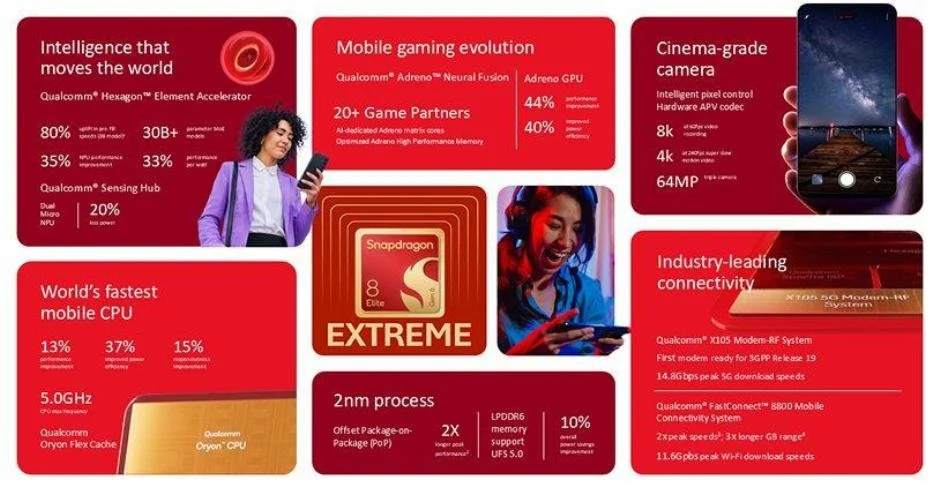
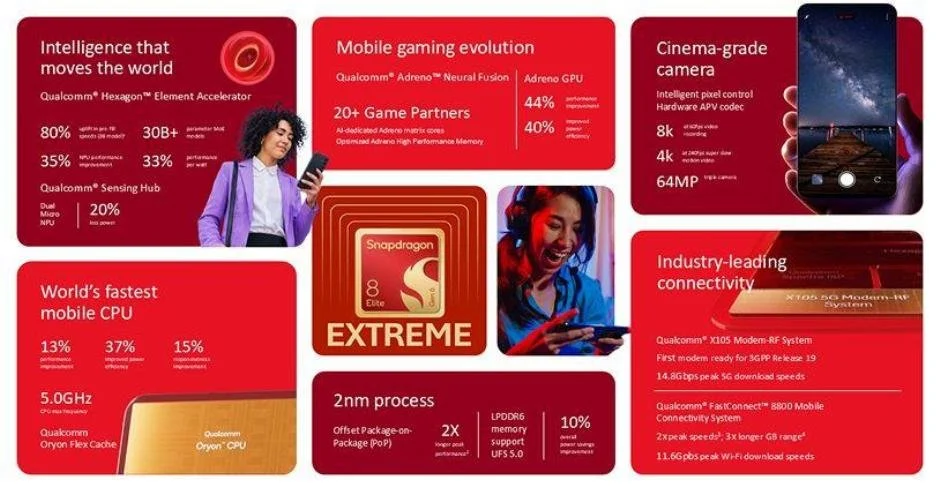
The undisputed hardware star of the summit was the introduction of the Snapdragon 8 Elite Extreme Gen 6 and Snapdragon 8 Elite Gen 6. This strategic decision to bifurcate its flagship mobile processor family addresses the increasingly diverse demands of the premium smartphone market. Both chips are manufactured using an advanced 2nm process and integrate Qualcomm’s cutting-edge Oryon CPU, Adreno GPU, and Hexagon NPU.
The "Extreme" variant represents Qualcomm’s most aggressive technological push, catering to devices that demand peak performance. The standard Snapdragon 8 Elite Gen 6, on the other hand, offers smartphone manufacturers greater flexibility to craft premium devices that balance performance, efficiency, and cost. This tiered approach is a shrewd response to the fragmented nature of today’s flagship market, which now encompasses conventional flagships, ultra-premium models, foldables, gaming-centric devices, and photography powerhouses, each with distinct thermal, performance, and pricing considerations.
Qualcomm confirmed that devices powered by these new processors will be available from a robust roster of industry leaders, including HONOR, iQOO, Motorola, OnePlus, OPPO, REDMI, RedMagic, vivo, and Xiaomi. These new platforms are instrumental in bolstering Qualcomm’s broader agentic AI smartphone strategy, aiming to transform the smartphone from a mere command-executing device into an intelligent orchestrator that understands context and seamlessly coordinates tasks across applications.
HIT: The Smartphone Evolves into the Personal AI Hub
Contrary to speculation, Amon was careful to temper expectations, clarifying that emerging devices like AI glasses are not intended to replace smartphones. Instead, Qualcomm posits that the smartphone’s importance could actually be amplified in this new agentic AI paradigm. The smartphone’s perpetual presence with the user, coupled with its existing repository of communications, photographs, location data, applications, identity credentials, and a burgeoning amount of behavioral context, makes it the ideal locus for the personal knowledge layer that AI agents require.
Qualcomm’s redesigned sensing and AI architecture is specifically engineered to empower future devices with the ability to understand user routines and context locally. IDC views this as a particularly strong facet of Qualcomm’s strategy, suggesting that personal context, rather than simply the raw processing power to run ever-larger models, could emerge as the definitive competitive advantage for edge AI.
Furthermore, Qualcomm offered a tantalizing preview of High Bandwidth Compute (HBC). This innovative technology is designed to bring memory and AI processing physically closer, a critical advancement for memory-intensive AI tasks. HBC is slated to eventually extend across smartphones, laptops, smart glasses, and automotive platforms, with more detailed revelations anticipated around Mobile World Congress 2027. If Qualcomm can significantly enhance the efficiency of memory-bound AI processing through HBC, it could become a cornerstone of its future edge-AI architecture.
HIT: Agentic AI’s Reach Extends Beyond Smartphones
The second day of the summit illuminated the true breadth of Qualcomm’s ambition: to embed Snapdragon processors at the core of personal intelligence across an entire spectrum of devices, including PCs, smart glasses, watches, earbuds, and other wearables. The strategic synergy becomes particularly compelling when these devices are considered collectively. A smartphone excels at managing location and communications, while glasses can potentially interpret visual input. Earbuds provide an always-accessible voice interface, and a smartwatch meticulously tracks activity and health metrics. A PC, with its greater memory and processing capacity, offers a more expansive interface.
The overarching strategic opportunity, therefore, transcends merely embedding AI into individual devices. It hinges on enabling a unified personal intelligence layer that can fluidly migrate and operate across this diverse array of hardware. The success of Qualcomm’s vision will ultimately be determined by its ability to achieve this seamless, cross-device intelligence.
HIT: Linux Support Bolsters Snapdragon X2’s Credibility with Developers
While the flagship smartphone processors garnered significant attention, one of the summit’s most strategically vital announcements was the expansion of official Linux support to the Snapdragon X2 Series. This move is poised to dramatically broaden the appeal of Snapdragon-powered PCs beyond the Windows ecosystem, opening the architecture to a vast community of developers, AI engineers, and technical users who rely heavily on Linux environments.
Qualcomm is actively contributing core Snapdragon X2 drivers upstream, including crucial support for the Hexagon NPU and Adreno GPU. This is a significant development, as the long-term competition for AI computing dominance will undoubtedly be influenced by the strength of developer ecosystems. The expansion of Snapdragon X2 into Linux platforms carries implications far beyond simply increasing laptop sales; it provides Qualcomm with a vital pathway into AI development environments traditionally dominated by x86 processors and NVIDIA GPUs.
HIT: AI Inference Economics Favor Qualcomm’s Edge Strategy
Kedar Kondap, head of Qualcomm’s compute business, framed a pivotal question for the summit: "Where should AI inference occur?" The answer, he argued, lies in a strategic distribution. Cloud infrastructure remains the domain for the largest AI models and the most profound reasoning capabilities. However, personal devices offer unparalleled advantages in privacy, ultra-low latency, and access to deeply personal information.
Crucially, there’s a compelling economic argument to be made for on-device inference. Transmitting every prompt, image, audio stream, and token generated by potentially billions of devices to data centers incurs substantial infrastructure and inference costs. As AI transitions from intermittent chatbot interactions to continuously available agents, these economic considerations become increasingly critical. By migrating appropriate AI workloads to smartphones, PCs, and other edge devices, Qualcomm can significantly reduce cloud processing demands while simultaneously enhancing user responsiveness. IDC believes this economic imperative may ultimately prove more persuasive than even the most impressive NPU performance figures.
HIT: Earbuds Emerge as a Potentially Crucial AI Interface
Qualcomm also unveiled the Snapdragon Sound Elite Gen 2, its inaugural premium audio platform meticulously engineered with Personal AI at its core. This platform integrates on-device AI capabilities with cloud-connected intelligence and introduces a significant innovation: micro-power Wi-Fi 6E. This last feature is particularly noteworthy, as it paves the way for future earbuds to potentially establish direct connections with AI services, bypassing the need for a smartphone intermediary.
Qualcomm’s "Personal AI Hearables" strategy reflects a broader, anticipated shift in how consumers will interact with AI. Voice remains one of the most intuitive modes of communication with intelligent assistants. If AI agents evolve into persistent companions rather than applications users actively launch on a screen, earbuds could transcend their current role as mere audio accessories to become vital AI endpoints. Snapdragon Sound Elite Gen 2 also promises support for a new generation of intelligent and multimodal audio wearables.
MISS: The Agentic Future Outshines the Agentic Present
The most significant weakness exposed at Snapdragon Summit 2026 was intrinsically linked to its most prominent theme. Agentic AI, while a compelling technological roadmap, still struggles to translate into a tangible, everyday consumer experience. Qualcomm effectively articulated the why behind personal agents, but the why now for mainstream consumers remains less clear.
There exists a profound chasm between posing a question to a chatbot like Gemini or ChatGPT and entrusting an AI agent to independently send messages, execute purchases, book travel, or interact with complex business applications. In this new paradigm, reliability is paramount. While an incorrect answer from a chatbot might be an inconvenience, an autonomous agent making an incorrect decision can have severe financial, professional, or personal repercussions.
Amon did acknowledge this critical challenge, emphasizing that consumers will only delegate tasks when they have unwavering trust in their agents and when those agents demonstrably simplify processes that would otherwise be more cumbersome to perform manually. IDC identifies trust, reliability, and robust permission management as potentially more significant barriers to agentic AI adoption than raw processor performance. While Qualcomm can provide the foundational computing platform, the onus remains on Google, Microsoft, application developers, and AI model providers to ensure these agents are dependable and trustworthy.
MISS: The Peril of Fragmentation in an AI-Dominated Device Landscape
Qualcomm’s demonstration of agentic AI spanned an impressive array of devices: phones, PCs, glasses, watches, earbuds, and emerging personal AI devices. While this broad reach is a logical strategy for a chip supplier seeking to maximize its addressable market, the consumer proposition becomes considerably more complex. Users are unlikely to desire a multitude of distinct AI agents operating independently on their phone, laptop, glasses, watch, and earbuds. Instead, the expectation will be for a singular, cohesive assistant that understands and serves them seamlessly, irrespective of the device they are currently using.
This necessitates the secure and fluid transfer of context, memory, identity, and permissions between devices – a formidable technical and ecosystem challenge at the heart of Qualcomm’s strategy. The personal AI vision will only truly succeed when consumers experience a unified agent across multiple devices, rather than being inundated by multiple devices vying for their attention.
MISS: AI Glasses and Pins Still Lack a Definitive Killer Use Case
Smart glasses emerged as one of the more intriguing demonstrations at the summit. Qualcomm highlighted the capabilities of Snapdragon AR1 and AR1+ chipsets, designed to support highly efficient multimodal AI models. This promises to enable more on-device intelligence despite the severe power, thermal, and memory constraints inherent in eyewear. The technical progress is undoubtedly impressive.
However, the commercial proposition remains less certain. Smartphones achieved indispensable status by consolidating communications, internet access, photography, navigation, entertainment, and applications into a single, indispensable device. AI glasses and pins, at present, have yet to articulate an equivalent "must-have" proposition. IDC recognizes the significant potential for AI glasses, particularly in their ability to combine visual and contextual information through cameras, microphones, and AI models in ways that smartphones cannot replicate. Yet, technical capability alone does not automatically translate into consumer demand. Qualcomm can empower OEMs to build smaller, more powerful, and more accessible AI glasses, but the industry still needs compelling applications to motivate millions of consumers to adopt them.
MISS: Googlebook’s Reliance on First-Generation Snapdragon X Elite
One of the more strategically interesting announcements surrounding Snapdragon Summit was the introduction of Googlebook. This novel laptop category blends elements of Chrome OS and Android, specifically targeting Android smartphone users with native Android application support, a desktop Chrome experience, and integrated Gemini-based AI functionalities. Dell and HP are among the initial hardware partners.
However, an unusual detail emerged: the initial Googlebook systems are powered by the first-generation Snapdragon X Elite, rather than the newer Snapdragon X2. From a product development standpoint, utilizing mature silicon may offer advantages in terms of cost, availability, and platform stability. From a marketing perspective, however, it creates an awkward juxtaposition. Qualcomm was simultaneously showcasing its latest Snapdragon X2 technology while one of the summit’s most anticipated new computing categories launched on an older generation of processors. IDC’s in-depth assessment of this new category, "Googlebook: A Modern, AI-Forward Take on Notebooks," explores why the platform could still prove strategically important.
MISS: The Enduring Developer Ecosystem Challenge
Hardware alone will not dictate the victors in the AI computing era; developers will. NVIDIA’s remarkable success serves as a testament to the strategic power of combining robust processors with a software ecosystem that developers know, trust, and depend upon. Qualcomm is demonstrably aware of this challenge. Its evolving developer strategy now encompasses Snapdragon AI tools, expanded Linux support, and technologies acquired through its Modular acquisition, including the promising Mojo programming language.
The ambition here is significant: Qualcomm aims for developers to deploy AI across a vast array of platforms, from smartphones and PCs to automotive systems, wearables, and potentially even datacenter infrastructure. However, building and nurturing developer ecosystems is a long-term endeavor. Qualcomm must demonstrably simplify the process of deploying AI models across its diverse Snapdragon device footprint if it hopes to translate its substantial installed device base into true AI platform power.
The Biggest Hit: A Strategy Transcending Smartphones
The most profound takeaway from Snapdragon Summit 2026 is that Qualcomm is increasingly shedding its identity as solely a smartphone-chip supplier. Its strategic vision now extends ambitiously across smartphones, PCs, automotive systems, Extended Reality (XR), smart glasses, earbuds, wearables, and even datacenter infrastructure. Agentic AI serves as the unifying thread weaving through this expansive tapestry.
Qualcomm’s fundamental bet is on a distributed future for AI. The largest, most complex models and the deepest reasoning capabilities will likely remain in datacenters. Concurrently, increasingly sophisticated inference, sensing, and the crucial element of personal context will migrate to edge devices. IDC views this hybrid AI architecture as one of Qualcomm’s most potent strategic advantages. The company already possesses silicon within many of the personal devices poised to become the critical endpoints for AI agents. The paramount challenge now lies in transforming these individual endpoints into a cohesive, interoperable ecosystem.
The Biggest Miss: The Elusive Killer Agent
Despite the impressive array of processors, compelling demonstrations, and strategic partnerships unveiled at Snapdragon Summit, one fundamental question remains conspicuously unanswered: What is the application that will compel consumers to declare they "cannot live without" an AI agent? Consumers readily understand the value proposition of smartphones and laptops. However, the indispensable utility of AI pins, persistent agents, and certain forms of smart glasses remains less obvious.
The problem is not AI adoption itself. Gemini’s reported 1 billion monthly users and the exponential growth in token consumption clearly indicate an immense consumer appetite for AI. The next transition, however, is considerably more challenging. It requires consumers to move beyond merely seeking information from AI to actively trusting AI to take autonomous action. This is the core gamble underpinning Snapdragon Summit 2026.
Qualcomm has compellingly demonstrated that the underlying hardware is rapidly evolving to support this pivotal transition. Its new Snapdragon mobile processors, the advanced X2 PC platform, the strategic expansion into Linux, its innovative AI wearables, and its comprehensive Personal AI strategy collectively position the company credibly across the edge computing landscape. However, IDC posits that the defining question for the next phase of agentic AI will not be measured in teraflops or TOPS. It will be far simpler: Will AI become reliable, personal, and demonstrably useful enough for consumers to willingly entrust it with their tasks?
Snapdragon Summit 2026 unequivocally showcased Qualcomm’s readiness for this transformative future. However, whether consumers and the broader software ecosystem are equally prepared will ultimately determine whether agentic AI ascends to become the next major computing platform – or remains an impressive technological feat in search of its defining application.