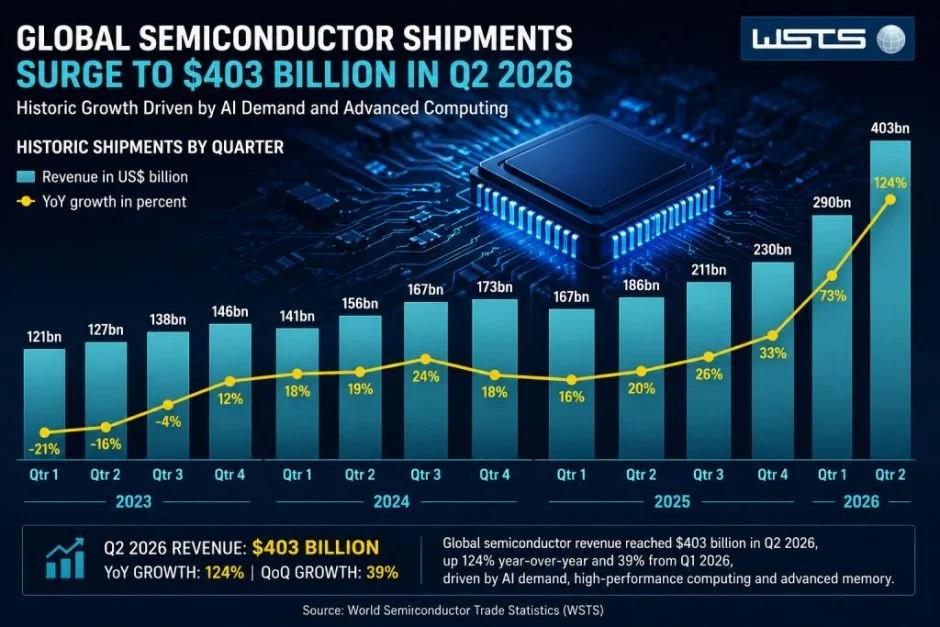
The global semiconductor industry is experiencing an unprecedented surge, poised for a historic year driven by insatiable demand for artificial intelligence (AI) infrastructure, high-performance computing (HPC), and advanced memory technologies. Projections indicate the market will reach a staggering approximately $1.655 trillion by 2026, marking an extraordinary annual growth rate of around 108 percent. This explosive expansion underscores the pivotal role semiconductors play in shaping the future of technology and the global economy.
The Unprecedented Growth Trajectory
The semiconductor market’s current trajectory is nothing short of revolutionary. In the second quarter of 2026 alone, global semiconductor sales soared to an impressive $403.3 billion, representing a remarkable 35.1 percent leap from the preceding quarter. This acceleration is a direct reflection of the colossal investments being poured into computing infrastructure, as technology giants aggressively expand their AI data centers and deploy increasingly sophisticated and powerful computing systems.
The momentum shows no signs of abating, with June 2026 figures revealing an even more pronounced acceleration. Worldwide semiconductor sales for June 2026 reached $134.5 billion, a staggering 123.6 percent increase compared to June 2025, and a healthy 9.7 percent rise from May 2026. These figures, meticulously compiled by World Semiconductor Trade Statistics (WSTS), paint a vivid picture of an industry operating at peak performance.
Cumulatively, the first half of 2026 witnessed global semiconductor sales reaching a colossal $702 billion, signifying a phenomenal 102 percent increase year-over-year. This dramatic growth is fundamentally driven by strategic investments in AI infrastructure, the burgeoning field of high-performance computing, and the relentless innovation in advanced memory technologies. The intricate ecosystem of AI servers and data centers, which are the backbone of modern artificial intelligence, necessitates vast quantities of processors, accelerators, memory modules, and a wide array of other semiconductor components. Consequently, the ongoing buildout of AI infrastructure has emerged as a critical and increasingly dominant engine for global chip demand.
A Historic Year in the Making: Projections and Key Drivers
The Semiconductor Industry Association (SIA) has provided further insights, with its President and CEO, John Neuffer, highlighting the sustained strength of semiconductor demand across the Americas, Asia Pacific, and China. This robust demand continues to be a powerful catalyst for global market growth, simultaneously reinforcing the industry’s indispensable importance to the next generation of technological innovation and overall economic competitiveness.
Looking ahead, the SIA anticipates that global chip sales will comfortably surpass the $1.5 trillion mark during 2026. The organization’s analysis indicates that the sales performance in the second quarter of the year substantially outpaced that of the first quarter, a trend that underscores the accelerating pace of adoption and deployment of semiconductor-intensive technologies.
The projections for the immediate future are equally astounding. Current calculations suggest that the global semiconductor market is on course to reach approximately $1.655 trillion by 2026. This figure represents a monumental annual growth rate of around 108 percent, a rate of expansion that is virtually unheard of in such a mature and complex industry. This historic growth is not merely a cyclical upswing; it is a fundamental paradigm shift driven by transformative technological advancements.
Memory Chip Market: The Undisputed Star Performer
Within this landscape of robust growth, the memory segment has emerged as the standout performer in the first half of 2026. Memory chips recorded an astonishing 305 percent increase in sales, a testament to the explosive demand for advanced memory solutions. This exceptional performance is directly attributable to the burgeoning need for sophisticated memory technologies that are crucial for powering AI infrastructure and high-performance computing systems. The insatiable appetite for data processing and storage in these cutting-edge applications has created a fertile ground for memory chip innovation and sales.
The growth story doesn’t end with memory. Logic semiconductor sales also demonstrated robust expansion, registering a significant increase of 45 percent. Furthermore, other semiconductor product categories have contributed positively to the annual growth, indicating that the current expansion is not solely confined to AI-related memory and computing chips. Instead, the growth is broadening, extending into a more diverse range of semiconductor applications across various industries.
The outlook for memory chips remains exceptionally strong. Latest calculations indicate that the memory segment could potentially grow by an astonishing 302 percent for the entirety of 2026, further solidifying its position as the primary driver of the semiconductor market’s historic surge.
Geographic Expansion: A Global Phenomenon with Regional Leadership
The current semiconductor boom is not confined to specific regions; it is a geographically broad-based phenomenon. However, the Americas have emerged as the region experiencing the most rapid growth in semiconductor sales. In June 2026, semiconductor sales in the Americas surged by an impressive 160.9 percent year-over-year.
Following closely behind, the Asia Pacific region (including "All Other" markets) demonstrated robust growth of 124.4 percent. China, a critical hub for both manufacturing and consumption of semiconductors, saw its semiconductor sales jump by a substantial 112.8 percent during the same period. Europe, while experiencing a slightly more moderate growth rate, still recorded a significant increase of 75.2 percent. Japan, a long-standing leader in semiconductor technology, also witnessed positive growth, with sales increasing by 39 percent compared to June 2025.
The upward trend is consistent on a month-to-month basis as well. Every major regional market experienced expansion in June. China led this monthly growth, with semiconductor sales increasing by 10.4 percent from May. The Asia Pacific/All Other region saw sales advance by 9.8 percent, while the Americas experienced a 9.6 percent increase. Japan recorded growth of 8.6 percent, and Europe expanded by 7.7 percent, further underscoring the widespread and sustained nature of the semiconductor industry’s current expansion.
Looking Beyond 2026: Continued Growth and Future Projections
While 2026 is shaping up to be a historic year, the expansion of the semiconductor market is expected to continue into 2027, albeit at a more moderated growth rate following the exceptional surge anticipated in the preceding year. Current projections estimate the global semiconductor market to reach approximately $2.1 trillion in 2027, representing another significant annual increase of 29 percent. This sustained growth trajectory indicates that the underlying demand drivers – particularly AI, HPC, and advanced computing – are deeply ingrained and are likely to continue shaping the technological landscape for years to come.
The sustained demand for advanced semiconductor technologies is not just about meeting current needs; it’s about enabling future innovations. The development of more powerful AI models, the exploration of complex scientific simulations, and the creation of immersive digital experiences all rely on the continuous evolution and proliferation of sophisticated semiconductor components.
The implications of this sustained growth are far-reaching. It signifies a significant shift in global economic power, with countries and companies that can innovate and manufacture advanced semiconductors gaining a strategic advantage. It also presents opportunities and challenges for workforce development, as the industry will require a highly skilled talent pool to drive research, development, and manufacturing.
The current boom in the semiconductor industry is a complex interplay of technological advancement, strategic investment, and evolving global demands. As the world becomes increasingly reliant on digital infrastructure and intelligent systems, the importance of semiconductors will only continue to grow, solidifying their position as the foundational element of the 21st-century economy.
This article was compiled by Baburajan Kizhakedath.