The rapid expansion of artificial intelligence (AI) has placed the global technology sector in a precarious position: as the demand for computational power skyrockets, so too does the industry’s hunger for electricity. As data centers become the primary engines of the modern economy, chipmakers find themselves at the center of a mounting climate challenge. Advanced Micro Devices (AMD) has emerged as a key player in this narrative, recently unveiling a bold roadmap that promises to decouple AI growth from runaway energy consumption.
In an Aug. 18 corporate blog post, AMD outlined a technical trajectory that aims to increase the energy efficiency of its AI infrastructure 20-fold by 2030, relative to a 2024 baseline. This ambitious target, which executives claim is three times faster than historical industry averages, marks a pivot toward “rack-scale” optimization. By focusing on the integrated performance of silicon, memory, and cooling, AMD is attempting to ensure that the AI boom does not become a carbon catastrophe.
The Core Strategy: Rack-Scale Optimization
At the heart of AMD’s strategy is a fundamental shift in how AI hardware is designed. Historically, performance gains were driven by individual chip improvements. Today, AMD argues that the next frontier lies in "co-optimization"—a holistic approach where compute silicon, memory modules, interconnects, software, and physical rack design are engineered to function as a singular, highly efficient organism.
“The next wave of AI efficiency will depend on tighter co-optimization across compute silicon, memory, interconnects, software and rack-scale system design,” explained Sam Naffziger, senior vice president and corporate fellow at AMD.
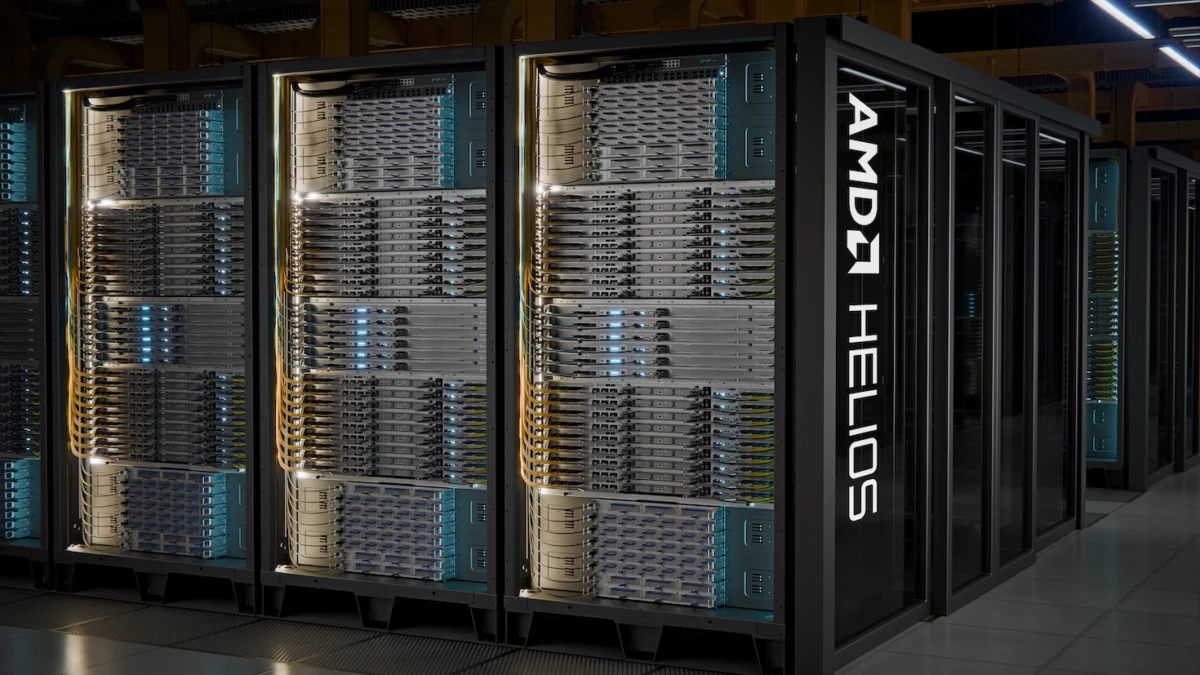
By optimizing the entire rack, AMD believes it can achieve radical efficiency gains. The company’s projections suggest that by 2030, the computational tasks currently requiring 570 server racks will be accomplished using just two AMD-configured racks. This 20-fold improvement in efficiency also translates to a 28-fold reduction in carbon intensity, a metric that is increasingly vital for corporate clients facing pressure to report and reduce their Scope 3 greenhouse gas (GHG) emissions.
Chronology of Innovation and Commitment
AMD’s journey toward this 2030 goal is not merely a theoretical exercise; it is rooted in a series of product-level milestones that have defined the company’s recent trajectory:
- 2022–2024: AMD solidified its position as a market leader in AI computing. During this period, the company shifted its focus toward integrated rack systems, such as the Helios platform, which is currently deployed by hyperscalers like Meta, Microsoft, OpenAI, and Oracle.
- 2024: The base year for AMD’s efficiency calculations. During this time, the company began formalizing its internal target-setting, embedding efficiency-per-watt metrics into the performance bonuses of every product team.
- 2024–2026: AMD reported a fourfold increase in energy efficiency through early implementation of its co-optimization approach.
- August 18, 2025: AMD released its 2025-2026 corporate responsibility report and a follow-up blog detailing the 2030 roadmap, emphasizing that 85% of its total GHG impact stems from the usage phase of its products.
- 2030 (Target): The deadline for the 20-fold efficiency increase and the broader goal of reducing Scope 1 and 2 emissions by 50%.
Supporting Data: The Efficiency Battleground
The race for efficiency is not merely an environmental crusade; it is a competitive imperative. With data center products accounting for 58% of AMD’s $11.5 billion second-quarter revenue, the ability to offer lower energy costs to cloud providers is a primary selling point.
Comparative Metrics
AMD and its primary rival, NVIDIA, have adopted different philosophies regarding public disclosure:
- AMD’s Approach: AMD focuses on rack-scale efficiency and provides granular data on its progress. Their disclosures include the impact of rack-level cooling but acknowledge the complexity of accounting for external data center heat removal.
- NVIDIA’s Approach: NVIDIA has pledged to reduce the emissions intensity of its products by 75% per PetaFLOP by 2030. However, in its most recent sustainability report (June 2026), the company highlighted a 10-fold efficiency improvement for its "Vera Rubin" architecture over the previous "Blackwell" generation, while remaining less specific on aggregate Scope 3 progress.
Industry analysts have taken note of the difference. Jonathan Koomey, a researcher known for his extensive work on data center energy consumption, lauded AMD’s transparency. "AMD is being very transparent about what it will take, and it is known for being rigorous," Koomey stated. "The systems-level view is very appropriate."
Official Responses and Corporate Accountability
The push for sustainability is increasingly driven by shareholder activism and rigorous corporate reporting standards. Justin Murrill, AMD’s Chief Sustainability Officer, has made it clear that efficiency is no longer a peripheral goal—it is central to the company’s operational DNA.
“Our biggest impact and opportunity is the energy efficiency of our products,” Murrill told reporters. By tying these efficiency targets to company-wide bonuses, AMD has moved sustainability from the marketing department to the engineering floor.
However, advocates like Giovanna Eichner, a shareholder advocate at Green Century, caution that efficiency metrics are only part of the story. "Energy efficiency doesn’t always translate to emissions reduction if you’re continuing to crank out products at a higher rate," Eichner noted. Green Century has been instrumental in pushing both AMD and NVIDIA to adopt more comprehensive climate transition plans.
While AMD published its first climate transition plan in 2025—a move prompted by shareholder pressure—NVIDIA has yet to publish a specific, comprehensive target for its Scope 3 emissions. Green Century and other institutional investors are currently advocating for NVIDIA to provide more transparency, particularly regarding the use-phase emissions of their hardware.
Implications: The Future of the Data Center
The implications of this "Green Compute" race are profound for the broader economy.
1. The Energy Supply Constraint
As AI demand surges, the energy grid is under unprecedented stress. Companies like Microsoft and Meta are not just buying chips; they are procuring vast amounts of renewable energy and, in some cases, exploring natural gas plants to ensure uptime. If AMD’s 20-fold efficiency improvement becomes reality, it could significantly alleviate the pressure on utilities to bring new, carbon-heavy generation online.
2. Supply Chain Sustainability
Being "fabless," both AMD and NVIDIA rely on third-party manufacturers. AMD’s strategy involves encouraging its supply chain partners to embrace renewable energy, claiming that as of 2025, every supplier has set its own GHG reduction targets. This indicates a shift where semiconductor design firms act as environmental gatekeepers for the entire electronics manufacturing ecosystem.
3. The Investor Perspective
Investors are increasingly using environmental, social, and governance (ESG) factors to de-risk their portfolios. Companies that fail to provide transparent, verified data on their carbon footprint—particularly regarding the energy consumption of their products once they are in the hands of customers—are increasingly viewed as carrying "transition risk." The pressure from groups like Green Century suggests that the era of "black box" efficiency claims is coming to an end.
4. Technological Co-dependency
The shift toward rack-level design means that chipmakers are becoming more involved in the physical architecture of the data center. This requires closer partnerships with facility managers and cooling technology providers. The success of AMD’s Helios system suggests that the future of computing is not just about the speed of the processor, but the thermal and electrical harmony of the environment in which that processor lives.
Conclusion
The path toward sustainable AI is fraught with technical and systemic challenges. While AMD’s commitment to a 20-fold increase in rack-scale efficiency is a significant step forward, the ultimate test will be whether these gains can outpace the exponential growth in global compute demand. As the industry grapples with the climate reality of the AI age, transparency and cross-system engineering will likely remain the gold standard for success. Whether rivals follow suit with similar levels of disclosure remains one of the most critical questions facing the technology sector as it approaches the 2030 climate deadline.