Main Facts
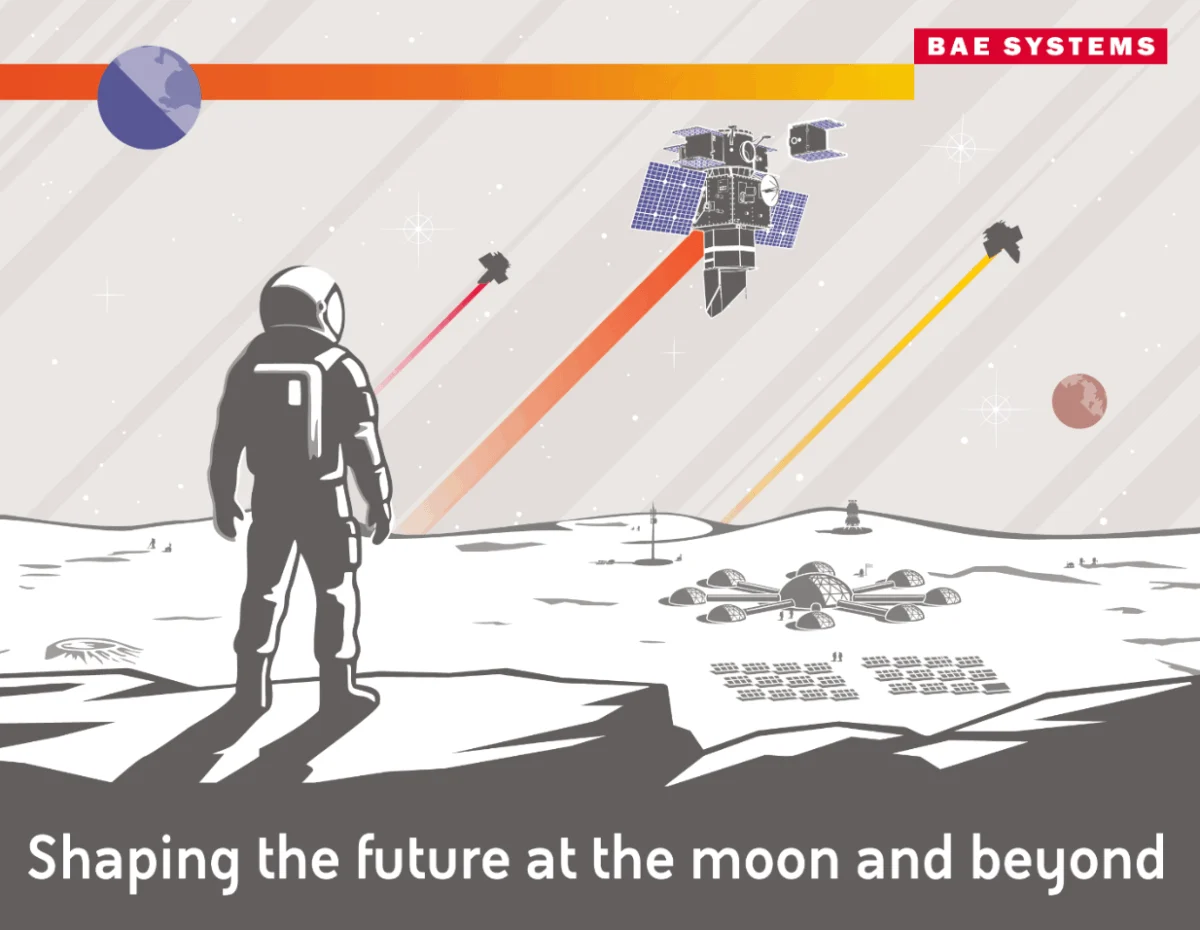
The United States is embarking on a transformative era of space exploration, shifting its focus from temporary missions to a permanent, sustainable presence in cislunar space—the region of space extending from the Earth’s atmosphere to just beyond the Moon’s orbit. This strategic pivot aims to establish a robust "cislunar economy," serving as both a laboratory for deep-space technologies and a cornerstone for national security.
To achieve this ambitious vision, federal agencies—primarily NASA and the Department of Defense—are increasingly relying on a new paradigm of public-private partnerships. Among the primary commercial entities positioning themselves to anchor this ecosystem is BAE Systems. Following its strategic acquisition of Ball Aerospace in early 2024, BAE Systems Space & Mission Systems has integrated decades of civil space heritage with industrial-scale defense capabilities.
The defense and aerospace contractor is currently developing next-generation technologies to facilitate this lunar transition. These include:
- The Ascent™ spacecraft: A highly maneuverable vehicle designed for dynamic space operations, including refueling, orbital transfers, and hosting rideshare payloads.
- Advanced spectral imaging suites: Instruments designed for critical scientific missions, including the University of Colorado’s Lunar Compact Infrared Imaging System (L-CIRiS) and NASA’s Lunar Vulcan Imaging and Spectroscopy Explorer (LunarVISE).
- Cross-sector recruitment initiatives: Programs aimed at addressing a critical aerospace labor shortage by drawing specialized talent from non-traditional industries like the automotive and software sectors.
This push comes amid intensifying geopolitical competition, with nations such as China aggressively pursuing their own lunar exploration timelines, making the rapid development of U.S. cislunar infrastructure a matter of strategic urgency.
Chronology of Exploration: From Apollo to the Cislunar Frontier
The path to the modern cislunar economy is built upon a continuous, multi-decadal timeline of scientific discovery and technological evolution. By tracing this lineage, the continuity between early planetary exploration and future lunar settlement becomes clear.
[1969] Apollo 11 Lunar Landing
   │
[2004] Deep Impact Mission Launch (Comet interior analysis)
   │
[2005] Mars Reconnaissance Orbiter Launch (High-resolution Martian imaging)
   │
[2009] Kepler Space Telescope Launch (Exoplanet discovery phase)
   │
[2021] James Webb Space Telescope Launch (Infrared deep-space observation)
   │
[Present] Development of Ascent™ Spacecraft, L-CIRiS, & LunarVISE
   │
[2026] Planned Launch of Nancy Grace Roman Space Telescope (August)
   │
[Future] Sustained Lunar Bases & Crewed Missions to Mars
The Apollo Foundation (1969)
The modern push for the Moon is the direct descendant of the Apollo program. When NASA astronauts first stepped onto the lunar surface in 1969, the primary yields were scientific samples and a profound geopolitical statement. However, the infrastructure of the era was not designed for sustainability. The current era seeks to turn those early, brief visits into permanent operational capabilities.
Robotic Deep-Space Pioneers (2004–2009)
In the decades following Apollo, the focus shifted to robotic exploration to master precision guidance, navigation, and imaging:
- Deep Impact (2004): This mission successfully deployed an impactor into the nucleus of comet Tempel 1, analyzing the debris to understand the foundational building blocks of the solar system.
- Mars Reconnaissance Orbiter (2005): Since entering Martian orbit in 2006, this spacecraft has utilized advanced imaging systems to search for evidence of water and map potential landing sites for future human missions.
- Kepler Space Telescope (2009): Kepler revolutionized astronomy by confirming 2,662 exoplanets, proving that planets are common throughout the galaxy and identifying potentially habitable worlds.
The Great Observatories (2021–2026)
The engineering lessons learned from these planetary explorers culminated in the deployment of humanity’s most complex space observatories:
- James Webb Space Telescope (2021): The largest and most powerful space telescope ever launched, JWST relies on ultra-precise optical systems to peer back to the dawn of cosmic time.
- Nancy Grace Roman Space Telescope (Planned August 2026): Designed to possess a field of view 100 times greater than that of the Hubble Space Telescope, Roman will investigate dark energy, dark matter, and search for distant planetary systems.
The Cislunar Transition (Present Day)
The expertise gained from deep-space imaging and precise orbital maneuvering is now being deployed closer to home. BAE Systems is utilizing this heritage to develop instruments like L-CIRiS and LunarVISE, adapting deep-space infrared and spectroscopy technology to withstand the abrasive dust and extreme thermal cycles of the lunar surface.
Technological Innovations and Supporting Data
Establishing a self-sustaining cislunar economy requires a shift from disposable, single-use hardware to modular, resilient, and highly maneuverable assets.
The Ascent™ Spacecraft and Elevation™ Product Line
To navigate the complex orbital mechanics of cislunar space—which involve navigating the gravitational pull of both the Earth and the Moon—spacecraft require dynamic maneuverability. BAE Systems’ Ascent™ spacecraft, the newest addition to its Elevation™ product line, is designed to meet this challenge.
| Feature | Technical Specification / Capability | Operational Benefit |
|---|---|---|
| Propulsion System | High-thrust, chemical/electric hybrid options | Enables rapid orbital plane changes and transit between Earth-Moon Lagrange points. |
| Maneuverability | In-space refueling compatibility | Extends mission lifespans indefinitely, breaking the "single-launch, single-use" paradigm. |
| Payload Capacity | Multi-manifest rideshare configuration | Allows government, military, and commercial payloads to share launch costs. |
| Guidance & Control | Autonomous relative navigation | Facilitates safe proximity operations and autonomous docking for servicing. |
Surface Science: L-CIRiS and LunarVISE
Scientific instruments destined for the lunar surface must survive one of the most hostile environments in the solar system, characterized by temperatures swinging from -246°C at night to 121°C during the day.
- L-CIRiS (Lunar Compact Infrared Imaging System): Developed in collaboration with the University of Colorado Boulder, this instrument is designed to map the distribution of volatile resources—such as water ice—in the shaded regions of the lunar South Pole. It utilizes thermal infrared imaging to measure composition and temperature profiles.
- LunarVISE (Lunar Vulcan Imaging and Spectroscopy Explorer): A NASA-funded suite designed to explore the mysterious Gruithuisen Domes. By analyzing the volcanic composition of these silicic domes, LunarVISE aims to answer fundamental questions about the Moon’s thermal and chemical evolution.
                        [CISLUNAR INFRASTRUCTURE]
                                    │
       ┌────────────────────────────┼────────────────────────────┐
       ▼                            ▼                            ▼
[Ascent™ Spacecraft]       [L-CIRiS Instrument]        [LunarVISE Suite]
 • In-space refueling       • Thermal IR mapping        • Volcanic composition
 • High-thrust propulsion   • Resource identification   • Gruithuisen Domes exploration
 • Rideshare payload hub    • Volatile tracking         • Surface spectroscopy
Industry Perspectives and Official Responses
Industry leaders and commercial space pioneers emphasize that returning to the Moon is not merely a repeat of the 20th-century space race, but a fundamental restructuring of how humanity interacts with space.
The "Why" of Deep-Space Exploration
During a high-profile industry press conference, prominent commercial astronaut and Polaris Dawn Commander Jared Isaacman addressed the recurring skepticism regarding the high cost of deep-space exploration:
"I am often asked why we send our astronauts into such a harsh, dangerous, unforgiving environment as space or the lunar surface and at such great cost. We go for the technology we will pioneer to get there, the science and all we might learn that will make life better back on Earth… and to be very clear, to master the skills for where we will inevitably go next."
The Geopolitical Imperative
The push into cislunar space is occurring against a backdrop of intense international competition. John Troeltzsch, Exploration Architect at BAE Systems, notes that the timeline for establishing lunar infrastructure is accelerating due to foreign state actors:
"We are in a global competition, and we need to address that. Other countries have well-stated goals and an aggressive timeline that they’re following to accomplish them. It’s exciting to see our customers match that tempo and set forth on a U.S. program to go explore the moon."
Troeltzsch emphasizes that the complexity of the cislunar environment requires specialized expertise that cannot be built overnight:
"Making that dream a reality will require commercial partners that have proven experience, advanced technology and skilled workers. That formula can help the United States maintain its competitive advantage in space."
Pushing the Technological Envelope
While legacy experience provides a foundation, the demands of a sustained lunar presence require continuous innovation. Christie Bertels, BAE Systems’ Director of Civil Space Business Development, highlights this balance:
"We’ve got that proven heritage, but we’re also pushing the envelope in terms of what we’re capable of doing to enable more challenging missions in the future."
Implications: The Human Capital Dilemma and Strategic Outlook
The transition to a permanent cislunar economy carries profound implications for both national security and the domestic labor market.
The Shift to Cislunar Security
Cislunar space is rapidly emerging as a new domain for national defense. The U.S. military requires "Space Domain Awareness" (SDA) beyond traditional geostationary orbits (approximately 36,000 kilometers) out to the Moon (approximately 384,000 kilometers).
Controlling and monitoring this vast volume of space requires autonomous satellites capable of long-duration missions without constant instructions from ground stations. The technologies pioneered by the Ascent™ spacecraft directly support these national security requirements, offering the maneuverability needed to patrol and protect vital orbital corridors.
The Workforce Challenge: Recruiting Outside the Box
To build, program, and operate these complex systems, the aerospace sector is facing a severe shortage of specialized talent. The modern space program requires expertise in:
- Astrodynamics: Mapping highly complex three-body orbits in the Earth-Moon-Sun system.
- Autonomy and Machine Learning: Enabling lunar landers and orbital tugs to make real-time decisions when communications with Earth are delayed or severed.
- Systems Engineering: Managing the interdependencies of life support, power, propulsion, and shielding.
To bridge this talent gap, BAE Systems is looking beyond traditional aerospace pipelines. The company is actively recruiting professionals from the automotive, consumer electronics, and software industries.
An automotive software engineer, for example, possesses highly transferable skills in sensor fusion, autonomous navigation, and battery management systems—all of which are critical for lunar rovers and automated spacecraft.
[Traditional Aerospace Talent] ──┐
                                 ├─► [BAE Systems Multidisciplinary Teams]
[Automotive Software Engineers] ─┤   • Dynamic Astrodynamics
                                 ├─► • Autonomous Systems & AI
[Consumer Tech Developers] ──────┘   • Systems-Level Holistic Engineering
Christie Bertels emphasizes the cross-functional nature of this challenge:
"We’re trying to solve the biggest problems we’ve ever tried to solve in space. To do that successfully, you need systems-level thinking experts across disciplines. Space companies who hire engineers and technicians also need to hire business experts, scientists and marketing and communications people. Cislunar exploration is a cross-functional problem, and you need to be able to approach that problem holistically."
The Multi-Generational Impact
Ultimately, the establishment of a cislunar economy is a multi-generational project, comparable to the building of transcontinental railroads or the early maritime exploration of Earth. For those entering the field, the mission offers a unique sense of purpose.
"For me, it harkens back to the Apollo era," Bertels reflects. "There’s just so much opportunity right now. For a new person coming into this company or this industry, it’s impossible not to be inspired. We’re building things that will help the United States take the next big leap in space and send humans to Mars someday."