Jakarta, Indonesia – August 26, 2026 – Indonesia’s vibrant smartphone market is undergoing a significant transformation, marked by increasing concentration among leading brands and a palpable shift away from the entry-level segment. Escalating memory costs, a primary driver of this change, are dampening demand for the most affordable devices, compelling manufacturers to recalibrate their strategies and push consumers towards higher price points. The latest data from Omdia reveals a market where the top five players now command an overwhelming 96 percent of shipments, underscoring a highly consolidated landscape.
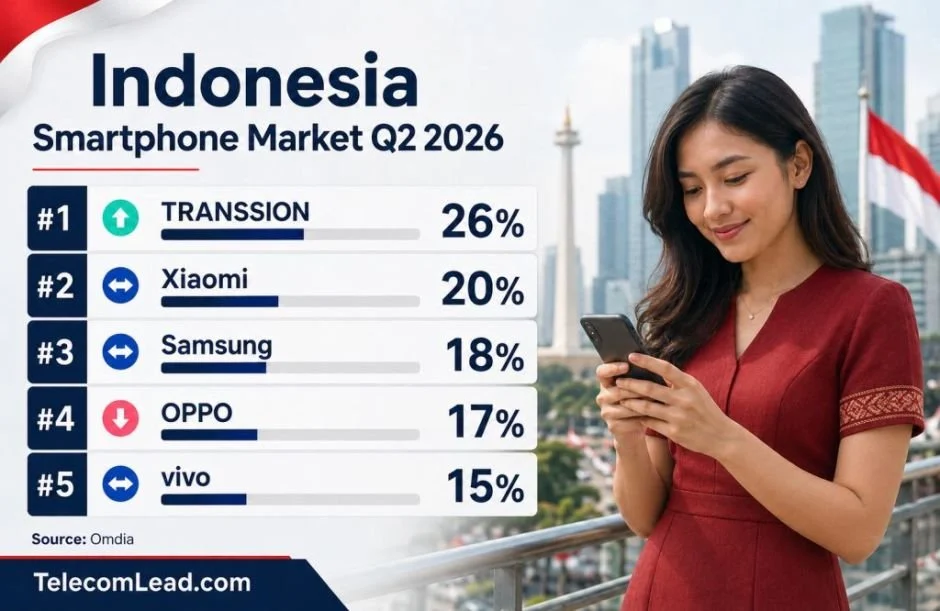
In the second quarter of 2026, Transsion, a formidable player in emerging markets, emerged as the frontrunner, securing a substantial 26 percent share of the Indonesian smartphone market. Following closely behind were Xiaomi at 20 percent, Samsung at 18 percent, OPPO at 17 percent, and vivo at 15 percent. This closely contested top tier, with only a five-percentage-point difference separating Xiaomi, Samsung, OPPO, and vivo, highlights the fierce competition for market share. However, Transsion maintained a more significant lead, holding a six-percentage-point advantage over Xiaomi and an eight-point edge over Samsung, solidifying its position as the current volume leader.
The Shifting Sands of Market Share: A Deeper Dive
The collective dominance of these five vendors is undeniable. Transsion and Xiaomi, in particular, have carved out a significant portion of the market, accounting for a combined 46 percent of all smartphone shipments. The influence of Chinese manufacturers is further amplified when considering Transsion, Xiaomi, OPPO, and vivo together, as they collectively controlled a commanding 78 percent of the market. This stands in stark contrast to Samsung’s 18 percent share, emphasizing the prevailing strength of Android-based brands within Southeast Asia’s largest smartphone market. The remaining 4 percent of the market is a fragmented battleground, shared by other brands including Apple, HONOR, and various local vendors, further illustrating the entrenched position of the top Android players.
A Challenging First Half: Market Contraction and Inventory Pressures
The positive performance in Q2 2026 emerges against a backdrop of a significantly challenging first quarter for the Indonesian smartphone market. In the first quarter of 2026, the market experienced a sharp year-on-year contraction of 17 percent, with smartphone shipments falling to 7.2 million units. This downturn represented the largest absolute shipment decline in Southeast Asia during that period. The data suggests that in Q1 2025, Indonesia shipped approximately 8.7 million smartphones, indicating a substantial reduction of around 1.5 million devices in the first quarter of 2026.
Several factors contributed to this first-quarter slump. Elevated channel inventory levels meant that retailers and distributors were holding more stock than anticipated, leading to a slowdown in new orders. Weaker-than-expected demand during the crucial Ramadan period also played a role, as consumer spending patterns shifted. Furthermore, recent retail price increases, driven by component cost fluctuations, likely deterred consumers from making timely replacement purchases, further exacerbating the decline. Given Indonesia’s status as the region’s largest smartphone market, its performance has a considerable impact on the overall figures for Southeast Asia.
Transsion’s Leadership Amidst Shifting Price Brackets
Transsion, operating through its well-established brands Infinix, TECNO, and itel, has successfully leveraged its extensive portfolio to cover a wide spectrum of consumer needs, from entry-level devices to affordable 5G and gaming-oriented options. This multi-brand strategy has been instrumental in its continued leadership in Indonesia. However, Omdia’s research indicates a broader regional trend for Transsion: the traditional sub-$100 smartphone model is becoming increasingly difficult to sustain.
Across Southeast Asia, Transsion’s shipments saw a notable decline of 25 percent in the second quarter of 2026, dropping to 3.4 million units from 4.6 million units in the same period last year. This regional downturn is particularly pronounced in the sub-$100 price segment, where Transsion’s shipments plummeted by a staggering 47 percent. Conversely, the company witnessed a healthy 12 percent increase in shipments within the $100 to $199 price bracket, which has now become its largest revenue-generating category.
This strategic shift is evident in Transsion’s product launches. New devices like the Infinix HOT 70 and TECNO SPARK 50 4G have been introduced at higher price points than their predecessors. This pricing strategy is accompanied by enhanced features, including larger batteries, high-refresh-rate displays, improved camera capabilities, and the integration of AI features. By offering these value-added enhancements, Transsion aims to nudge consumers beyond the traditional entry-level price ceiling. While Transsion’s 26 percent leadership in Indonesia is a significant achievement, its historical reliance on price-sensitive consumers makes it particularly vulnerable to ongoing memory and component price inflation. Any further increases in these costs could put considerable pressure on its margins and market share.
Xiaomi’s Ascent: Driving Up Average Selling Prices
Xiaomi secured the second position in Indonesia with a 20 percent market share, trailing Transsion by six percentage points and leading Samsung by a narrow two-point margin. Regionally, Xiaomi shipped 3.7 million smartphones in Q2 2026, a 21 percent decrease from 4.7 million units in the prior year. Despite this regional decline, its market share in Southeast Asia remained stable at 19 percent.
A key indicator of Xiaomi’s evolving strategy is its impressive 43.5 percent increase in average selling price (ASP) across Southeast Asia, the second-highest ASP growth among the top five vendors in the region. This surge in ASP is a direct consequence of a significant 69 percent drop in its sub-$100 shipments, which has been offset by a robust 55 percent increase in shipments within the $100 to $199 price segment.
These figures suggest that Xiaomi has been more adept than some of its competitors in successfully transitioning its customer base from the entry-level segment to the next price tier. The company’s pricing adjustments on popular series like the Redmi Note 15, coupled with higher launch prices for its newer models, have directly contributed to this ASP growth. For instance, in Indonesia, the Redmi Note 15 6GB+128GB is priced at Rp2.899 million. The Redmi Note 15 Pro 5G commands a higher price of Rp5.099 million, while the flagship Redmi Note 15 Pro+ 5G reaches Rp8.999 million. The substantial price difference, with the Pro+ model costing approximately 3.1 times more than the standard Redmi Note 15, allows Xiaomi to effectively compete for both price-conscious consumers vying for affordable options and those seeking higher-value devices, putting it in direct contention with Samsung and OPPO in these more lucrative segments.
Samsung’s Steady Hand: Gaining Ground in Mid-Tier Segments
Samsung maintained an 18 percent share of Indonesian smartphone shipments, positioning itself two percentage points behind Xiaomi and just one point ahead of OPPO. On a regional level, Samsung demonstrated the most resilient performance among the top five vendors in Q2 2026. While its Southeast Asian shipments declined by 11 percent to 3.9 million units, this contraction was less severe than that experienced by Xiaomi, Transsion, OPPO, or vivo. Consequently, Samsung’s regional market share saw an increase, rising from 17 percent to 20 percent.
A particularly noteworthy aspect of Samsung’s regional strategy is its significant expansion within the $200 to $299 price category. Its share in this segment surged from 18 percent in Q2 2025 to an impressive 32 percent in Q2 2026, marking a substantial gain of 14 percentage points. Samsung has also broadened its presence across the wider sub-$300 category, a strategic move that has seen several competitors reduce their focus. This approach, emphasizing value and features within these mid-tier price bands, appears to be resonating with Indonesian consumers looking for a balance of performance and affordability.
OPPO’s Uphill Battle: Entry-Level Collapse and Promotional Strategies
OPPO accounted for 17 percent of Indonesian smartphone shipments, placing it just one percentage point behind Samsung and three points adrift of Xiaomi. However, the company’s regional performance was considerably weaker. OPPO’s Southeast Asian shipments, including those of its sub-brand realme but excluding OnePlus, fell by a sharp 41 percent to 3.1 million units. This decline resulted in a reduction of its regional market share from 21 percent to 16 percent.
The most dramatic impact for OPPO was seen in the sub-$100 segment, where its shipments plunged by an astonishing 96 percent, representing the steepest contraction among all the leading vendors. Shipments in the $100 to $199 category also experienced a decline of 25 percent, indicating that an increase in higher-priced segments did not compensate for the substantial loss of volume from the entry-level market.
In response to these challenges, OPPO is intensifying its focus on its Reno series smartphones, emphasizing AI capabilities, advanced imaging, battery performance, and promotional offers. The recent Indonesian Reno16 campaign, for instance, featured a significant Rp1.6 million discount on the Reno16 Pro, a promotion more than double the maximum discount offered on the Reno16 F Eco Pack (up to Rp700,000). This strategy highlights OPPO’s concerted effort to stimulate demand for its higher-value smartphones as it strategically reduces its reliance on the lowest price bands.
vivo’s Financing Focus: Navigating the $100 Threshold
vivo secured a 15 percent share of Indonesia’s smartphone shipments, trailing OPPO by two percentage points and Samsung by three. Across Southeast Asia, vivo shipped 2 million smartphones in Q2 2026, a 26 percent decrease from 2.8 million units in the same quarter of the previous year. Despite this volume decline, its regional market share remained relatively stable at 11 percent.
A significant shift is evident in vivo’s product mix. Its sub-$100 shipments declined by a substantial 88 percent, now accounting for only 5 percent of its regional volume, a stark contrast to the 32 percent contribution it held a year earlier. This represents a considerable 27 percentage-point drop in the significance of sub-$100 devices for the brand.
To maintain affordability as its devices move above the $100 mark, vivo is increasingly leveraging financing options. For example, its financing offer for the vivo Y500 includes attractive terms such as zero percent interest, zero down payment, and monthly installments starting at approximately Rp500,000. This reliance on financing is likely to become a critical strategy in the Indonesian market, enabling consumers to acquire higher-priced devices without the immediate burden of the full upfront cost.
Broader Market Outlook: Global Trends and Future Predictions
The challenges observed in Indonesia are mirrored across the broader Southeast Asian market. Omdia forecasts a significant 25 percent decline in Southeast Asian smartphone shipments for the full year 2026, projecting a total of 75.3 million units. This forecast implies a market of approximately 100.4 million devices in 2025, indicating an annual reduction of about 25.1 million shipments.
The global smartphone market is also facing headwinds. IDC anticipates a worldwide decline of 13.9 percent in smartphone shipments for 2026, bringing the total to around 1.09 billion units – the steepest annual contraction on record. Projections suggest a further 1.1 percent decline in 2027, with a potential recovery of 5.5 percent anticipated in 2028 as memory supply chains normalize. These global trends, particularly the impact of memory costs and geopolitical factors, are undoubtedly influencing the dynamics within individual markets like Indonesia.
The Future of Indonesian Smartphone Competition: A Multi-Faceted Arena
The Indonesian smartphone market is entering a new phase of competition, characterized by a consolidation of power among the top players and a strategic pivot towards higher price segments. While Transsion holds the volume lead, the narrow margins between Xiaomi, Samsung, OPPO, and vivo indicate an intense battle for supremacy.
Transsion faces the critical task of defending its leadership in the affordable segment as sub-$100 demand continues to contract. Meanwhile, Xiaomi’s success in migrating consumers to the $100-$199 range positions it well for continued growth. Samsung’s steady gains in the $200-$299 category demonstrate its ability to capture a more affluent segment of the market. OPPO, grappling with the steepest regional shipment pressures, is actively seeking to revitalize its performance through aggressive promotions on higher-end models. vivo, on the other hand, is increasingly relying on innovative financing solutions to make its more expensive devices accessible.
The coming period will see an intensified focus on a range of competitive factors. Pricing strategies, the availability and attractiveness of instalment plans, the adoption of 5G technology, the integration of AI features, enhanced battery life, superior camera performance, robust software support, and compelling promotional value will all play crucial roles. Ultimately, vendors that can deliver superior specifications and features without pushing prices beyond the reach of the average consumer will be best positioned to gain significant market share in this evolving Indonesian smartphone landscape.
By Fasna Shabbir