Ho Chi Minh City, Vietnam – August 15, 2026 – Vietnam’s vibrant smartphone market experienced a significant trend towards consolidation in the second quarter of 2026, with industry leader Samsung further solidifying its dominant position. The latest analysis from Omdia reveals that while Samsung strengthened its hold, Chinese powerhouses Xiaomi and OPPO made substantial gains in shipment share, intensifying the competition for market supremacy. This dynamic shift underscores a broader regional trend of declining overall shipments, forcing vendors to adapt their strategies and focus on higher-value segments.
Key Market Dynamics: Concentration and Shifting Fortunes
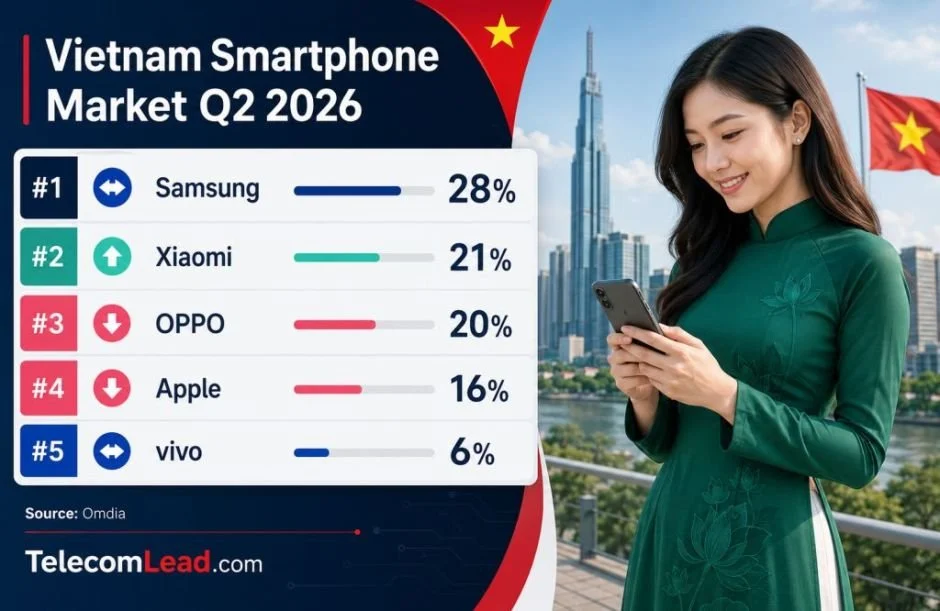
The second quarter of 2026 painted a picture of a more concentrated Vietnamese smartphone landscape. Samsung emerged as the undisputed leader, commanding an impressive 28 percent of all shipments. Hot on its heels, Xiaomi secured a strong second place with 21 percent, closely followed by OPPO at 20 percent. Apple, a consistent performer in the premium segment, held 16 percent, while vivo rounded out the top five with 6 percent of the market.
This elite group of five vendors collectively accounted for a staggering 91 percent of total shipments in Vietnam during Q2 2026. This marks a notable increase from the 87 percent share they held in the same period last year (Q2 2025), indicating that smaller brands are finding it increasingly challenging to carve out significant market share in the face of these dominant players. The remaining 9 percent of the market is now contested by a more fragmented group of manufacturers, including HONOR, realme, and Transsion.
The competition for the second and third positions was particularly fierce. Samsung’s lead over Xiaomi was a substantial seven percentage points. However, the gap between Xiaomi and OPPO was a mere one percentage point, highlighting the intense rivalry and strategic maneuvering underway between these two Chinese giants.
A Year of Significant Gains and Losses: The Q2 2026 Performance Snapshot
Examining the year-over-year performance, OPPO emerged as the biggest winner in terms of market share growth among the top five vendors. The company recorded a remarkable four-percentage-point increase in its share, signaling a successful strategic push. Xiaomi also demonstrated strong momentum, gaining three percentage points, while Samsung, despite already holding a leading position, managed to add two percentage points to its share.
Conversely, Apple experienced the steepest decline, shedding four percentage points from its previous share. This indicates a potential softening of demand for its premium offerings or increased pressure from aggressive pricing strategies by competitors. vivo also saw a slight decrease, losing one percentage point.
The combined strength of the top Chinese vendors – Xiaomi, OPPO, and vivo – is a significant factor in the Vietnamese market. Together, they captured a formidable 47 percent of total smartphone shipments, giving them a notable 19-percentage-point advantage over Samsung. This highlights the growing influence and market penetration of Chinese brands in Vietnam.
Samsung: Extending its Reign with a Diversified Strategy
Samsung’s continued dominance in Vietnam is a testament to its robust product portfolio and effective market strategies. The company successfully increased its market share from 26 percent in Q2 2025 to 28 percent in Q2 2026, a significant achievement in a maturing market. This growth occurred even as smartphone prices, on average, saw an increase, suggesting that Samsung’s broad range of offerings effectively caters to both mainstream and discerning premium consumers.
This strong performance in Vietnam mirrors Samsung’s regional success. In the wider Southeast Asian market, Samsung led in Q2 2026. Despite a 11 percent year-over-year decline in its regional shipments, reaching 3.9 million units, its market share rose from 17 percent to 20 percent. This indicates that Samsung’s competitors experienced even sharper contractions, allowing Samsung to gain ground. Notably, Samsung saw a significant surge in its share within the $200-$299 price segment in Southeast Asia, climbing from 18 percent to 32 percent.
Globally, Samsung’s performance was even more impressive. According to Counterpoint Research, the company secured a 23 percent global shipment share in Q2 2026, with volumes increasing by 9 percent year-on-year. This demonstrates Samsung’s resilience and ability to grow even in a challenging global smartphone environment.
In Vietnam, Samsung’s strategy appears to be centered around its well-established Galaxy A-series for mainstream appeal, its premium Galaxy S smartphones for the high-end market, and its innovative foldable devices. The Galaxy A57 5G, for instance, is priced competitively starting from VND12.49 million for the 8GB+128GB variant, going up to VND14.49 million for the 12GB+256GB model. The Galaxy A37 5G is positioned at a more accessible entry point, starting at VND10.29 million. Both these models offer extended software support, with six generations of operating system upgrades and six years of security updates, a strong selling point for consumers seeking longevity from their devices. The A57 further boasts a robust 5,000mAh battery, a 50MP main camera, IP68 water and dust resistance, and fast charging capabilities, reaching 65 percent charge in just 30 minutes, as detailed by Samsung Vietnam.
Xiaomi’s Ascent: Climbing to Second Place Amidst Price Tier Shifts
Xiaomi’s impressive surge in Vietnam, moving from third place in Q2 2025 to a strong second place in Q2 2026 with a 21 percent market share, is a significant development. The company’s three-percentage-point gain suggests that its Redmi, POCO, and Xiaomi-branded smartphones continue to resonate with Vietnamese consumers, even as prices have reportedly increased.
While Xiaomi’s performance in Vietnam was a bright spot, its regional results across Southeast Asia told a different story. The company’s shipments in the region declined by 21 percent year-on-year, from 4.7 million to 3.7 million units in Q2 2026. However, its regional market share remained stable at 19 percent, indicating that its overall market position held firm despite the volume drop.
A key observation from Xiaomi’s performance in Southeast Asia is its significant shift in pricing strategy. The company reported the second-highest average selling price (ASP) increase among the top five vendors, with its ASP rising by 43.5 percent. This indicates a strategic move away from the ultra-low-cost segment. Shipments of devices priced below $100 plummeted by 69 percent, while sales in the more lucrative $100-$199 segment saw a substantial 55 percent increase. This strategic pivot signifies Xiaomi’s intent to move consumers towards more premium and higher-margin devices.
In Vietnam, this strategy is evident in the pricing of its devices. The Xiaomi 17T, for instance, is priced at VND20.09 million for the 12GB+256GB configuration and VND20.99 million for the 12GB+512GB variant, though promotional discounts can bring these prices down by up to VND3 million. Similarly, the POCO X8 Pro, originally priced at VND11.99 million, has been available for VND10.29 million, representing a significant discount of approximately 14 percent. These pricing adjustments demonstrate Xiaomi’s efforts to balance aspirational branding with competitive offers in the mid-to-upper-mid-range segments.
OPPO’s Remarkable Comeback: Dominating Market Share Gains
OPPO staged a remarkable comeback in the Vietnamese market, capturing a significant 20 percent of smartphone shipments in Q2 2026, a substantial leap from its 16 percent share in the previous year. This four-percentage-point gain was the most impressive among the top five vendors, underscoring a highly effective market strategy.
This surge placed OPPO just one percentage point behind Xiaomi and eight percentage points behind the market leader, Samsung. The combined force of Xiaomi and OPPO is now a formidable bloc, controlling 41 percent of Vietnam’s smartphone shipments and holding a significant 13-percentage-point lead over Samsung.
However, OPPO’s success in Vietnam stood in stark contrast to its performance in the broader Southeast Asian market. Omdia estimates that OPPO’s shipments in the region (including realme but excluding OnePlus) fell by a significant 41 percent year-on-year, to 3.1 million units. This led to a decline in its regional market share from 21 percent to 16 percent.
OPPO appears to be strategically retreating from the sub-$100 price segment in Southeast Asia, where its shipments dropped by a staggering 96 percent. Even shipments in the $100-$199 segment saw a 25 percent decline. Instead, the company is increasingly prioritizing its Reno series, focusing on advanced camera capabilities, AI integration, and enhanced battery performance, rather than pursuing volume in entry-level categories.
In Vietnam, this focus is evident in the positioning of its latest offerings. The Reno16 5G is priced at VND18.99 million, while the Reno16 F 5G is available at approximately VND15 million. The Reno16 5G, in particular, is equipped with a substantial 6,700mAh battery, supports 80W fast charging, and boasts IP69K protection, reinforcing OPPO’s commitment to delivering premium features in the upper-mid-range segment. This strategic shift away from low-cost devices and towards feature-rich, higher-priced models appears to be paying dividends in the Vietnamese market.
Apple’s Shifting Position: Premium Resilience Amidst Market Pressures
Apple’s market share in Vietnam experienced a notable decline in Q2 2026, falling by four percentage points from 20 percent in Q2 2025 to 16 percent. This contraction saw the tech giant slip from the second position to fourth place, trailing Samsung, Xiaomi, and OPPO.
Despite this decline, Apple maintains a significantly stronger position in Vietnam compared to many other price-sensitive Southeast Asian markets. Its 16 percent share is nearly three times that of vivo, which holds 6 percent. This indicates that while facing increased competition, Apple’s premium brand appeal and loyal customer base continue to be strong factors in Vietnam.
Globally, Apple’s performance was markedly different. The company reported a 13 percent increase in shipments in Q2 2026, achieving its highest second-quarter market share of 21 percent. The iPhone 17 was identified as the world’s most-shipped smartphone model, and notably, Apple was the only major global vendor to avoid price increases during the quarter.
In Vietnam, the standard iPhone 17 starts at VND24.999 million, with the iPhone 17e priced at VND17.999 million and the iPhone 17 Pro beginning at VND34.999 million, according to Apple’s Vietnam store. While trade-in credits and monthly financing options help mitigate upfront costs, the expanding upper-mid-range portfolios of Xiaomi and OPPO are presenting increasingly compelling alternatives for consumers who may find Apple’s core premium price bands less accessible. This competition from more feature-rich devices in the mid-range segment is a key factor contributing to Apple’s market share adjustments in Vietnam.
vivo’s Steady Presence: Navigating the Shrinking Entry-Level Segment
vivo maintained its fifth-place position in Vietnam’s smartphone market, though its share saw a slight decrease from 7 percent to 6 percent in Q2 2026. The company now trails Apple by 10 percentage points and Samsung by a considerable 22 percentage points.
Across Southeast Asia, vivo experienced a more pronounced decline in shipments, falling 26 percent to 2 million units. However, its regional market share remained stable at 11 percent. This suggests that vivo is actively managing its market presence and potentially reallocating resources.
A significant strategic shift for vivo has been its reduced reliance on the lowest smartphone price category. Shipments of devices priced below $100 plummeted by 88 percent, now accounting for only 5 percent of its regional volume in Q2 2026, a sharp drop from 32 percent a year prior. This translates to a 27-percentage-point reduction in the contribution of sub-$100 devices to its overall business.
In Vietnam, the vivo V70 5G is priced at VND17.99 million for the 8GB+256GB variant and VND19.99 million for the 12GB+256GB model. This device features advanced ZEISS cameras, a substantial 6,500mAh battery, and 90W fast charging. To support demand in the lower price tiers, vivo continues to employ promotional strategies. The Y05 has been offered at VND4.79 million, a VND200,000 reduction, while the Y31d is available at VND8.09 million, representing a VND900,000 or 10 percent discount. These efforts demonstrate vivo’s attempt to balance its premium aspirations with the continued need to cater to price-conscious consumers in specific segments.
Broader Southeast Asian Context: A Downturn with Resilient Value
The vendor-specific trends in Vietnam must be viewed within the context of a severe regional downturn. Southeast Asian smartphone shipments plummeted by 23 percent in Q2 2026, reaching 19.3 million units, down from 25 million units in the same period last year. This marks the lowest quarterly shipment volume for the region since 2014, indicating a significant contraction in the overall market.
Despite the sharp decline in unit sales, the market value proved more resilient, reaching $6.6 billion. This was driven by a substantial 31 percent increase in the average selling price (ASP), which rose to $342. This suggests that while fewer devices are being sold, vendors are commanding higher prices, partially compensating for lost shipment volume.
The $100-$199 price category saw its regional share grow from 32 percent to 39 percent, indicating a shift towards mid-range devices. However, total shipments of devices priced above $100 still declined by 2 percent. This implies that a significant portion of the lost demand from the sub-$100 segment did not entirely migrate to higher price bands, but rather disappeared from the market altogether.
Looking ahead, Omdia forecasts a further 25 percent decline in Southeast Asian smartphone shipments for the full year 2026, projecting a total of 75.3 million units. This forecast suggests a substantial drop from an estimated 100.4 million units shipped in 2025, representing an annual loss of approximately 25.1 million units.
In conclusion, Vietnam’s smartphone market is navigating a period of intense consolidation and strategic recalibration. Samsung has successfully reinforced its leadership, while Xiaomi and OPPO are aggressively challenging the status quo with significant market share gains. Apple, though facing headwinds, remains a strong contender in the premium segment, while vivo is adapting to the shrinking entry-level market. The broader regional downturn underscores the challenging environment, forcing all players to focus on delivering value and innovation to capture the attention of an increasingly discerning and evolving consumer base.