

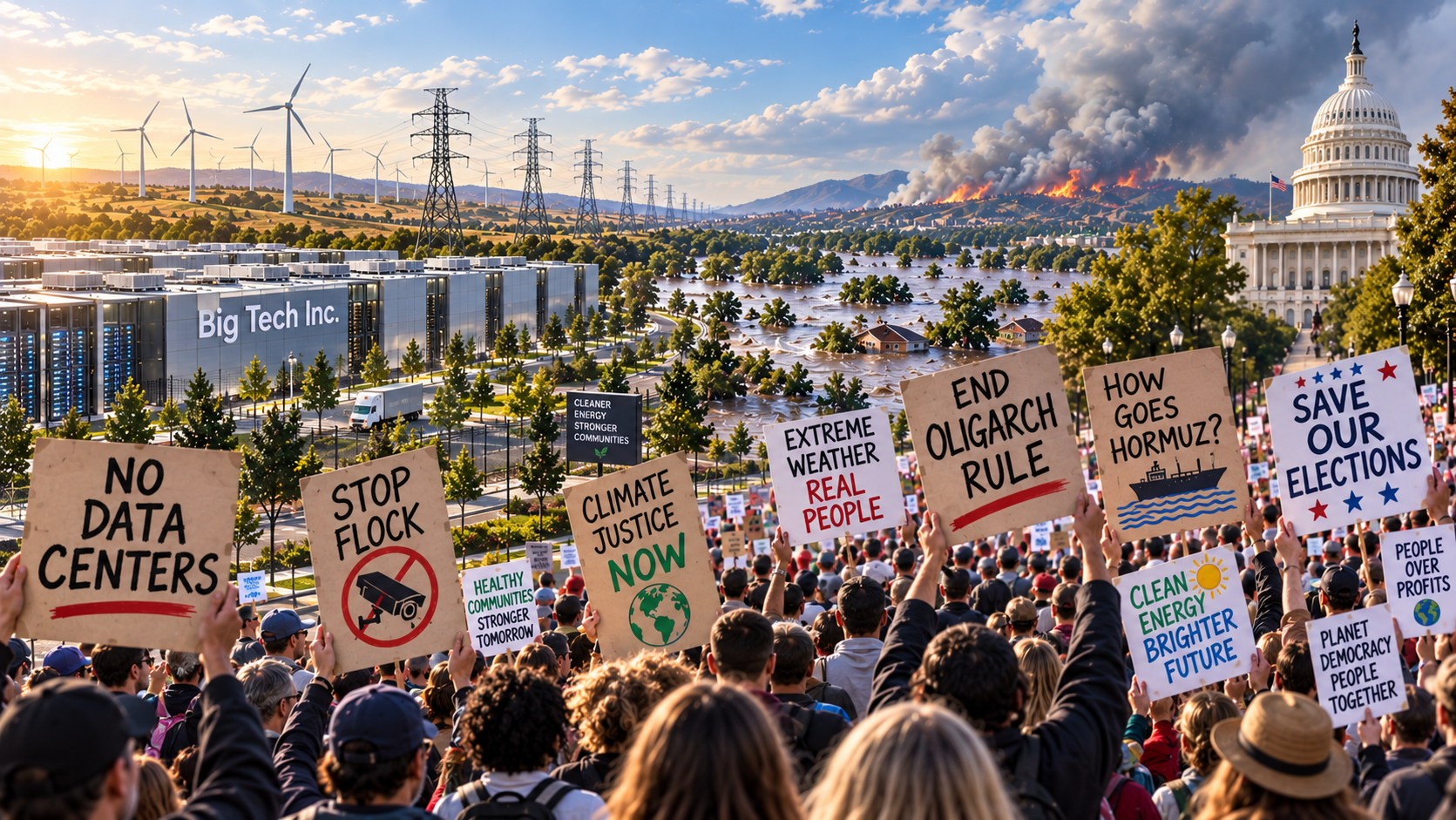
In the landscape of modern business, the concept of a “black swan” event—a rare, unpredictable, and high-impact occurrence—has become almost quaint. Today, global enterprises are facing something far more daunting: the simultaneous eruption of multiple, seemingly unrelated crises that threaten to coalesce into a systemic challenge to the corporate status quo. From the localized backlash against data center energy consumption to the global ripples of energy-price shocks and the existential anxiety of a shifting climate, the operating environment for business is undergoing a fundamental transformation.
As Joel Makower and Solitaire Townsend, co-hosts of the Two Steps Forward podcast, recently explored, the danger is no longer in any single issue. The danger lies in the convergence of these “wild cards.” When these disruptions align, they do not merely add to a company’s risk profile; they multiply it, potentially catalyzing a new, populist-driven movement that could reshape the social license to operate for entire industries.
The Anatomy of the Convergence: A Multi-Front Challenge
To understand the scope of this phenomenon, one must look at the disparate threads currently fraying the fabric of public trust.
- Infrastructure Resistance: The massive surge in data center construction, driven by the AI gold rush, is meeting fierce local opposition. Communities are pushing back against the strain on local power grids and water supplies, turning "Big Tech" into a neighborhood nuisance.
- Geopolitical Energy Shocks: The escalation of conflicts, such as the tensions involving Iran, continues to introduce volatility into global energy markets, creating inflationary pressures that hit household budgets long before they impact corporate bottom lines.
- Environmental Instability: The looming specter of a “Super El Niño” threatens to disrupt global supply chains, exacerbate food insecurity, and force a rapid reappraisal of climate resilience strategies.
- The Surveillance Backlash: Technologies once viewed as safety tools, such as Flock license-plate cameras, are now triggering widespread public outcry. The rapid expansion of corporate-backed surveillance in the public square is fueling concerns about privacy and civil liberties.
- Anti-Oligarch and Anti-Tech Sentiment: There is a palpable shift in the zeitgeist. The discourse is moving away from the "move fast and break things" ethos of the early 2000s toward a skeptical, often hostile, critique of the billionaire class and the perceived "techno-fascism" of the Silicon Valley elite.
Chronology of Disruption: From Seattle to the Present
History provides a roadmap for how such convergences can manifest, though it offers no guarantees on the outcome.
1999: The Seattle WTO Protests
At the turn of the millennium, the World Trade Organization protests in Seattle served as a watershed moment. It was a chaotic convergence of labor unions, environmentalists, and human rights activists. While the protests were initially disruptive, they ultimately forced a dialogue that bridged the gap between activists and corporate leaders, leading to the formation of the Blue Green Alliance. This suggests that convergence can, under the right conditions, lead to constructive, long-term policy evolution.
2012–2014: The New York Fracking Ban
Conversely, the campaign to ban fracking in New York demonstrates how fragile these coalitions can be. Initially, the movement enjoyed broad, cross-partisan support, uniting environmentalists with rural landowners concerned about water quality. However, as the debate became polarized, the movement was successfully reframed by political opponents as a “radical-left” endeavor that sacrificed working-class jobs. The coalition fractured, and the momentum stalled.
2025–2026: The Current Inflection Point
We are currently in the early stages of a new cycle. The modern convergence is characterized by a high-speed digital feedback loop. Unlike the protests of 1999, which required physical mobilization, today’s dissent is fueled by creators in their late 20s and early 30s—a generation that views “late-stage capitalism” not as a theory, but as an lived reality.
Supporting Data: The Erosion of the Social License
The “social license to operate”—the informal, intangible agreement between a company and the community in which it functions—is currently under severe duress.
Data from recent sociological and economic tracking indicates that wealth inequality has reached levels comparable to the Gilded Age in the United States and the Victorian era in Britain. Historical precedents show that when inequality hits these thresholds, legislative and social upheaval is rarely far behind.
- Demographic Shifts: According to recent analyses, the primary drivers of anti-capitalist discourse are not radical fringe groups, but young professionals who feel locked out of the housing and investment markets.
- Public Sentiment: Surveys tracking "tech-lash" indicate that trust in major platforms has plummeted by nearly 30% over the last five years. The sentiment is no longer just about privacy; it is about power. When communities see data centers consuming the electricity that they need to keep their own lights on, the "social license" evaporates instantly.
The Corporate Response: Bridging the Gap
How are corporations responding? The reaction has been, thus far, uneven.
Large-scale energy and infrastructure firms have attempted to pivot toward transparency, publishing impact reports and hosting community town halls. However, these are often viewed by skeptics as "corporate-speak" rather than genuine shifts in policy.
In the tech sector, the response has been defensive. Many firms have doubled down on legal efforts to install surveillance infrastructure, often bypassing municipal oversight by framing their work as "public-private safety partnerships." Official statements from these companies emphasize efficiency and crime reduction, yet they consistently fail to address the underlying philosophical objection: who owns the data, and who is ultimately accountable for its use?
Implications: The New Imperative for Sustainability Teams
For the sustainability professional, the mandate has changed. The historical role of sustainability—measuring carbon footprints, reporting backward-looking metrics, and achieving incremental efficiency—is no longer sufficient.
1. From Reporting to Red-Teaming
Sustainability teams must evolve into an early-warning system for the C-suite. This requires “red-teaming”—a practice borrowed from cybersecurity where teams actively simulate how their company’s activities might be weaponized or attacked by a social movement. By asking “what if?” before an issue reaches a boiling point, companies can move from a defensive posture to a proactive one.
2. Redefining the Social License
Companies must recognize that the social license is not a permanent asset. It is a lease that must be renewed daily. In an era of high inequality, this means that companies must align their operations with the broader public good. If a data center is the bottleneck for a city’s power, the solution cannot be "more power." The solution must be integrated energy efficiency and community investment that provides a tangible benefit to the local population.
3. Anticipating the Unlikely
The “wild card” nature of current events means that linear forecasting models will fail. Sustainability departments should diversify their intelligence gathering. This includes monitoring the social media discourse of the next generation of thought leaders, tracking the legislative patterns of local municipalities, and understanding the geopolitical tensions that fuel energy prices.
Conclusion: A Moment for Forward-Looking Leadership
It is impossible to predict with certainty whether the current trends of anti-tech sentiment, climate anxiety, and economic frustration will coalesce into a singular, transformative movement. However, the conditions for such a movement are undeniably present.
History is clear: societies do not remain static when faced with extreme wealth inequality and technological disruption. The Gilded Age eventually gave way to the Progressive Era; the Victorian age faced the Chartist movement. In each case, companies that refused to adapt were left behind by the tides of history.
For today’s leaders, the path forward is not found in more sophisticated PR, but in a radical reassessment of how their business contributes to the health and stability of the society in which they operate. The “Two Steps Forward” mindset requires the courage to look at the worst-case scenario and the foresight to build a business model that is resilient enough to survive, and contribute to, the inevitable changes ahead.
As the lines between environmental, social, and technological crises continue to blur, the most successful companies will be those that view their social license not as a hurdle to be jumped, but as the foundation upon which their future must be built. The era of the “wild card” is here; it is time for business to stop playing from the old deck.