For years, the boardroom consensus on climate change has been defined by a paralyzing fear: the belief that taking a stand on environmental, social, and governance (ESG) issues is a one-way ticket to alienating half the customer base. Corporate leaders have long operated under the assumption that sustainability initiatives are inherently "coded" as liberal, potentially triggering a backlash from conservative consumers and political stakeholders.
However, a groundbreaking new study suggests this fear may be significantly misplaced. According to a comprehensive survey of 2,000 U.S. voters, companies can secure broad consumer support for climate action—even among climate-skeptical Republicans—provided they frame their initiatives through the correct lens. The findings, released by the Center for Climate and Energy Solutions (C2ES) in partnership with the communications agency maslansky + partners and the nonprofit Potential Energy Coalition, offer a roadmap for businesses navigating an increasingly polarized political landscape.
The Myth of the Partisan Divide
The political divide between Democrats and Republicans on climate change is undeniably real, but the survey reveals it is far more nuanced than common wisdom suggests. When the conversation shifts from abstract political ideology to the concrete responsibilities of the private sector, the chasm narrows significantly.
Approximately three-quarters of all respondents agreed that corporations have a fundamental responsibility to limit their negative impact on the climate and the environment. While support for this statement was understandably higher among Democrats, the Republican response was striking: more than two-thirds of GOP voters echoed the sentiment that businesses bear a duty to steward the environment.
This data suggests that while the "climate change" label itself may carry partisan baggage, the underlying concept of corporate responsibility is a non-partisan value. Voters of all stripes expressed a willingness to back companies that actively pursue climate initiatives, while simultaneously signaling a readiness to punish those that fail to uphold their environmental promises.
Chronology: The Rise of Climate Politicization
To understand the current state of consumer sentiment, one must look at the recent trajectory of climate communications. In the early 2020s, many major corporations leaned into aggressive, high-profile sustainability pledges, often framed in the language of global climate justice. While these efforts resonated with younger, urban demographics, they also coincided with a broader "anti-ESG" political movement that sought to portray corporate environmentalism as an intrusion of "woke" ideology into the marketplace.
By 2024, the landscape had shifted. Increased regulatory scrutiny and the emergence of "anti-ESG" legislation in various states prompted some companies to retreat from their climate goals. This phenomenon, often termed "greenhushing," became a focal point of the survey.

- 2023: Corporate climate commitments reached a saturation point.
- 2024: Political pushback against ESG initiatives intensified. 40% of Democrats and a significant portion of Republicans began to perceive decisions like phasing out fossil fuels as "political stances" rather than business operations.
- 2025: The politicization deepened. The percentage of Democrats viewing the abandonment of fossil fuels as a "political" act rose to 55%, reflecting a growing public awareness that corporate climate policy is now a battlefield in the culture wars.
Despite this, the survey highlights a crucial irony: while consumers increasingly view climate action as "political," they simultaneously view the lack of action or the backtracking on climate promises as a failure of business integrity.
Supporting Data: The Cost of Backtracking
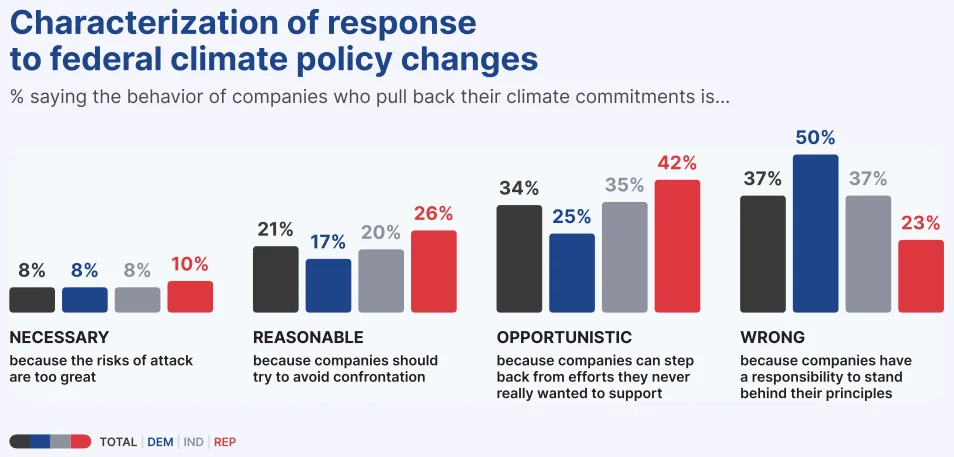
The survey data provides a sobering warning for companies tempted to abandon their environmental goals to appease political pressure. When asked how they would perceive a company that walks back its climate initiatives in response to government or public criticism, the results were unequivocal.
- The "Opportunistic" Label: A staggering 71% of all voters described such backtracking as "opportunistic" or "wrong."
- The GOP Consensus: Crucially, this sentiment was shared by 65% of Republican respondents.
"I was surprised by that," noted Nicholle Manners, a senior vice president at maslansky + partners. "The assumption is often that Republicans want companies to drop climate initiatives. But what they really dislike is perceived insincerity or a lack of spine. If a company makes a promise and breaks it, that is viewed as a character flaw, regardless of where the voter sits on the political spectrum."
Furthermore, more than 60% of all respondents confirmed they are more likely to purchase products and services from companies that prioritize clean energy usage and carbon reduction. The data suggests that for the average consumer, the "business case" for climate action is becoming synonymous with reliability and forward-thinking management.
Official Responses and Strategic Shifts
The findings have sent ripples through the corporate communications sector, forcing a reassessment of how sustainability is marketed.
Verena Radulovic, vice president for business engagement at C2ES, expressed optimism regarding the findings. "I did not expect climate-skeptical Republicans to agree that this is ‘smart business,’" she remarked. "That was really encouraging to see. It suggests that there is a path forward where companies can talk about energy efficiency, innovation, and long-term economic stability without falling into the trap of ideological labeling."
The Potential Energy Coalition, which specializes in identifying the language that moves public opinion, suggests that the "secret sauce" for corporate leaders lies in framing. When climate action is framed as "energy independence," "operational efficiency," or "future-proofing," the resistance from skeptical cohorts drops significantly. The challenge for modern corporations is to translate their decarbonization efforts into the language of resilience and competitive advantage.
Implications: The Path Forward
The implications for the C-suite are clear. First, the survey suggests that "staying out of it" is no longer a viable strategy. As climate impacts become more visible, the public is increasingly holding corporations accountable. Remaining silent is no longer perceived as neutral; it is increasingly interpreted as a lack of leadership.
Second, the "partisan divide" should not be an excuse for inaction. The survey confirms that while the terminology used by activists may alienate some, the actual outcomes of climate-smart business—cleaner air, more efficient energy, and long-term stability—are broadly popular.
Third, companies must be wary of "opportunistic" policy shifts. The public, including a majority of conservative voters, values consistency. Companies that make public commitments must be prepared to see them through. Engaging in "greenhushing" to avoid short-term political heat may result in long-term brand damage, as consumers perceive such retreats as a lack of corporate backbone.
Conclusion: A Call for Authentic Communication
As we move into the latter half of the decade, the narrative surrounding corporate climate action is undergoing a necessary evolution. The data from the C2ES survey suggests that the era of "climate as an ideology" may be giving way to "climate as a business fundamental."
For business leaders, the message is one of cautious optimism. The polarization of the American electorate is a reality, but it is not a total barrier to progress. By stripping away the inflammatory rhetoric and focusing on the tangible, economic benefits of sustainable operations, companies can navigate the current climate with their reputations—and their bottom lines—intact.
The task ahead is not to avoid the topic of climate change, but to master the art of talking about it in a way that resonates with the practical, common-sense values of the American consumer. In a world where consumers are increasingly looking for leaders rather than followers, those companies that can articulate a clear, consistent, and benefit-driven vision for a sustainable future will undoubtedly emerge as the winners.